
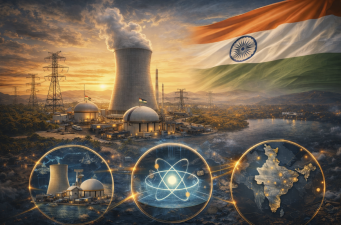
India has recently enacted the SHANTI Act 2025, a landmark legislation modernising its nuclear energy sector. This follows India’s announcement of the Nuclear Energy Mission in 2025 and the Union Budget 2026-27, which align with the country’s goal to achieve net-zero carbon emissions by 2070. The Act introduces reforms to boost nuclear capacity and open the sector to private and foreign participation under strict regulation.
Modernisation of Nuclear Legislation
The SHANTI Act 2025 replaces the Atomic Energy Act 1962 and the Civil Liability for Nuclear Damage Act 2010. It grants statutory status to the Atomic Energy Regulatory Board (AERB), strengthening oversight. The Act allows limited private sector involvement in power generation, plant operations, and equipment manufacturing. Certain sensitive nuclear fuel-cycle activities remain under central government control. It also sets clear safety, security, and emergency preparedness standards.
Expansion of Nuclear Capacity
India aims to expand nuclear power capacity from 8.8 GW to 100 GW by 2047. This requires investments exceeding $200 billion. Nuclear power currently contributes about 3% of India’s electricity but is expected to grow . The SHANTI Act supports this by integrating licensing, regulation, liability, and dispute resolution into a unified legal framework. Customs duty exemptions for nuclear goods have been extended to 2035 to encourage long-term planning.
Private and Foreign Participation
The Act permits private and foreign entities to participate as joint venture partners or suppliers in India’s nuclear sector. It removes unlimited liability risks that previously deterred global suppliers. This change aligns India with international nuclear liability conventions. The Act encourages collaboration with countries like Russia, which is a key partner in projects such as the Kudankulam Nuclear Power Plant (KKNPP). The focus on Small Modular Reactors (SMRs) aims to further strengthen these partnerships.
Applications Beyond Power Generation
The SHANTI Act provides a regulatory framework for the peaceful use of nuclear and radiation technologies in healthcare, agriculture, industry, and research. It allows exemptions for limited research and innovation activities without licensing. This broadens the scope of nuclear technology use in India’s development agenda.
Topics for Prelims:
SHANTI Act 2025
- Replaces Atomic Energy Act 1962 and Civil Liability for Nuclear Damage Act 2010.
- Grants statutory recognition to Atomic Energy Regulatory Board (AERB).
- Allows limited private and foreign participation with regulatory oversight.
- Strengthens safety, security, and emergency preparedness frameworks.
- Supports India’s goal of 100 GW nuclear capacity by 2047.
Kudankulam Nuclear Power Plant (KKNPP)
- Located near Kanyakumari, Tamil Nadu.
- Built and operated by NPCIL with Russian cooperation (Rosatom).
- Units 1 and 2 operational; Units 3 to 6 under construction.
- India’s largest nuclear power facility.
- Key to India’s nuclear expansion strategy.
Small Modular Reactors (SMRs)
- Compact nuclear reactors with modular design.
- Supported under India’s Nuclear Energy Mission.
- Expected to enhance Indo-Russian nuclear collaboration.
- Offer flexible, scalable nuclear power options.
- Backed by Rs. 20,000 crore funding in Budget 2025-26.
Questions for Mains:
- Discuss in the light of India’s SHANTI Act 2025, how legislative reforms can accelerate clean energy transitions in developing countries. [GS-III-Economic Development]
- Analyse the role of international partnerships in nuclear energy development with examples from India-Russia cooperation and their strategic implications. [GS-II-International Relations]
- Examine the challenges and opportunities of integrating private and foreign participation in India’s nuclear sector under the SHANTI Act 2025. Critically discuss the balance between national security and economic growth. [GS-II-Constitution of India & Polity]
- With suitable examples, discuss the potential of Small Modular Reactors (SMRs) in transforming global nuclear power generation and their relevance to India’s energy goals. [GS-III-Science & Technology]
Answer Hints:
1. Discuss in the light of India’s SHANTI Act 2025, how legislative reforms can accelerate clean energy transitions in developing countries. [GS-III-Economic Development]
- SHANTI Act modernises nuclear legislation, replacing outdated laws to create a unified, clear regulatory framework.
- Enables private and foreign participation under strict regulation, attracting investment and technology transfer.
- Supports large-scale nuclear capacity expansion (from 8.8 GW to 100 GW by 2047), aiding clean energy goals.
- Integrates safety, security, liability, and dispute resolution to build investor confidence and public trust.
- Aligns with national net-zero carbon emissions target (2070), demonstrating commitment to sustainable development.
- Provides customs duty exemptions and budgetary support, facilitating long-term planning and industry growth.
2. Analyse the role of international partnerships in nuclear energy development with examples from India-Russia cooperation and their strategic implications. [GS-II-International Relations]
- India-Russia partnership exemplified by Kudankulam Nuclear Power Plant (KKNPP), a flagship joint project.
- Russian technology (Rosatom) supports construction and operation of multiple KKNPP units, enhancing India’s capacity.
- SHANTI Act facilitates foreign participation as JV partners or suppliers, strengthening bilateral ties.
- Collaboration on Small Modular Reactors (SMRs) leverages Russian advanced nuclear tech for flexible power solutions.
- Strategic cooperation enhances energy security, technological advancement, and geopolitical alignment.
- President Putin’s visit reaffirmed commitment, reflecting nuclear energy as a pillar of Indo-Russian strategic partnership.
3. Examine the challenges and opportunities of integrating private and foreign participation in India’s nuclear sector under the SHANTI Act 2025. Critically discuss the balance between national security and economic growth. [GS-II-Constitution of India & Polity]
- Opportunities – Attracts investment ($200+ billion), accelerates capacity growth, and introduces global best practices.
- Challenges – Ensuring stringent regulatory oversight to prevent security risks and safeguard sensitive fuel-cycle activities.
- SHANTI Act reserves sensitive activities for Central Government, balancing openness with national security.
- Removal of unlimited liability boosts supplier confidence but requires robust liability and dispute mechanisms.
- Regulated private participation in power generation, fuel fabrication, and manufacturing promotes economic growth.
- Continuous monitoring and emergency preparedness frameworks mitigate risks from increased sector complexity.
4. With suitable examples, discuss the potential of Small Modular Reactors (SMRs) in transforming global nuclear power generation and their relevance to India’s energy goals. [GS-III-Science & Technology]
- SMRs are compact, modular nuclear reactors allowing scalable, flexible deployment in diverse locations.
- Supported by Rs. 20,000 crore Nuclear Energy Mission, emphasizing India’s commitment to SMR technology.
- Enhances Indo-Russian collaboration by leveraging Russia’s advanced SMR designs and expertise.
- SMRs can provide clean, reliable power to remote or smaller grids, complementing large nuclear plants.
- Potential to reduce construction time, costs, and improve safety through standardized modular units.
- Aligns with India’s target of 100 GW nuclear capacity by 2047 and net-zero emissions by 2070.