
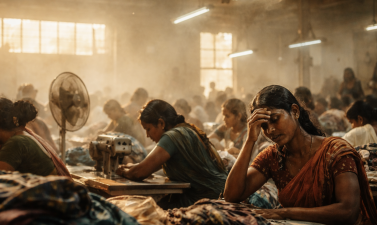
Recent studies reveal a severe heat stress crisis in India’s garment industry. Workers face extreme indoor temperatures that endanger their health and productivity. The problem is worsening due to climate change and inadequate workplace safeguards.
Heat Stress and Worker Health
A report by HeatWatch and Tata Institute of Social Sciences surveyed 115 garment workers in Tamil Nadu, Delhi-NCR, and Gujarat. Nearly 90% reported heat-related illnesses like headaches, dizziness, and muscle cramps. Factory machines can reach 99°C, creating furnace-like conditions. Many workers skip breaks to meet production targets, increasing physical strain. Women workers suffer more, with disrupted menstrual cycles and dehydration symptoms common.
Workplace Conditions and Infrastructure
Most factories lack proper medical facilities; only 6 out of 15 had clinics or doctors on site. Factory roofs made from metal or asbestos trap heat, worsening conditions. Water availability is unreliable and often unclean. Workers reduce water intake to avoid using scarce toilets, increasing dehydration risk. Ventilation and cooling are minimal, forcing workers to endure suffocating heat.
Economic Impact and Policy Gaps
The International Labour Organization warns India could lose 35 million full-time jobs by 2030 due to heat stress. The textile sector employs 45 million people and contributes to exports. However, national climate policies overlook indoor heat risks in workplaces. Labour and climate authorities lack coordination, leaving workers unprotected. The report calls for recognising heat stress as an occupational disease and including it in labour laws.
Gender and Social Dimensions
Women bear the brunt of heat stress due to biological and workplace inequalities. Female workers face greater physiological strain and workplace discrimination when raising heat concerns. Male-dominated management often ignores women’s heat-related health issues. This gender gap marks the need for inclusive workplace policies and better worker representation.
Topics for Prelims:
Heat Stress in Garment Industry
- Nearly 90% of garment workers report heat-related illnesses.
- Factory machines can reach temperatures up to 99°C.
- Workers skip breaks to meet production targets.
- Women suffer higher heat stress than men.
- Heat stress disrupts menstrual cycles and causes dehydration.
Workplace Safety and Infrastructure
- Only 6 of 15 factories have on-site medical clinics.
- Metal and asbestos roofs trap heat inside factories.
- Water supply is often insufficient or unclean.
- Workers avoid drinking water to reduce toilet use.
- Ventilation and cooling are minimal in garment factories.
Economic and Policy Challenges
- ILO estimates loss of 35 million jobs by 2030 due to heat stress.
- Textile sector employs 45 million people in India.
- Heat stress is not recognised as an occupational disease.
- National climate policies lack focus on indoor heat risks.
- Labour and climate departments work in silos.
Questions for Mains:
- Critically discuss the impact of climate change on occupational health with reference to heat stress among India’s garment workers. [GS-III-Environment & DM]
- Examine the role of workplace infrastructure and labour laws in addressing heat stress in India’s informal sector. [GS-II-Governance]
- With suitable examples, discuss how gender disparities affect workplace health and safety in Indian industries. [GS-I-Indian Society]
- Analyse the challenges of integrating labour welfare concerns into national climate policy frameworks and suggest measures for better coordination. [GS-II-Constitution of India & Polity]
Answer Hints:
1. Critically discuss the impact of climate change on occupational health with reference to heat stress among India’s garment workers. [GS-III-Environment & DM]
- Rising temperatures due to climate change increase indoor heat exposure, especially in factories with poor ventilation.
- Garment workers face extreme heat (machines up to 99°C), causing heat-related illnesses like headaches, dizziness, muscle cramps.
- Heat stress disrupts physiological functions, including dehydration and menstrual irregularities, disproportionately affecting women.
- Workers skip breaks to meet targets, worsening physical strain and reducing productivity.
- Heat stress leads to increased health risks and reduced work capacity, posing a threat to livelihoods.
- Climate change intensifies occupational hazards, necessitating urgent adaptation and mitigation in workplace health policies.
2. Examine the role of workplace infrastructure and labour laws in addressing heat stress in India’s informal sector. [GS-II-Governance]
- Majority of factories lack adequate medical facilities; only 6/15 had clinics, many without full-time doctors.
- Factory infrastructure (metal/asbestos roofs) traps heat, aggravating indoor temperatures.
- Water supply is often insufficient or unclean; lack of toilets forces workers to reduce water intake, increasing dehydration risks.
- Labour laws currently do not recognize heat stress as an occupational disease, limiting legal protection and compensation.
- Informal sector workers have minimal safeguards; reliance on informal training for medical emergencies is inadequate.
- Improved infrastructure (ventilation, cooling, sanitation) and legal reforms are essential to mitigate heat stress impacts.
3. With suitable examples, discuss how gender disparities affect workplace health and safety in Indian industries. [GS-I-Indian Society]
- Women garment workers report higher Heat Stress Index (HSI) scores (61.5 vs 18.6 for men), indicating greater physiological strain.
- Heat stress causes specific health issues for women, e.g., disrupted menstrual cycles and burning sensations during urination (dehydration signs).
- Male-dominated management often ignores or dismisses women’s heat-related health concerns and requests (fans, toilet breaks).
- Women face criticism and lack of representation, limiting their ability to advocate for safer work conditions.
- Gendered power dynamics exacerbate vulnerabilities, reflecting broader workplace discrimination.
- Inclusive policies and women-led worker representation are crucial to address these disparities effectively.
4. Analyse the challenges of integrating labour welfare concerns into national climate policy frameworks and suggest measures for better coordination. [GS-II-Constitution of India & Polity]
- Current climate policies (NAPCC, NDCs, SAPCCs) focus on sectors like energy and agriculture, overlooking indoor workplace heat risks.
- Labour Ministry is largely absent from climate action planning, causing policy silos and lack of coordination.
- Absence of enforceable safeguards for heat stress in workplaces leaves millions of workers vulnerable.
- Recognition of heat stress as an occupational disease is missing from labour laws, limiting welfare and compensation mechanisms.
- Measures needed – integrate labour welfare in climate policies, establish inter-ministerial coordination, and develop enforceable heat safety standards.
- Adopt graded heatwave classifications and include heat stress in Employees’ State Insurance and Compensation Acts for comprehensive protection.