
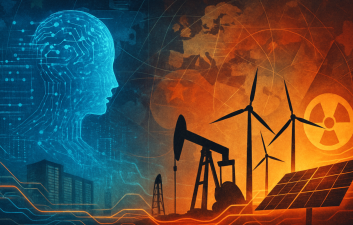
Artificial Intelligence (AI) is no longer a futuristic abstraction; it is rapidly becoming the defining force of the 21st century. From large language models to autonomous weapon systems, AI promises transformations comparable to the Industrial Revolution. Yet, unlike previous technological revolutions, its impact spans simultaneously across economics, warfare, diplomacy, governance, and civil society. In an era already marked by geopolitical rupture and strategic competition, AI could become the most consequential disruptor of the global order.
A Technological Leap Amid Global Rupture
The world today is witnessing intensified great power rivalry, especially between the United States and China. Competition in advanced technologies — particularly AI — has emerged as a central axis of this rivalry. Rapid advances in large language models, machine learning systems, and generative AI tools are being rolled out at unprecedented speed.
At global platforms such as the World Economic Forum (WEF), discussions increasingly recognise the transformative potential of AI. However, much of the debate remains focused on economic competitiveness rather than systemic disruption. The strategic implications of AI — especially its capacity to alter power hierarchies — are yet to be fully internalised by political leadership worldwide.
AI is not merely another sectoral innovation; it is a general-purpose technology that permeates every domain. Its diffusion is reshaping both markets and states.
AI as an Instrument of Statecraft
AI is increasingly being viewed as a tool of diplomacy, governance, and strategic resilience. Countries are investing in “sovereign AI stacks” — domestic infrastructure comprising data centres, algorithms, compute capacity, and semiconductor ecosystems — to reduce dependence on external actors.
Its applications extend across:
- Predictive analytics in diplomacy and intelligence gathering
- Financial monitoring and sanctions enforcement
- Supply chain optimisation and strategic planning
- Information warfare and narrative shaping
In this sense, AI is becoming embedded in the architecture of statecraft. Nations that control advanced AI ecosystems gain not only economic leverage but also geopolitical influence. The rivalry between major powers in AI development resembles earlier contests over nuclear technology and space exploration, but with broader civilian and commercial spillovers.
The Militarisation of Artificial Intelligence
Perhaps the most profound impact of AI is visible in the domain of warfare. Autonomous systems, AI-enabled drones, cyber weapons, and intelligent surveillance platforms are redefining the conduct of conflict.
The Russia–Ukraine conflict offers a vivid example. Ukrainian forces have deployed AI-assisted drones, surveillance systems, and low-cost unmanned platforms to offset conventional disadvantages. This asymmetric use of technology has demonstrated that AI can erode traditional military hierarchies and alter battlefield outcomes.
Key shifts include:
- Transition from manned to unmanned systems
- Automation of targeting and operational decisions
- Integration of cyber, electronic, and space warfare capabilities
- Emergence of drone swarms and autonomous weapons
Unlike earlier military revolutions, AI operates at granular, real-time levels, enabling rapid data processing and autonomous decision-making. This reduces reaction times and increases the risk of unintended escalation. The movement from human-in-the-loop systems to human-on-the-loop — and potentially human-out-of-the-loop — architectures raises ethical and strategic dilemmas.
Asymmetry, Power Diffusion and New Threats
AI’s asymmetric impact is both its strength and its danger. It lowers barriers to entry. Non-state actors, smaller states, or technologically adept groups may leverage AI tools to challenge established powers.
Potential risks include:
- Autonomous drone attacks on civilian populations
- AI-generated disinformation campaigns destabilising democracies
- Cyber intrusions targeting critical infrastructure
- Weaponisation of predictive analytics for coercion
AI acts as a “force multiplier.” Its diffusion represents a significant redistribution of power from traditional military establishments to technology developers and private corporations. This blurring of civil-military boundaries complicates regulatory frameworks.
The unpredictability of autonomous systems — particularly the phenomenon of “hallucinations” in AI models — has also raised concerns in non-military domains, including judicial proceedings and public administration. Over-reliance without accountability mechanisms could erode institutional integrity.
Institutional Lag and Governance Deficits
A central concern is that governance frameworks are lagging behind technological advances. International institutions were largely designed in the post-Second World War context, where power was state-centric and technology evolved at a slower pace.
AI challenges these assumptions:
- It is transnational and difficult to regulate within territorial boundaries.
- It evolves exponentially, outpacing legislative processes.
- It is driven significantly by private corporations rather than governments.
Existing arms control, cyber governance, and digital trade frameworks are inadequate to address autonomous systems or algorithmic warfare. Without multilateral norms and transparency mechanisms, AI-driven militarisation may intensify security dilemmas.
The Imperative of Oversight and Ethical Guardrails
AI also offers enormous potential for crisis response, disaster management, healthcare innovation, climate modelling, and conflict prevention. Its predictive capacities can strengthen early warning systems and enhance governance efficiency.
However, effective oversight is essential. This includes:
- International norms on autonomous weapons systems
- Robust ethical standards and algorithmic transparency
- Human accountability in critical decision-making processes
- Institutional collaboration between scientists, policymakers, and civil society
Balancing innovation with control is the central challenge. The goal is not technological stagnation but responsible advancement.
What to Note for Prelims?
- AI as a General-Purpose Technology (GPT).
- Concept of “sovereign AI stack”.
- Human-in-the-loop vs human-on-the-loop systems.
- Autonomous weapons systems and drone swarms.
- Role of AI in cyber warfare and information operations.
What to Note for Mains?
- Examine how Artificial Intelligence is reshaping global power structures.
- Discuss the ethical and strategic implications of AI-driven autonomous weapons.
- Analyse the challenges of regulating AI in a multipolar and competitive international order.
- Evaluate whether AI represents a rupture in the international system rather than a mere technological transition.