
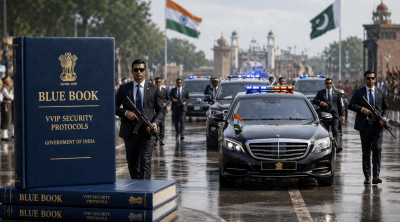
India and Pakistan, despite their complex bilateral relations, adhere to the Blue Book guidelines for VVIP security protocols. The Blue Book is a comprehensive manual developed to ensure the safety and security of very important persons (VVIPs) during official visits and public events. Both countries have institutionalised these protocols to manage risks associated with high-profile individuals, including heads of state, government officials, and foreign dignitaries.
Overview of the Blue Book Protocol
The Blue Book is a detailed security manual that outlines standard operating procedures for the protection of VVIPs. It covers aspects such as route reconnaissance, advance security checks, communication protocols, and emergency response mechanisms. The book is regularly updated to incorporate new threats and technological advancements. It is used by various security agencies to maintain uniformity and efficiency in VVIP protection.
Implementation in India
In India, the Blue Book is primarily implemented by the Special Protection Group (SPG), the Intelligence Bureau (IB), and local police forces. The SPG provides close protection to the Prime Minister and their immediate family. Coordination between central and state agencies is critical during VVIP movements. The Blue Book mandates thorough advance planning, including securing the venue, controlling crowd movement, and deploying quick reaction teams.
Implementation in Pakistan
Pakistan’s security agencies, including the Elite Force and the Special Security Unit, follow the Blue Book protocols to safeguard their VVIPs. The guidelines are adapted to local security challenges, such as terrorism and political instability. Pakistan emphasises intelligence gathering and coordination between civilian and military agencies to ensure VVIP safety. The Blue Book also guides the management of motorcades, aerial surveillance, and emergency medical support.
Significance of Using a Common Protocol
The adoption of the Blue Book by both India and Pakistan highlights the universal importance of standardised security measures for VVIPs. It facilitates training, inter-agency cooperation, and quick decision-making during crises. Despite geopolitical tensions, the shared use of these protocols underscores a common understanding of the risks involved in protecting high-profile individuals. This also aids in diplomatic engagements where security arrangements need to be seamless and professional.
What to Study for UPSC Exams?
- VVIP Security Management
- Special Protection Group (SPG)
- Counter-Terrorism Measures
- Inter-Agency Coordination
- Diplomatic Security Protocols
VVIP Security Management
VVIP security management involves layered protection, including advance route checks, secure communication, and threat assessment. It integrates physical security, intelligence inputs, and emergency response plans. Protocols mandate coordination between multiple agencies and use of technology like surveillance drones and electronic jamming devices to prevent attacks.
Special Protection Group (SPG)
The SPG is an elite Indian force established in 1985 exclusively for Prime Minister security. It operates under the Ministry of Home Affairs with authority to use lethal force. Its members undergo rigorous training in close combat, intelligence gathering, and counter-surveillance techniques.
Counter-Terrorism Measures
Counter-terrorism measures include intelligence-led operations, pre-emptive strikes, and community policing. Use of biometrics, cyber surveillance, and drone reconnaissance has increased. Legal frameworks often enable preventive detention and enhanced interrogation to disrupt terror networks.
Inter-Agency Coordination
Inter-agency coordination involves real-time intelligence sharing, joint training exercises, and unified command centers. It reduces information silos among police, military, and intelligence agencies. Secure communication networks and standardized protocols are essential for crisis response.
Diplomatic Security Protocols
Diplomatic security protocols govern protection of foreign dignitaries, including advance site surveys and motorcade security. They follow Vienna Convention guidelines and incorporate local threat assessments. Use of counter-surveillance teams and secure communication channels is standard practice.
Last Modified: April 10, 2026