
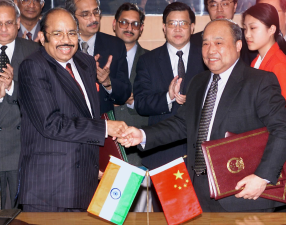
India’s decision to consider easing restrictions on Chinese firms bidding for government contracts has reopened a complex economic and strategic debate. The curbs, imposed after the 2020 border clash in the Galwan Valley, were rooted in national security concerns. Now, with the Ministry of Finance signalling a possible rethink, the key question is whether selective Chinese foreign direct investment (FDI) can advance India’s economic goals without undermining its strategic interests.
Why the 2020 curbs were imposed
After the Galwan Valley clash, India tightened scrutiny of investments from neighbouring countries, a move that effectively targeted China. The objective was not economic protectionism per se, but risk mitigation: preventing strategic assets, infrastructure, and digital ecosystems from falling under potential adversarial influence. Since then, Chinese firms have faced higher barriers in government procurement and investment approvals.
Economic rationale behind a rethink
The reconsideration comes amid India’s broader push to expand manufacturing, integrate with global supply chains, and boost exports. According to the Economic Survey 2023–24, calibrated Chinese FDI could help India plug into established production networks, particularly where China already dominates component manufacturing. The logic is pragmatic: supply chains are not built overnight, and excluding a key node may raise costs and limit competitiveness.
National security as the non-negotiable filter
A central point in the debate is that not all sectors carry equal risk. Coastal infrastructure, ports near naval bases, telecommunications, and the digital economy are widely seen as sensitive because of surveillance, data flows, and potential “kill-switch” vulnerabilities. The argument gaining traction is that restrictions should be sector-based rather than country-specific. If a sector is critical to security, it should be closed to all foreign investment; if not, selective openness can be considered.
Can Chinese FDI reduce the trade deficit?
India runs a large trade deficit with China, largely due to imports of intermediates and components. Allowing Chinese firms to manufacture in India—especially in non-sensitive sectors like consumer electronics or electric vehicles—could localise production, substitute imports, and potentially increase exports. The experience of firms such as Xiaomi and Oppo suggests that Chinese companies can operate successfully within India’s regulatory framework when clear rules are in place.
Supply chains, tariffs, and India’s constraints
However, supply-chain integration requires more than investment approvals. Efficient global production networks thrive in low-tariff, predictable regimes where components cross borders multiple times. India’s tariff structure, quality control orders, logistics costs, and infrastructure gaps remain constraints. This is one reason why many Chinese firms diversifying production have preferred Southeast Asian economies over India, despite India’s large market.
What China gains from investing in India
From China’s perspective, overseas investment helps manage excess industrial capacity and hedge against China-focused tariffs imposed by the U.S. and Europe. Establishing production bases in India offers access to the world’s fastest-growing large market and the possibility of exporting to third countries under a different geopolitical label. This “India premium” exists, but India has yet to fully capitalise on it due to regulatory and ease-of-doing-business challenges.
The Apple example and its limits
India’s success in attracting Apple manufacturing illustrates both opportunity and constraint. While final assembly has shifted to India, many critical components are still sourced from China. Special policy concessions were needed to allow Chinese suppliers to operate locally. Scaling this model economy-wide would require difficult choices on tariffs, incentives, and regulatory flexibility—choices India may not be ready to make across the board.
Broader implications for India’s China policy
Easing curbs on Chinese FDI does not signal strategic rapprochement. Instead, it reflects a more granular approach: separating economic utility from security risk. If done carefully, India could leverage Chinese capital and technology to strengthen domestic manufacturing while maintaining clear red lines in sensitive areas.
What to note for Prelims?
- 2020 FDI curbs linked to Galwan Valley clash.
- Sector-based vs country-specific investment restrictions.
- China’s dominance in global component manufacturing.
- Role of FDI in supply-chain integration.
What to note for Mains?
- Critically examine whether Chinese FDI can help reduce India’s trade deficit.
- Discuss national security concerns associated with foreign investment.
- Evaluate India’s readiness to integrate into global supply chains.
- Analyse the balance between strategic autonomy and economic pragmatism.