
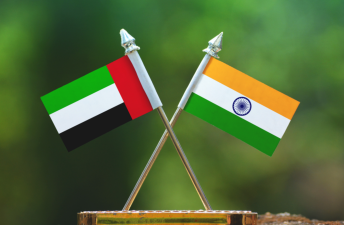
India’s engagement with the Arab world is entering a qualitatively different phase. Once anchored largely in hydrocarbons, remittances, and merchandise trade, the relationship is now expanding into technology, digital trade, clean energy, and investment-led growth. As global supply chains fragment and South–South cooperation gains strategic salience, India is increasingly viewed by Arab economies as a pivotal partner in shaping a more resilient and diversified economic order.
India’s rising role in South–South trade architecture
Arab economies see India’s growing trade activism as both timely and strategic. In an era marked by protectionism in Western markets and disruptions in global supply chains, India’s push for comprehensive trade agreements has opened new southward corridors of commerce. Recent agreements with Gulf and Middle Eastern partners reflect a deliberate attempt to integrate Asian and Arab value chains, providing exporters with stability amid global uncertainty.
This approach aligns with a broader South–South vision, where economic integration across Asia, Africa, and the Arab world reduces dependence on traditional markets and cushions economies against external shocks.
Investment corridors beyond oil and infrastructure
Capital flows from the Arab world to India are undergoing a structural shift. Sovereign wealth funds and strategic investors are moving beyond conventional energy and infrastructure projects into technology-intensive and future-oriented sectors. Bilateral engagements with countries such as Saudi Arabia and the United Arab Emirates increasingly emphasise fintech, artificial intelligence, clean energy, and advanced manufacturing.
Major logistics players like DP World have committed multi-billion-dollar investments in Indian ports and supply-chain infrastructure, reinforcing India’s role as a hub linking the Gulf with South Asian and global markets. Going forward, sectors such as IT, digital infrastructure, life sciences, renewable energy, and green hydrogen are expected to drive the next wave of Indo-Arab investments.
Energy security meets energy transition
Energy remains the backbone of India–Arab relations, but its character is changing. Gulf producers continue to supply a significant share of India’s oil and gas needs, ensuring short-term energy security for a rapidly growing economy. At the same time, both sides recognise that the future lies beyond hydrocarbons.
India’s ambitious renewable energy expansion plans intersect with the capital strength and resource endowments of Arab economies. This creates scope for collaboration across solar power, green hydrogen, and integrated clean-energy value chains. For Arab producers, this is an opportunity to reposition themselves not merely as fossil fuel suppliers, but as long-term partners in India’s decarbonisation journey.
Food and water security as shared vulnerabilities
Food and water security have emerged as common strategic concerns for India and the Arab world, driven by climate change, demographic pressures, and shifting consumption patterns. Cooperation in agritech, climate-resilient agriculture, and food processing offers tangible gains for both regions.
Indian strengths in agricultural research, digital farming platforms, and low-cost innovation can be combined with Arab capital and market access to improve productivity and supply-chain efficiency. Recent India–Egypt initiatives linking startup ecosystems illustrate how technology-driven partnerships can support small farmers while addressing broader food and water challenges.
Digital trade and regulatory alignment
The next frontier of India–Arab economic ties lies in digital trade, fintech, and e-commerce. Unlocking this potential requires regulatory harmonisation across key areas such as cross-border data flows, cybersecurity standards, electronic authentication, and digital payments.
Mutual recognition of digital identities and e-signatures, alongside shared norms on consumer protection and competition policy, would significantly lower transaction costs. CEPA-linked innovation corridors and startup platforms already point to gradual movement towards a more integrated digital economic space.
Integrating MSMEs into regional value chains
Beyond large conglomerates, the sustainability of India–Arab economic cooperation depends on integrating micro, small, and medium enterprises into cross-border value chains. MSMEs are central to job creation in both regions, but face constraints in finance, market access, and regulatory compliance.
Targeted measures—such as accessible credit, risk-sharing mechanisms, entrepreneurship linkages, and capacity-building programmes—can enable MSMEs to participate meaningfully in bilateral trade and investment flows. Emerging interconnections between Indian and Arab startup ecosystems offer a scalable template for inclusive growth.
Why this partnership matters strategically
The India–Arab partnership is evolving into a multidimensional economic relationship encompassing trade diversification, investment-led growth, digital integration, and energy transition. For India, it strengthens economic resilience and access to capital and markets. For Arab economies, it offers a dynamic growth partner and a gateway to broader Asian value chains.
What to note for Prelims?
- India–Arab trade agreements and South–South cooperation.
- Role of Gulf sovereign wealth funds in India.
- Energy cooperation beyond hydrocarbons.
- Digital trade and regulatory harmonisation.
What to note for Mains?
- Analyse the strategic significance of India–Arab economic relations.
- Discuss how South–South trade can mitigate global supply-chain risks.
- Examine the role of clean energy and green hydrogen in future cooperation.
- Evaluate the importance of MSME integration in bilateral economic frameworks.