
As India approaches the golden jubilee of the Indian Coast Guard on February 1, 2026, it marks fifty years of a force that has silently but decisively shaped India’s maritime security architecture. From a small coastal law-enforcement agency in the late 1970s to one of the world’s largest coast guard services today, the journey mirrors India’s transition from a continental mindset to a confident maritime power.
Why India needed a Coast Guard
The origins of the Indian Coast Guard are rooted in the global maritime churn of the 1970s, particularly negotiations around the United Nations Convention on the Law of the Sea. As new norms expanded coastal states’ rights over territorial waters and Exclusive Economic Zones (EEZs), India realised that its security challenges were no longer confined to land borders or wartime naval threats.
Smuggling, illegal fishing, offshore asset protection, and maritime law enforcement during peacetime fell outside the Indian Navy’s core mandate. With a coastline stretching over 11,000 km and an EEZ of more than 2 million sq km, India required a specialised force focused on constant vigilance rather than combat deterrence.
Institutional birth and legal mandate
The Indian Coast Guard was formally raised on February 1, 1977, and later given statutory backing through the Coast Guard Act of 1978. Operating under the Ministry of Defence as an armed force of the Union, it was tasked with enforcing maritime law in India’s territorial waters, contiguous zone, and EEZ. This institutional step marked a strategic recognition that sovereignty at sea required permanent, dedicated presence—not episodic naval deployments.
From modest beginnings to a large maritime force
Over five decades, the Coast Guard has evolved into a technologically sophisticated service. Its present-day force structure includes a large fleet of offshore patrol vessels, fast interceptor boats, aircraft, helicopters, hovercraft, and a dense coastal radar network. Together, these assets enable round-the-clock surveillance of a maritime area larger than India’s landmass.
On any given day, dozens of ships and aircraft remain deployed, reflecting a shift from reactive enforcement to continuous domain awareness. This operational posture has been crucial in deterring illegal activities and responding swiftly to emergencies at sea.
Search, rescue, and human security at sea
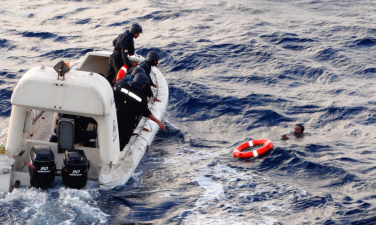
Beyond security, the Coast Guard’s most visible contribution has been in saving lives. Over 11,000 people have been rescued since its inception—mostly fishermen and seafarers caught in cyclones, engine failures, or sinking vessels. These operations highlight the human security dimension of maritime governance, often carried out in harsh weather and limited visibility.
Medical evacuations, disaster response, and coordination with civil authorities have become routine roles, reinforcing the Coast Guard’s image as a first responder rather than a coercive force.
Combating maritime crime and illegal activities
The nature of maritime crime has evolved significantly. From gold smuggling in the 1980s to sophisticated narcotics trafficking today, the Coast Guard has adapted its tactics and coordination mechanisms. Joint operations with customs, intelligence agencies, and state police have disrupted transnational criminal networks and protected India’s coastal economy.
The interception of poachers, smugglers, and illegal fishing vessels has also helped safeguard marine resources and coastal livelihoods.
Environmental protection as a core mission
A less visible but increasingly important role of the Coast Guard is environmental stewardship. As India’s designated agency for marine pollution response, it enforces international conventions and leads clean-up operations during oil spills and maritime accidents. Rapid response to incidents such as tanker sinkings or leaks underscores how maritime security today extends to ecological security.
Regional outreach and humanitarian diplomacy
The Coast Guard’s mandate now extends beyond India’s immediate waters. Humanitarian assistance and disaster relief missions in the Indian Ocean region—ranging from cyclone response to medical aid deliveries—have reinforced India’s image as a net security provider. These missions complement naval diplomacy and demonstrate India’s commitment to regional stability.
Engaging coastal communities as security partners
One of the most innovative aspects of the Coast Guard’s evolution has been its engagement with fishing communities. Community Interaction Programmes have effectively turned fishermen into stakeholders in maritime security, creating an informal but extensive surveillance network along the coast. This approach recognises that technology alone cannot substitute for human presence and trust.
Emerging threats in the maritime domain
Looking ahead, the Coast Guard faces a rapidly changing threat landscape. Autonomous underwater vehicles, drone swarms, cyber-enabled maritime attacks, and cross-border drone smuggling present challenges that blur the line between traditional law enforcement and high-tech warfare. Criminal networks increasingly exploit digital tools, encryption, and unmanned platforms, demanding new skills and doctrines.
Modernisation and indigenisation drive
Aligned with Aatmanirbhar Bharat and defence reforms, the Coast Guard is investing in indigenised platforms, advanced sensors, unmanned systems, and AI-enabled surveillance. Future capabilities will focus on predictive maintenance, anti-drone measures, cyber resilience, and integrated maritime awareness—ensuring readiness for hybrid threats.
Why the Coast Guard matters strategically
As India’s maritime trade, offshore energy assets, and regional responsibilities expand, the Coast Guard sits at the intersection of security, economy, and environment. It relieves the Navy of peacetime policing duties while ensuring that India’s vast maritime zones remain governed, safe, and resilient.
What to note for Prelims?
- Indian Coast Guard established in 1977; Coast Guard Act, 1978.
- Mandate covers territorial waters, contiguous zone, and EEZ.
- Nodal agency for marine pollution response.
- Distinct role from the Indian Navy.
What to note for Mains?
- Examine the role of the Indian Coast Guard in maritime security.
- Discuss how UNCLOS reshaped India’s maritime governance needs.
- Analyse emerging non-traditional threats in the maritime domain.
- Evaluate the importance of community participation in coastal security.