
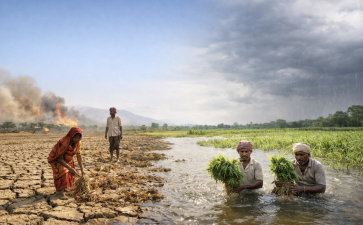
India faces a serious threat to its food security as global temperatures rise. A 2026 study by the International Institute for Environment and Development (IIED) marks India’s worsening position in a global food security index. Currently, India scores 5.31, below the global average of 6.74. With 1.5°C warming, the score falls to 4.96 and to 4.52 at 2°C, indicating declining access to sufficient and nutritious food.
Global Food Security Index and Climate Impact
The Food Security Index (FSI) measures 162 countries on four pillars – food availability, accessibility, nutritional utilisation, and sustainability of food systems. Climate change worsens food security, especially in poorer nations. At 1.5°C warming, many low-income countries face dietary instability. At 2°C, food availability and diversity decline sharply, particularly in conflict-affected and fragile regions like South Asia and sub-Saharan Africa. This deepens the gap between rich and poor countries.
India’s Food Security Challenges
India’s baseline FSI score is below key developing countries such as Brazil and Mexico. Rising temperatures threaten agricultural productivity, affordability, and nutritional quality. Economic growth offers limited protection, improving access but not resilience. Food systems remain vulnerable to repeated climate shocks, risking millions’ nutrition and survival.
Global and Regional Food Security Trends
Globally, 4.56 billion people live in countries below the average FSI. This number could rise by 291 million at 2°C warming. Wealthier countries like the US and UK also face declines in food security due to climate disruptions affecting supply chains. China’s food security score is projected to drop from 7.62 to 7.06 at 2°C. The study warns that climate risks in poorer countries will affect global food markets and economies.
Economic Growth and Food System Resilience
Economic growth raises food security scores modestly. Each $1,000 increase in GDP per capita adds 0.2 points to the FSI on average. However, gains are uneven and weakest in food system sustainability. Growth alone cannot shield countries from climate-driven shocks. Building resilient food systems is essential to withstand future climate impacts.
Topics for Prelims:
Food Security Index (FSI)
- Measures food security in 162 countries.
- Four pillars – availability, accessibility, utilisation, sustainability.
- Global average score is 6.74 (2026 data).
- Worsens with global warming scenarios.
- Used to assess climate change impacts on food systems.
Climate Change and Food Security
- Rising temperatures reduce crop yields and food quality.
- Low-income countries face highest risks.
- 2°C warming causes sharp declines in food availability.
- Climate shocks disrupt supply chains globally.
- Food insecurity deepens global inequality.
India’s Food Security
- Baseline FSI score 5.31 in 2026.
- Projected to fall to 4.52 at 2°C warming.
- Below countries like Brazil and Mexico.
- Economic growth improves access but not resilience.
- Vulnerable to climate-driven shocks and nutritional decline.
Questions for Mains:
- Critically analyse the impact of climate change on food security in developing countries with examples from South Asia. [GS-III-Economic Development]
- Explain the role of economic growth in enhancing food security and discuss its limitations in the context of climate resilience. [GS-III-Economic Development]
- With suitable examples, comment on how global supply chain disruptions due to climate change affect food security in both rich and poor countries. [GS-II-International Relations]
- What are the challenges in building sustainable food systems under climate change and how can policy interventions address these challenges? Critically analyse. [GS-III-Environment & Disaster Management]
Answer Hints:
1. Critically analyse the impact of climate change on food security in developing countries with examples from South Asia. [GS-III-Economic Development]
- Climate change causes rising temperatures, reducing crop yields and food quality, especially in developing countries.
- South Asia, including India, faces sharp declines in food availability and nutritional diversity at 1.5°C to 2°C warming.
- Low-income and conflict-affected regions have fragile food systems vulnerable to climate shocks.
- Food Security Index (FSI) shows South Asian countries scoring below global average, with worsening trends under warming scenarios.
- Climate-driven disruptions exacerbate existing inequalities in food access and affordability.
- Examples – India’s FSI projected to fall from 5.31 to 4.52 at 2°C; impacts on agricultural productivity and nutrition.
2. Explain the role of economic growth in enhancing food security and discuss its limitations in the context of climate resilience. [GS-III-Economic Development]
- Economic growth improves food access by increasing household income and purchasing power.
- Each $1,000 increase in GDP per capita adds roughly 0.2 points to the Food Security Index on average.
- Growth has uneven benefits across food security pillars; weaker impact on sustainability and resilience of food systems.
- Economic growth alone cannot protect food systems from repeated climate shocks and supply disruptions.
- Building climate-resilient agriculture and supply chains is essential beyond just economic growth.
- India’s example – growth improves access but food systems remain vulnerable to climate-driven shocks.
3. With suitable examples, comment on how global supply chain disruptions due to climate change affect food security in both rich and poor countries. [GS-II-International Relations]
- Climate shocks in major crop-producing regions disrupt global food supply chains, causing volatility worldwide.
- Poor countries suffer from reduced food availability, affordability, and nutritional quality due to fragile systems.
- Rich countries are affected through import dependencies and supply chain interdependencies.
- Examples – US projected to see large declines in food security; UK faces smaller but notable declines.
- China’s food security score declines from 7.62 to 7.06 at 2°C warming, indicating impact on emerging economies.
- Global interdependence means food insecurity in one region cascades to others, affecting international relations and trade.
4. What are the challenges in building sustainable food systems under climate change and how can policy interventions address these challenges? Critically analyse. [GS-III-Environment & Disaster Management]
- Challenges – climate-driven shocks reduce food availability, disrupt supply chains, and degrade nutritional quality.
- Food systems lack resilience and sustainability, especially in low-income and conflict-affected regions.
- Economic growth insufficient to build resilience; sustainability scores lag behind access and utilisation.
- Policy interventions needed to promote climate-smart agriculture, diversify crops, and strengthen infrastructure.
- Governments must invest in research, early warning systems, and social safety nets to protect vulnerable populations.
- International cooperation and financing critical to support adaptation and resilience building in poorer countries.