
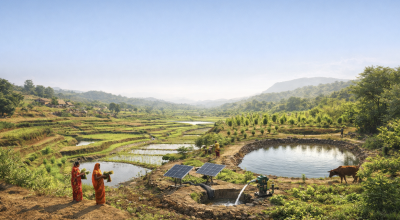
Recent policy focus marks watershed development as a key tool for sustainable rural growth in India. With over half of the country’s cropped area dependent on rain, water uncertainty poses major risks. The Pradhan Mantri Krishi Sinchayee Yojana–Watershed Development Component (PMKSY-WDC) has scaled up efforts to conserve water, restore land and improve farm livelihoods. These initiatives are critical amid growing land degradation and groundwater depletion worsened by climate change.
Importance of Watershed Development
A watershed is a natural drainage area where rainwater flows to a common outlet. Development in such units focuses on conserving rainwater, improving soil moisture, and recharging groundwater. This approach addresses water scarcity and land degradation, especially in semi-arid and rainfed regions. Watershed projects help stabilise agriculture by increasing water availability and reducing climate vulnerability.
Implementation and Impact
India’s watershed projects receive sustained funding under PMKSY-WDC, supported by state schemes and rural employment programmes. Investments range between Rs 2,000 crore and Rs 3,000 crore annually. Structures like check dams, farm ponds, and contour bunds raise groundwater levels and expand irrigation. These improvements boost cropping intensity by 10-20%, enabling crop diversification into horticulture and pulses, which stabilises farm incomes.
Role of Community and Institutions
Successful watershed management integrates technical measures with local participation and institutional support. States like Maharashtra, Karnataka, and Telangana show how community involvement and convergence with employment schemes restore degraded lands and improve livestock productivity. Decentralised planning and fiscal transfers to Panchayats enhance service delivery and sustain benefits.
Challenges and Future Directions
Programmes often measure success by physical outputs rather than outcomes like productivity or livelihood improvements. Shifting to outcome-based evaluation is essential. Capacity building must extend beyond engineering to include participatory planning and climate-adaptive agriculture. Strengthening district institutions and creating trained resource pools will improve effectiveness. Watershed development offers a cost-effective climate adaptation strategy with wide-ranging economic and ecological benefits.
Topics for Prelims:
Watershed Development
- Natural hydrological unit draining to a common outlet.
- Focus on rainwater conservation and soil moisture improvement.
- Includes structures like check dams and farm ponds.
- Enhances groundwater recharge and reduces land degradation.
- Key component of PMKSY-WDC scheme.
Pradhan Mantri Krishi Sinchayee Yojana (PMKSY)
- Launched to improve irrigation and water use efficiency.
- Includes Watershed Development Component (WDC).
- Supports rural employment and land restoration.
- Receives central and state funding.
- Promotes climate-resilient agriculture.
Land Degradation and Climate Risk
- Over 96 million hectares degraded in India.
- Concentrated in semi-arid and rainfed zones.
- Groundwater extraction exceeds recharge in many states.
- Climate change increases rainfall variability.
- Requires localised water conservation strategies.
Questions for Mains:
- Discuss the role of watershed development in enhancing rural livelihoods and climate resilience in India. [GS-III-Economic Development]
- Critically examine the challenges in implementing watershed programmes and suggest measures to improve their effectiveness. [GS-II-Governance]
- Explain the impact of land degradation on agricultural productivity and rural economy in semi-arid regions, and discuss policy responses. [GS-III-Environment & DM]
- With suitable examples, discuss the importance of community participation and institutional convergence in natural resource management. Comment on its relevance in India’s rural development. [GS-II-Social Justice]
Answer Hints:
1. Discuss the role of watershed development in enhancing rural livelihoods and climate resilience in India. [GS-III-Economic Development]
- Watershed development conserves rainwater, improves soil moisture, and recharges groundwater, critical for rainfed agriculture.
- It increases cropping intensity by 10-20%, enabling diversification into horticulture, pulses, and high-value crops, stabilizing incomes.
- Improved water availability supports livestock, agro-processing, and rural enterprises, broadening livelihood options.
- Enhances resilience against droughts and erratic rainfall by stabilizing local water resources and soil health.
- Reduces seasonal migration by providing stable income and employment opportunities locally.
- Cost-effective climate adaptation strategy with benefits spanning agriculture, employment, and ecological sustainability.
2. Critically examine the challenges in implementing watershed programmes and suggest measures to improve their effectiveness. [GS-II-Governance]
- Over-reliance on physical output indicators (e.g., hectares treated) rather than outcome-based metrics like productivity or livelihood impact.
- Uneven programme performance due to weak institutional capacity and lack of convergence among stakeholders.
- Insufficient community participation and limited integration with local governance structures.
- Capacity building focused mainly on engineering, lacking participatory planning and socio-economic monitoring skills.
- Suggested measures – shift to outcome-based evaluation, strengthen district-level institutions and Panchayats, promote participatory and climate-adaptive approaches.
- Develop a national pool of trained resource persons to support implementation and monitoring.
3. Explain the impact of land degradation on agricultural productivity and rural economy in semi-arid regions, and discuss policy responses. [GS-III-Environment & DM]
- Over 96 million hectares of land degraded, mainly in semi-arid and rainfed areas, reducing soil fertility and crop yields.
- Land degradation exacerbates water scarcity by reducing soil moisture retention and groundwater recharge.
- Leads to lower agricultural productivity, income instability, and increased rural poverty and migration.
- Policy responses include watershed development under PMKSY-WDC to restore degraded lands and conserve water.
- Integration with rural employment schemes and decentralized planning enhances land restoration efforts.
- Climate-adaptive agriculture and outcome-focused monitoring improve long-term sustainability.
4. With suitable examples, discuss the importance of community participation and institutional convergence in natural resource management. Comment on its relevance in India’s rural development. [GS-II-Social Justice]
- Community participation ensures local knowledge, ownership, and sustainable management of watershed resources.
- Examples – Maharashtra’s semi-arid districts, Karnataka, and Telangana show improved groundwater recharge, multi-cropping, and livestock productivity through local involvement.
- Institutional convergence with employment schemes and Panchayat fiscal transfers strengthens implementation and service delivery.
- Decentralized governance promotes accountability, tailored solutions, and sustained benefits.
- Enhances social equity by involving marginalized groups and reducing seasonal migration.
- Critical for inclusive rural development, climate resilience, and natural resource sustainability in India.