
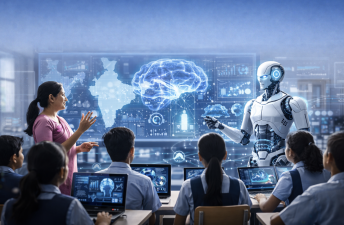
India’s Ministry of Education is set to host a special session on artificial intelligence (AI) at the India AI Impact Summit 2026, signalling a decisive shift from policy formulation to large-scale implementation of AI in education. The session, to be held at Bharat Mandapam, aligns with the National Education Policy (NEP) 2020 and the long-term vision of Viksit Bharat 2047, underscoring the government’s ambition to embed AI across school, higher, and skill education ecosystems.
What Is the India AI Impact Summit Session About?
The session titled “Ministry of Education – Pushing the Frontier of AI in India” will be attended by Dharmendra Pradhan and Jayant Chaudhary.
The focus will be on:
- Scaling AI integration across education levels.
- Strengthening public digital infrastructure.
- Enhancing collaboration between academia, startups, and industry.
- Building governance frameworks for responsible AI deployment.
The summit represents a pivot toward systemic adoption rather than isolated pilot projects.
Institutional Foundations: NEP 2020 and Centres of Excellence
The push for AI-enabled education is rooted in the National Education Policy 2020, which emphasises digital learning, multidisciplinary research, and technology integration.
A major institutional milestone is the establishment of a Centre of Excellence in AI for Education at Indian Institute of Technology Madras. Such centres aim to:
- Advance research in AI-driven pedagogy.
- Develop indigenous AI tools for learning analytics.
- Support teacher training and curriculum innovation.
- Encourage ethical and responsible AI use.
The ministry has also undertaken broad consultations with academia, industry, and civil society to shape a national AI-in-education roadmap.
From Digital Platforms to AI-Driven Classrooms
Over the past decade, India has built extensive digital education infrastructure, including national learning platforms and capacity-building initiatives. The next phase involves embedding AI into:
- Adaptive learning systems.
- Personalised student assessment tools.
- Language translation and accessibility features.
- Skill mapping and career guidance systems.
The integration of AI is expected to enhance inclusivity, reduce learning gaps, and improve outcome measurement at scale.
Industry–Academia Convergence
The summit panel includes prominent figures from technology, academia, and investment ecosystems:
- , Founder and CEO of .
- , Managing Director at .
- , Director of .
Such cross-sector dialogue reflects the recognition that AI in education requires collaboration across policy, innovation, funding, and pedagogy.
Governance and Ethical Considerations
AI deployment in education raises important governance questions:
- Data privacy and student protection.
- Bias and algorithmic fairness.
- Transparency in automated decision-making.
- Teacher autonomy versus AI automation.
The ministry’s emphasis on “responsible AI” suggests an awareness of these concerns and the need for regulatory safeguards.
Strategic Importance for Viksit Bharat 2047
The AI-in-education push aligns with India’s aspiration to become a knowledge-driven economy by 2047. By leveraging AI:
- Skill development can be aligned with emerging industry needs.
- Research and innovation capacity can be strengthened.
- Global competitiveness in digital technologies can be enhanced.
Education is increasingly viewed not merely as a social sector but as a strategic economic pillar.
What to Note for Prelims?
- National Education Policy (NEP) 2020 — framework for digital and AI integration.
- Centre of Excellence in AI for Education at IIT Madras.
- India AI Impact Summit 2026 — platform for AI policy discussions.
- Role of AI in adaptive learning and personalised education.
What to Note for Mains?
- Opportunities and challenges of AI in education.
- Balancing innovation with ethical governance.
- Role of public digital infrastructure in education reform.
- Industry–academia collaboration in emerging technologies.
- Education as a driver of India’s long-term development strategy.