
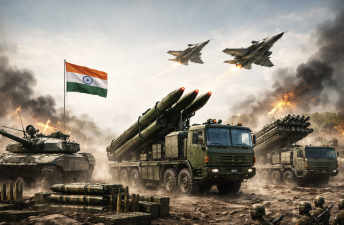
India has taken a major step toward strengthening its military preparedness with the Defence Acquisition Council (DAC) clearing proposals worth nearly ₹3.6 lakh crore. The approvals span advanced fighter aircraft, missiles, surveillance systems, naval platforms, and indigenous equipment upgrades — signalling a comprehensive modernisation drive across the Army, Navy, Air Force, and Coast Guard. Beyond capability enhancement, the decisions underline a strategic shift towards domestic defence manufacturing under the Aatmanirbhar Bharat framework.
What the Defence Acquisition Council Cleared
The Defence Acquisition Council accorded Acceptance of Necessity (AoN) — the first formal step in India’s defence procurement process — for multiple high-value acquisitions.
Key clearances include:
- Multi Role Fighter Aircraft (MRFA) – Rafale: To strengthen air dominance and long-range strike capabilities of the Indian Air Force.
- Combat Missiles: To enhance stand-off precision strike and deep attack capacity.
- Air-Ship Based High Altitude Pseudo Satellite (AS-HAPS): For persistent high-altitude surveillance and communication support.
- Anti-Tank Mines (Vibhav): For the Indian Army’s defensive and tactical battlefield requirements.
- Overhaul of Armoured Recovery Vehicles (ARVs), T-72 tanks, and Infantry Combat Vehicles.
- Four MW Marine Gas Turbine-based Electric Power Generators for the Navy.
- P-8I Long Range Maritime Reconnaissance Aircraft.
- Electro-Optical/Infra-Red systems for Dornier aircraft of the Indian Coast Guard.
Additionally, the Ministry of Defence signed a ₹2,312 crore contract with Hindustan Aeronautics Limited for eight Dornier 228 aircraft, equipped with operational role systems for the Coast Guard.
Why the MRFA Programme Matters for Air Power
4
The clearance for Multi Role Fighter Aircraft, including Rafale platforms, addresses a critical capability gap in the Indian Air Force (IAF). The IAF’s squadron strength has been below its sanctioned levels, raising concerns about preparedness in a potential two-front conflict scenario.
The MRFA induction is expected to:
- Enhance air superiority across contested theatres.
- Enable long-range offensive operations with precision-guided munitions.
- Improve deterrence through advanced avionics and missile systems.
- Boost domestic manufacturing, as the majority of aircraft are planned to be produced in India.
In strategic terms, this strengthens India’s ability to project power while reducing dependence on imports.
Expanding Deep Strike and Surveillance Capabilities
4
The approval of combat missiles significantly augments India’s stand-off strike capability — allowing targets to be engaged from beyond enemy air defence ranges.
Similarly, the P-8I maritime reconnaissance aircraft enhances maritime domain awareness, anti-submarine warfare (ASW), and long-range surveillance across the Indian Ocean Region (IOR).
The AS-HAPS platform represents a cutting-edge surveillance innovation. Operating at high altitudes for extended durations, it bridges the gap between satellites and conventional UAVs, enabling persistent ISR (Intelligence, Surveillance, Reconnaissance) coverage.
Army Modernisation and Mechanised Warfare Upgrades
The Army-focused approvals — including Vibhav anti-tank mines and overhaul of T-72 tanks and Infantry Combat Vehicles — reflect attention to conventional deterrence along land borders.
Modernisation of armoured recovery vehicles and legacy platforms ensures:
- Extended operational life of existing fleets.
- Improved battlefield mobility and survivability.
- Cost-effective enhancement compared to outright replacement.
This incremental yet systematic upgrade approach balances fiscal prudence with operational necessity.
Maritime Security and the Coast Guard’s Expanding Role
4
The procurement of Dornier 228 aircraft and marine gas turbine generators underscores the importance of maritime security in India’s strategic calculus.
With increasing activity in the Indian Ocean Region — including piracy, illegal fishing, and geopolitical competition — the Indian Navy and Coast Guard require enhanced surveillance and rapid response capabilities.
The Dornier fleet strengthens coastal patrol, search and rescue, and pollution monitoring operations, reinforcing India’s maritime security architecture.
Strategic Context: Aatmanirbhar Bharat in Defence
A notable feature of the approvals is the emphasis on domestic production. Manufacturing the majority of MRFA aircraft in India and awarding contracts to public sector entities like HAL align with the Make-in-India vision.
This shift reflects:
- Reduced foreign exchange outflow.
- Technology transfer and skill development.
- Growth of India’s defence industrial ecosystem.
- Long-term strategic autonomy.
India remains one of the world’s largest arms importers; indigenisation is therefore both an economic and strategic imperative.
What to Note for Prelims?
- Defence Acquisition Council (DAC) – chaired by the Defence Minister.
- Acceptance of Necessity (AoN) – first stage in capital acquisition process.
- P-8I – Long Range Maritime Reconnaissance and Anti-Submarine Warfare aircraft.
- Dornier 228 – Maritime patrol aircraft used by ICG and Navy.
- AS-HAPS – High Altitude Pseudo Satellite for ISR functions.
What to Note for Mains?
- Defence modernisation and two-front war preparedness.
- Role of indigenisation in strategic autonomy.
- Maritime security in the Indo-Pacific.
- Balancing capital expenditure with fiscal sustainability.
- Technology-driven warfare: ISR, precision strikes, and network-centric capabilities.