
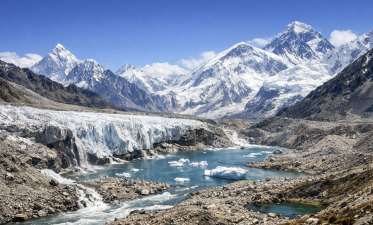
Recent studies by the International Centre for Integrated Mountain Development (ICIMOD) reveal that Himalayan glaciers have lost ice equivalent to 24 metres of water depth between 1973 and 2023. This ice loss threatens water security and increases flood risks in the Hindu Kush Himalayan (HKH) region. The report marks varying glacier behaviour across sub-regions but confirms an overall decline due to rising temperatures.
Hindu Kush Himalayan Region Overview
The HKH spans eight countries and includes 16 mountain ranges such as the Himalayas and Karakoram. It contains over 60,000 glaciers holding nearly 6,000 cubic kilometres of ice. The region feeds 10 major river basins vital for millions. The Himalayas are the largest mountain range here and have lost 17% of their glacial area from 1990 to 2020. The central Himalayas, from Shimla to eastern Nepal, faced the greatest loss exceeding 20%. The western and eastern flanks lost 12% and 17%, respectively. In contrast, the Karakoram range showed only about 2% loss.
Glacier Monitoring and Data Gaps
Only 38 glaciers in the HKH have long-term observations since 1974. None meet the World Glacier Monitoring Service (WGMS) criteria of 30 years continuous data for ‘reference glaciers’. To address this, WGMS introduced ‘benchmark glaciers’ for shorter but data sets. Currently, seven glaciers in the region qualify as benchmark glaciers. However, key areas like Karakoram, Sikkim, Zanskar, and Bhutan lack sufficient long-term data.
Consequences of Glacier Mass Loss
Glacier retreat alters runoff patterns and expands glacial lakes. This raises the risk of Glacial Lake Outburst Floods (GLOFs), threatening downstream communities. The Ganga and Brahmaputra basins have lost 21% and 16% of glacier area in the last 30 years, impacting water availability. Ice loss affects river ecosystems and agriculture dependent on meltwater. The report warns of long-term instability in water supply due to ongoing warming.
Regional Variations in Glacier Change
Glaciers in the eastern Himalayas, covering Bhutan, eastern India, China, and Myanmar, show the highest ice loss rates. Specific glaciers like Hamta (Western Himalaya), West Changri Nup (Central Himalaya), and Gangju La and Thana (Eastern flank) lost between 1.5 to 1.67 metres of ice depth. The Karakoram exhibits complex glacier behaviour with slower ice loss compared to other sub-regions.
Topics for Prelims:
Hindu Kush Himalayan Region
- Spans eight countries in South and Central Asia.
- Contains over 60,000 glaciers.
- Source of 10 major river basins.
- Largest ice reserves outside polar regions.
- Known as the ‘Third Pole’ due to ice volume.
Glacier Monitoring and WGMS
- WGMS sets 30 years minimum for reference glaciers.
- Benchmark glaciers used where data is limited.
- Only 38 glaciers in HKH have long-term data.
- Seven glaciers qualify as benchmark in Himalayas.
- Data gaps persist in Karakoram and Bhutan.
Glacial Impact on River Basins
- Ganga basin lost 21% glacier area in 30 years.
- Brahmaputra basin lost 16% glacier area.
- Glacier retreat alters river flow patterns.
- Increased risk of Glacial Lake Outburst Floods (GLOFs).
- Impacts agriculture and water security.
Questions for Mains:
- Discuss in the light of climate change the role of Himalayan glaciers in sustaining South Asian river systems and the implications of their retreat. [GS-III-Environment & DM]
- Critically examine the challenges in glacier monitoring in the Hindu Kush Himalayan region and suggest measures to improve data collection and analysis. [GS-III-Science & Technology]
- Explain the phenomenon of Glacial Lake Outburst Floods (GLOFs) and discuss their socio-economic impacts with examples from the Himalayan region. [GS-III-Internal & External Security]
- With suitable examples, discuss the significance of international cooperation among HKH countries for sustainable water resource management in the context of glacier retreat. [GS-II-International Relations]
Answer Hints:
1. Discuss in the light of climate change the role of Himalayan glaciers in sustaining South Asian river systems and the implications of their retreat. [GS-III-Environment & DM]
- Himalayan glaciers feed 10 major river basins including Ganga, Brahmaputra, and Indus, supporting millions dependent on meltwater for agriculture, drinking, and hydropower.
- Glaciers act as natural water reservoirs, releasing meltwater during dry seasons, ensuring river flow stability.
- Climate change-induced glacier retreat leads to reduced ice mass and altered runoff patterns, threatening long-term water availability.
- Significant glacier area loss – 17% overall in Himalayas (1990-2020), with Ganga and Brahmaputra basins losing 21% and 16%, respectively.
- Retreat increases glacial lake formation, raising risks of Glacial Lake Outburst Floods (GLOFs), causing floods and damaging ecosystems.
- Overall, glacier retreat undermines river ecosystem health, agricultural productivity, and water security in South Asia.
2. Critically examine the challenges in glacier monitoring in the Hindu Kush Himalayan region and suggest measures to improve data collection and analysis. [GS-III-Science & Technology]
- Only 38 glaciers in HKH have long-term observations since 1974; none meet WGMS 30-year continuous data criteria for ‘reference glaciers’.
- Data gaps exist in key sub-regions like Karakoram, Sikkim, Zanskar, and Bhutan, limiting comprehensive assessment.
- Harsh terrain, political boundaries, and logistical constraints hinder regular glacier monitoring and data sharing.
- WGMS introduced ‘benchmark glaciers’ concept for shorter datasets, with 7 glaciers in HKH qualifying, but coverage remains insufficient.
- Need to expand ground-based observations with remote sensing, satellite imagery, and automated sensors for real-time data.
- Promote regional cooperation, standardize methodologies, and invest in capacity building to improve data quality and accessibility.
3. Explain the phenomenon of Glacial Lake Outburst Floods (GLOFs) and discuss their socio-economic impacts with examples from the Himalayan region. [GS-III-Internal & External Security]
- GLOFs occur when glacial lakes, formed by melting glaciers and dammed by unstable moraines or ice, suddenly breach, releasing large floodwaters downstream.
- Glacier retreat and warming increase glacial lake size and number, heightening GLOF risks in HKH region.
- GLOFs cause catastrophic flooding, damaging infrastructure, agriculture, settlements, and leading to loss of life.
- Example – 1985 Dig Tsho GLOF in Nepal caused major destruction of hydropower and bridges.
- Increased GLOF risk threatens water security and disaster management in vulnerable Himalayan communities.
- Early warning systems, lake drainage projects, and community preparedness are critical mitigation measures.
4. With suitable examples, discuss the significance of international cooperation among HKH countries for sustainable water resource management in the context of glacier retreat. [GS-II-International Relations]
- HKH spans eight countries sharing transboundary rivers (e.g., Indus, Ganga, Brahmaputra), necessitating coordinated water management amid changing glacier-fed flows.
- Glacier retreat affects water availability, flood risks, and ecosystem health across borders, requiring joint monitoring and data sharing.
- ICIMOD exemplifies regional cooperation by conducting joint glacier assessments and capacity building among HKH nations.
- Cooperation helps develop early warning systems for GLOFs, disaster risk reduction, and sustainable hydropower development.
- Example – India-Nepal and India-Bhutan water sharing agreements can be strengthened with climate-resilient frameworks.
- International collaboration encourages peace, regional stability, and sustainable development by addressing shared climate challenges.