
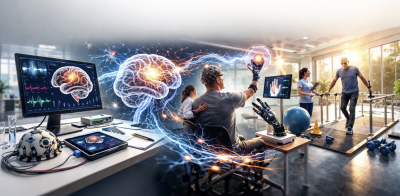
The Indian Institute of Science (IISc) launched a pioneering brain co-processor project in 2026. Funded by the Pratiksha Trust, this initiative aims to develop AI-driven devices to enhance or restore brain functions. The project focuses on stroke survivors who have lost motor skills like reaching and grasping.
Project Overview and Goals
The project develops brain co-processors combining neuromorphic hardware and AI algorithms. These devices decode neural signals, process them, and send feedback to the brain. Both implantable and non-invasive versions are planned. The goal is cognitive rehabilitation and sensorimotor coordination restoration.
Technological and Clinical Approach
The devices use closed-loop systems interfacing with brain regions. The first phase targets non-invasive devices for sensorimotor feedback in stroke patients. The second phase aims for minimally invasive implants to help those with chronic brain deficits. Clinical validation will involve neurologists, therapists, patients, and caregivers.
Indigenous Development and Collaboration
The project stresses indigenous technology creation, including implant design and AI software suited for low-resource settings. India-specific databases of brain recordings will be developed. Open-source AI tools and datasets will be made available as public digital goods. Collaboration spans Indian and international research partners.
Institutional and Funding Support
The Pratiksha Trust, founded by Kris Gopalakrishnan and Sudha Gopalakrishnan, funds the project. IISc’s Brain, Computation and Data Science programme supports it with over 20 faculty members. The initiative integrates neuroscience, bioelectronics, electrical engineering, and neuromorphic computing expertise.
Topics for Prelims:
Brain Co-Processors
- Devices combining neuromorphic hardware and AI algorithms.
- Decode and re-encode neural activity to restore brain functions.
- Used for cognitive rehabilitation, especially post-stroke.
- Include implantable and non-invasive types.
- Operate as closed-loop systems for real-time brain interaction.
Pratiksha Trust
- Founded by Kris and Sudha Gopalakrishnan.
- Funds neuroscience and medical technology projects.
- Supports IISc’s Brain, Computation and Data Science programme.
- Promotes indigenous innovation in medical devices.
- Focuses on global impact through Indian research.
Stroke Rehabilitation
- Focuses on restoring motor functions lost after stroke.
- Goal-directed reach and grasp are common impairments.
- Requires neural signal decoding and feedback mechanisms.
- Combines clinical and technological interventions.
- Involves multi-disciplinary teams including neurologists and therapists.
Questions for Mains:
- Discuss in the light of recent advances how AI and neuromorphic computing can transform neurological rehabilitation. [GS-III-Science & Technology]
- Critically examine the importance of indigenous innovation in medical technology development in India and its impact on healthcare accessibility. [GS-III-Economic Development]
- Explain the role of collaborative research and public-private partnerships in advancing neuroscience and brain-computer interface technologies. With suitable examples, discuss the challenges involved. [GS-II-Governance]
- Comment on the ethical considerations involved in implantable brain devices and the implications for patient autonomy and privacy. [GS-IV-Ethics, Integrity and Aptitude]
Answer Hints:
1. Discuss in the light of recent advances how AI and neuromorphic computing can transform neurological rehabilitation. [GS-III-Science & Technology]
- AI algorithms decode neural signals and provide real-time feedback to restore brain functions.
- Neuromorphic hardware mimics brain-like processing, enabling efficient, low-power brain co-processors.
- Closed-loop systems enable dynamic interaction between brain and device, enhancing rehabilitation outcomes.
- Applications include restoring motor skills in stroke survivors, e.g., goal-directed reach and grasp.
- Advances allow development of both implantable and non-invasive devices, broadening patient accessibility.
- Integration of AI with neuroscience accelerates personalized and adaptive therapy approaches.
2. Critically examine the importance of indigenous innovation in medical technology development in India and its impact on healthcare accessibility. [GS-III-Economic Development]
- Indigenous innovation reduces dependence on expensive foreign technologies and imports.
- Tailors medical devices to India-specific clinical infrastructure and low-resource settings.
- Promotes cost-effective solutions, improving affordability and accessibility of healthcare.
- Builds domestic expertise and manufacturing capabilities, encouraging economic growth.
- Creation of India-specific data (e.g., brain recordings) enhances relevance and effectiveness of technologies.
- Challenges include funding, regulatory frameworks, and scaling innovations nationally.
3. Explain the role of collaborative research and public-private partnerships in advancing neuroscience and brain-computer interface technologies. With suitable examples, discuss the challenges involved. [GS-II-Governance]
- Collaboration pools multidisciplinary expertise (neuroscience, engineering, AI) essential for complex tech development.
- Public-private partnerships (e.g., IISc and Pratiksha Trust) provide funding, infrastructure, and translational pathways.
- Enables clinical validation with medical professionals, ensuring real-world applicability and safety.
- Facilitates sharing of data, resources, and open-source tools enhancing innovation speed and inclusivity.
- Challenges – coordinating diverse stakeholders, intellectual property issues, ethical approvals, and sustaining long-term funding.
- Example – IISc’s Brain Co-Processors Moonshot Project integrating academia, philanthropy, and clinical partners.
4. Comment on the ethical considerations involved in implantable brain devices and the implications for patient autonomy and privacy. [GS-IV-Ethics, Integrity and Aptitude]
- Risk of compromising patient autonomy due to device control over brain functions and decision-making.
- Privacy concerns from continuous neural data monitoring and potential misuse of sensitive brain information.
- Informed consent complexities given the experimental and invasive nature of implantable devices.
- Need for strict data security, transparency, and regulatory oversight to protect patients.
- Balancing therapeutic benefits against risks of psychological impact or device malfunction.
- Ethical frameworks must evolve alongside technology to address emerging dilemmas in neurotechnology.