
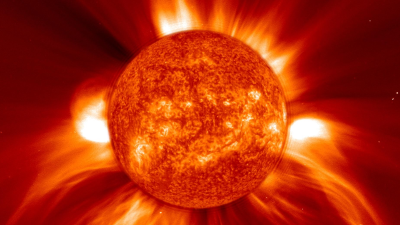
A recent study of a solar event from March 2023 has highlighted a growing challenge in space weather forecasting: not all dangerous geomagnetic storms are triggered by dramatic solar explosions. Sometimes, weak and nearly invisible eruptions from the Sun — known as stealth Coronal Mass Ejections (CMEs) — can travel silently through space and still unleash intense disturbances when they reach Earth.
What are CMEs and why they matter
Coronal Mass Ejections are massive expulsions of plasma and magnetic fields from the Sun’s outer atmosphere. When directed towards Earth, they can interact with the planet’s magnetosphere and trigger geomagnetic storms. Such storms are known to disrupt satellites, GPS signals, radio communication, aviation routes, and even terrestrial power grids.
Traditionally, forecasters rely on visible solar warning signs — such as X-ray flares, radio bursts, or bright eruptions on the Sun’s disk — to anticipate CME-driven storms. However, observations show that nearly 10% of intense geomagnetic storms occur without any obvious solar eruption.
The puzzle of stealth CMEs
Stealth CMEs are weak solar eruptions that leave little to no detectable signature near the Sun. They lack the dramatic flares or bursts that usually alert scientists, making them extremely difficult to identify with current instruments.
Understanding these events is crucial because their impacts on Earth can be as severe as those from stronger, more visible CMEs. The March 2023 storm is a striking example of this hidden threat.
The March 2023 stealth CME event
Astronomers studied a stealth CME that erupted on 19 March 2023 and reached Earth roughly three days later, producing an intense geomagnetic storm. The research was led by scientists from the Indian Institute of Astrophysics, an autonomous institution under India’s Department of Science and Technology.
Unlike typical CMEs, this eruption originated from a longitudinal filament channel near the centre of the Sun and occurred without accompanying X-ray flares or radio emissions. Its subtle nature meant it could easily have gone unnoticed.
The role of coronal holes
A key finding of the study was the role of a nearby coronal hole — a region where the Sun’s magnetic field lines open into space, allowing high-speed solar wind to escape. Extreme ultraviolet images revealed that the stealth CME erupted close to such a coronal hole.
This proximity likely allowed the CME to be carried outward by fast solar wind streams, helping it survive the journey to Earth. Without this assistance, the eruption might have dissipated closer to the Sun, causing little or no impact.
Tracking the CME through space
The researchers used observations from multiple NASA spacecraft — including Solar Dynamics Observatory, Solar Orbiter, STEREO-A, and WIND — which were nearly aligned along the Sun–Earth direction.
This rare alignment allowed scientists to track the interplanetary CME (ICME) as it expanded and evolved. The magnetic cloud within the ICME showed increasing size, decreasing speed, and rotating magnetic fields with a southward component — a configuration particularly effective at triggering geomagnetic storms on Earth.
Why the storm was intense despite a weak origin
Although the CME was weak near the Sun, it carried two dangerous features as it reached Earth:
- A sustained southward magnetic field, which couples efficiently with Earth’s magnetosphere
- Enhanced plasma density, which amplified geomagnetic disturbance
Modelling of geomagnetic indices showed strong agreement with observed storm intensity, especially when solar wind density and electric field variations were included. This confirms that even inconspicuous solar eruptions can evolve into major space weather hazards.
Implications for space weather forecasting
The study underscores a critical limitation in current space weather prediction systems: reliance on visible solar activity alone is insufficient. Stealth CMEs, aided by coronal holes and complex solar wind structures, can evade early detection yet still cause serious disruptions.
As India and the world become increasingly dependent on satellites, navigation systems, and power infrastructure, improving detection and modelling of such subtle solar events becomes a strategic necessity.
What to note for Prelims?
- Coronal Mass Ejections (CMEs) and geomagnetic storms
- Stealth CMEs and coronal holes
- Solar wind and Earth’s magnetosphere
- Role of multi-spacecraft observations
What to note for Mains?
- Challenges in space weather forecasting
- Impact of solar activity on critical infrastructure
- Importance of heliophysics research for disaster preparedness
- India’s contribution to space science and solar studies