
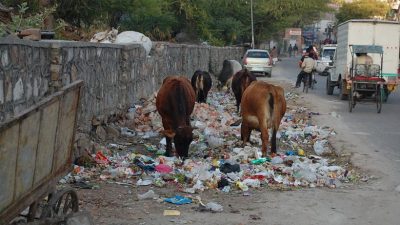
The global discourse on urban management has undergone a fundamental transformation, most notably evidenced by proceedings at COP30. For a significant period, waste management was relegated to a “housekeeping” or municipal sanitation issue—a secondary concern for local authorities focused on concealing refuse in landfills. However, COP30 essentially rebranded waste management as a frontline climate solution. For India, this evolution is not merely about achieving cleaner urban environments; it represents a strategic necessity to decouple economic growth from environmental pollution. The transition toward a circular economy is now critical due to several interconnected factors:
- Methane as a Potent Threat: Landfills are prolific producers of methane, a greenhouse gas significantly more potent than CO2 in the short term. By aggressively addressing organic waste, India can accelerate its progress toward international climate targets.
- The Resource Imperative: Rapid urbanization in India has led to a skyrocketing demand for raw materials such as steel, plastic, and paper. A circular economy model—where waste serves as a secondary raw material—mitigates the need for ecologically destructive mining and energy-intensive manufacturing processes.
- Economic Drivers: This transition is fundamentally an economic opportunity. Shifting from a “take-make-dispose” linear model to a circular one has the potential to generate millions of jobs in recycling, upcycling, and the sustainable technology sectors.
The “urban dilemma” is characterized by a direct correlation between construction and waste generation. The central challenge lies in developing the infrastructure necessary to loop waste back into the productive system before existing landfills reach a catastrophic breaking point.
Reshaping Urban Sustainability through COP30 Recognition
The recognition of waste as a critical climate variable under the United Nations Framework Convention on Climate Change (UNFCCC) at COP30 has profound implications for India. It elevates waste management from a localized sanitation task to a central climate mitigation strategy.
Waste as a Primary Climate Driver
- Focus on Methane Mitigation: The identification of organic waste in landfills as a primary source of methane reframes waste management as an immediate climate imperative rather than a simple hygiene concern.
- Quantifiable Emissions: Urban waste in India is projected to emit over 41 million tonnes of greenhouse gases annually by 2030. Addressing these emissions is now recognized as a non-negotiable component of India’s climate goals.
The Transition to Circularity
- Resource Recovery: The traditional “linear” model of consumption is increasingly viewed as unsustainable. The new paradigm emphasizes circularity—the systematic recovery, recycling, and reuse of materials to reduce reliance on virgin resources.
- Economic Framing: This transition is no longer framed as an environmental cost but as a driver of green jobs within the repair, bio-energy, and recycling sectors.
Policy and Governance Integration
- Alignment with Mission LiFE: Global shifts align with India’s Mission LiFE (Lifestyle for Environment), which advocates for “deliberate utilization” over mindless consumption. This integrates individual behavioral changes, such as waste segregation, into the national climate policy framework.
- Systemic Reform Requirements: Achieving the national target of “Garbage Free Cities” now necessitates deep systemic changes, including source segregation, the establishment of Material Recovery Facilities (MRFs), and the deployment of bio-methanation plants.
Health and Urban Resilience
- Public Health Linkages: Unmanaged waste is intrinsically linked to air pollution via waste burning, water contamination, and the proliferation of disease vectors. Circular systems enhance public health and bolster urban resilience against climate-related shocks.
- Growth Pressures: With India’s urban population expected to nearly double by 2050, circularity offers a vital “survival strategy” to manage growth sustainably, shifting the conversation from “hiding trash” to “extracting value.”
Practical Pathways for Circular Integration in Indian Cities
Indian cities can practically integrate circular principles by transitioning away from the “collect-and-dump” approach toward a system that treats waste as a continuous resource stream. Models from cities like Indore, Pune, and Surat provide a roadmap:
1. Institutionalizing Hyper-Segregation at Source
The core of circularity is preventing the creation of mixed “garbage.”
- The Strategy: Mandating granular segregation into categories such as plastic, paper, metal, e-waste, and hazardous materials to maximize recovery value.
- Implementation: Indore enforces a 6-bin segregation system at the household level, allowing the city to process 100% of its daily waste and convert organic matter into Bio-CNG for public transport.
2. Decentralized Processing Models
Reducing the carbon footprint and cost associated with hauling waste to distant landfills.
- The Strategy: Establishing “Garbage Clinics” or decentralized recovery centers within city wards to sort and sell materials immediately.
- Implementation: Ambikapur utilizes a “zero-landfill” model managed by women Self-Help Groups (SHGs), sorting waste into 156 categories for sale to recyclers.
3. Formalization of the Informal Sector
Integrating the existing workforce of waste pickers into the formal urban governance structure.
- The Strategy: Providing identity cards, uniforms, and formal contracts to informal workers to ensure high segregation rates and dignified livelihoods.
- Implementation: Pune’s SWaCH model is a cooperative authorized by the municipal corporation that collects waste directly from doorsteps, saving the city significant transport and landfill costs.
Comparative Analysis: India and the Global South
While India shares the “growth-before-infrastructure” challenge common in the Global South, its specific policy choices and scale create unique contrasts with its peers.
| Feature | India’s Context | Global South Peers (Examples) |
| Informal Sector | Heavily reliant on informal pickers; often lacks formal recognition or safety nets. | Brazil: Legally recognizes catadores as service providers, integrating cooperatives into municipal systems. |
| Engagement | Campaign-driven (e.g., Swachh Bharat); focuses on voluntary behavioral change. | Indonesia: Uses the “Waste Bank” (Bank Sampah) system, providing direct financial incentives for segregation. |
| Enforcement | Robust federal rules (2016 SWM Rules) but faces implementation gaps. | Rwanda/Other Centralized States: Often exhibit stricter centralized enforcement of specific bans (e.g., plastics). |
Multi-Dimensional Risks of Delayed Reform
Failure to implement systemic waste reforms during rapid urbanization poses severe environmental, economic, and governance risks.
Environmental Risks: Ecosystem Collapse
- Methane Acceleration: Landfills in major hubs like Delhi contribute disproportionately to climate change impacts.
- Contamination: Toxic leachate destroys groundwater quality, while plastic waste devastates river ecosystems like the Yamuna.
- Air Quality: Waste burning contributes significantly to PM2.5 and dioxin levels, exacerbating the air quality crisis in Indian cities.
Economic Risks: Value Loss and Stagnation
- Fiscal Stress: Urban Local Bodies (ULBs) often spend 70-90% of waste budgets on collection and transport, with minimal cost recovery.
- Resource Loss: India loses an estimated $13 billion annually due to the failure to recycle valuable materials.
- Productivity Impacts: Pollution-related health damages cost India approximately ₹2.6 lakh crore annually (roughly 3% of GDP).
- Real Estate Depreciation: Proximity to dumpsites significantly lowers market demand and property values within a 10 km radius.
Governance Risks: Institutional Paralysis
- Fragmentation: Overlapping mandates and poor coordination hinder accountability.
- Social Inequity: Low-income communities disproportionately bear the burden of living near dumpsites, leading to environmental injustice and social tension.
- Land Lock: Many municipalities lack the land or resources to acquire new sites as existing landfills reach capacity, halting essential infrastructure development.
Strategic Shifts for Low-Carbon Development
Transforming waste from a liability into a driver of low-carbon development requires rewriting the urban operating manual across three pillars:
1. Policy Shifts: Prioritizing Mitigation
- Carbon-Efficient Procurement: Favoring decentralized processing in municipal tenders to reduce transport emissions.
- Rigorous EPR Enforcement: Holding producers financially liable for the entire lifecycle of packaging and electronics.
- Urban Mining Incentives: Creating tax incentives for reclaiming land and materials from legacy landfills to prevent further methane release.
2. Infrastructure Shifts: Waste as an Energy Factory
- Decentralized Bio-Methanation: Replacing failing incinerators with ward-level Bio-CNG plants that capture methane from wet waste.
- Material Recovery Facilities (MRFs): Moving infrastructure closer to the source to reduce the carbon footprint of collection logistics.
- C&D Recycling: Establishing dedicated plants to process Construction and Demolition waste into recycled aggregates, reducing the need for carbon-heavy river sand mining.
- Digital Integration: Using GPS and sensors to prevent waste leakage and illegal open burning.
3. Behavioral Shifts: Active Participation
- Normalization of Hyper-Segregation: Moving beyond the binary wet/dry split to ensure the purity of recyclable streams.
- Adoption of Mission LiFE: Moving from passive consumption to the active refusal of single-use items.
- Market Acceptance: De-stigmatizing products made from recycled materials to ensure the economic loop remains closed.
Questions
- Critically analyze the role of the informal sector in India’s waste management landscape. How can the formalization of “waste pickers” enhance urban resource efficiency while ensuring social justice? (GS-I: Indian Society)
- What are the technological and economic challenges associated with the large-scale implementation of Bio-methanation and Waste-to-Energy projects in India? Discuss in the light of the low-caloric value of Indian municipal solid waste. (GS-III: Science & Technology)
- Examine the significance of “Urban Mining” as a strategy for sustainable city planning. To what extent can the reclamation of legacy landfills address the twin challenges of land scarcity and methane emissions? (GS-III: Environment & DM)
- With suitable examples, discuss how the “Waste Bank” (Bank Sampah) model from Indonesia could be adapted to the Indian socio-economic context to incentivize source segregation. (GS-II: Governance)
- Explain the concept of Extended Producer Responsibility (EPR) under the Solid Waste Management Rules, 2016. What are the governance hurdles in its effective enforcement across diverse industrial sectors? (GS-II: Governance)
- Critically discuss the impact of unmanaged urban waste on the “right to a healthy environment.” How do landfill sites exacerbate environmental injustice for marginalized urban populations? (GS-II: Social Justice)