
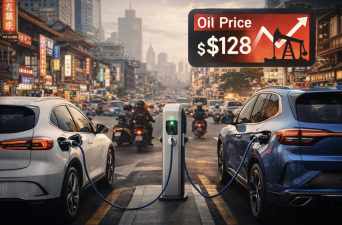
The recent U.S.-Iran war in early 2026 caused a sharp rise in global oil prices. The OPEC basket price surged by 67% within a month. This spike increased petrol, diesel, and LPG costs in Asia’s largest economies, India and China. The conflict also threatened oil supply by risking closure of the Strait of Hormuz, a key global oil route. This situation revived interest in Electric Vehicles (EVs) and alternative fuels, denoting the energy vulnerabilities of these nations.
Impact of Oil Price Surge on Asia
The war led to a rapid increase in fuel costs. China and India depend heavily on imported oil. China imports 5.4 million barrels daily through the Strait of Hormuz. India imports 2.1 million barrels daily. Rising prices have pressured both countries but exposed their different energy strategies. China’s faster EV adoption reduces its fuel shock exposure. India remains more reliant on fossil fuels in transport.
EV Adoption and Market Trends
China leads in EV sales and usage. In March 2026, EVs were 52.9% of new passenger car sales in China. India’s EV share was only 6% in 2026. China sold about 900,000 new-energy cars in March alone. India sold 72,000 electric cars in three months. In electric two- and three-wheelers, China sold 7.2 million in 2024. India’s sales were 427,000 in 2026. China’s total EV fleet is much larger, with 23 million electric two- and three-wheelers versus India’s 2.3 million.
Infrastructure and Supply Chain Differences
Charging infrastructure affects EV adoption. India has 14 electric cars per public charger. China has about 9 cars per charger, indicating better availability. This supports faster EV growth in China’s passenger vehicle market. India has made progress in electric three-wheelers but lags in cars and buses. Limited charging points and supply chain gaps slow India’s EV transition.
Energy Security and Future Outlook
High EV adoption reduces vulnerability to oil shocks. Countries with more EVs face less impact from fuel price rises. The Iran conflict reinforced the need for electric mobility in Asia. Chinese carmakers like BYD have seen rising demand post-crisis. India’s heavy reliance on petrol and diesel means oil shocks directly affect households. Accelerating EV infrastructure and adoption remains critical for India’s energy security.
Topics for Prelims:
Electric Vehicles (EVs)
- EVs use electricity instead of fossil fuels for transport.
- China has the largest EV market globally.
- EV adoption reduces dependence on imported oil.
- Public charging infrastructure is key to EV growth.
- Electric two- and three-wheelers are popular in Asia.
Strait of Hormuz
- Key maritime chokepoint for global oil supply.
- About 20% of world oil passes through it daily.
- Located between the Persian Gulf and Gulf of Oman.
- Political conflicts here affect global energy security.
- Closure risks disrupt oil exports and increase prices.
India-China Energy Vulnerability
- Both heavily import crude oil for transport.
- China’s faster EV adoption reduces fuel price risks.
- India relies more on petrol, diesel, and LPG.
- China’s EV fleet is much larger than India’s.
- Infrastructure gaps hinder India’s EV growth.
Questions for Mains:
- Critically analyse the impact of geopolitical conflicts on global energy security and the role of alternative energy sources in mitigating these risks. [GS-III-Economic Development]
- With suitable examples, point out the factors influencing the adoption of electric vehicles in developing countries and estimate their impact on reducing fossil fuel dependency. [GS-III-Environment & DM]
- Underline the strategic importance of maritime chokepoints like the Strait of Hormuz and discuss how they affect international relations and trade security. [GS-II-International Relations]
- Critically analyse the challenges and opportunities in India’s transition to electric mobility and how policy measures can accelerate this shift. [GS-II-Governance]
Answer Hints:
1. Critically analyse the impact of geopolitical conflicts on global energy security and the role of alternative energy sources in mitigating these risks. [GS-III-Economic Development]
- Geopolitical conflicts (e.g., U.S.-Iran war) disrupt major oil supply routes, causing price volatility and supply uncertainty globally.
- Strait of Hormuz’s closure risk threatens about 20% of global oil transit, impacting energy-importing countries severely.
- Rising oil prices increase costs for transport, industry, and households, affecting economic stability and growth.
- Countries heavily dependent on imported fossil fuels (e.g., China) face heightened vulnerability to such shocks.
- Alternative energy sources like Electric Vehicles (EVs) reduce dependence on fossil fuels, cushioning against supply disruptions.
- Accelerating clean energy adoption enhances energy security, lowers emissions, and promotes sustainable economic development.
2. With suitable examples, point out the factors influencing the adoption of electric vehicles in developing countries and estimate their impact on reducing fossil fuel dependency. [GS-III-Environment & DM]
- Infrastructure availability (charging stations) is critical; China has better charger-to-car ratio than India, aiding faster EV adoption.
- Government policies, subsidies, and incentives influence EV market growth and consumer uptake.
- Economic factors – affordability, income levels, and availability of EV models affect adoption rates.
- Public awareness and environmental concerns drive demand, as seen in China’s large EV market share (52.9% new cars in 2026).
- EV adoption reduces fossil fuel consumption, lowering import dependency and exposure to oil price shocks (China vs India contrast).
- Electric two- and three-wheelers are popular in Asia, providing affordable, cleaner transport options in urban and rural areas.
3. Underline the strategic importance of maritime chokepoints like the Strait of Hormuz and discuss how they affect international relations and trade security. [GS-II-International Relations]
- Strait of Hormuz is a critical chokepoint connecting Persian Gulf oil producers to global markets, handling ~20% of world oil daily.
- Its narrow geography makes it vulnerable to blockades, conflicts, or piracy, threatening global energy supplies.
- Closure or disruption leads to sharp increases in oil prices, affecting global economies and energy security.
- Major powers and regional actors engage diplomatically and militarily to secure free navigation (e.g., US naval presence).
- Disputes here impact international relations, triggering alliances, sanctions, and geopolitical tensions.
- Ensuring trade security at chokepoints is vital for stable energy flows and global economic stability.
4. Critically analyse the challenges and opportunities in India’s transition to electric mobility and how policy measures can accelerate this shift. [GS-II-Governance]
- Challenges – Limited charging infrastructure (14 cars per charger), low EV penetration (~6% new cars), and supply chain gaps hinder growth.
- High dependence on petrol, diesel, and LPG in transport increases vulnerability to oil price shocks.
- Opportunities – Growing market for electric three-wheelers and potential to leapfrog fossil fuel reliance with strong policy support.
- Government initiatives like FAME scheme, subsidies, and battery manufacturing incentives can boost adoption.
- Improving infrastructure, local manufacturing, and consumer awareness are key to scaling up EV usage.
- Accelerating EV transition enhances energy security, reduces pollution, and aligns with climate commitments.