
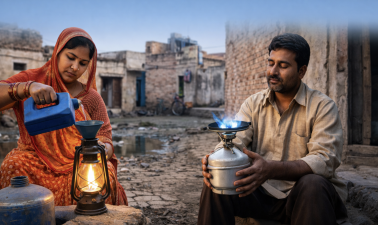
India has temporarily reintroduced kerosene through the Public Distribution System (PDS) amid global energy market disruptions. This move aims to secure household energy access during supply shocks caused by geopolitical tensions, including the closure of the Strait of Hormuz. The government’s order, effective for 60 days, covers 21 states and Union Territories and eases regulatory norms for kerosene storage and distribution.
Background and Context
Kerosene, once a major household fuel, has sharply declined in India’s energy mix. Production fell from 7.6 million tonnes in 2014-15 to about 1 million tonnes in 2024-25. Consumption dropped from 6.83 million tonnes in 2015-16 to roughly 408,000 tonnes in 2024-25. The fuel was widely used for cooking and lighting, especially in rural areas, but has been largely replaced by LPG and electricity due to cleaner energy policies.
Government Measures and Rationale
The government’s notification permits oil marketing companies to store more kerosene and relaxes licensing rules for dealers and transporters. Kerosene is allowed only for household cooking and lighting as an emergency fuel. The decision responds to reduced LNG supplies caused by West Asian conflicts, ensuring energy access if LPG or electricity supplies are disrupted or prices spike.
Energy Transition and Policy Challenges
India phased out kerosene subsidies starting 2016, promoting LPG under schemes like the Pradhan Mantri Ujjwala Yojana. Despite this, affordability issues persist for some households. Many still use a mix of fuels, switching back to kerosene when LPG prices rise. Experts stress that kerosene’s return is temporary and does not signal a reversal of India’s clean energy goals.
Current Consumption and Regional Variations
Kerosene use is minimal nationally but remains higher in some regions like Meghalaya, Lakshadweep, and Ladakh. About 230,000 tonnes of kerosene were consumed by households in 2024-25. Its use in commercial and industrial sectors is negligible, underscoring its limited role outside emergencies.
Topics for Prelims:
Kerosene Fuel
- Middle distillate petroleum product used for cooking and lighting.
- Production declined from 7.6 million tonnes (2014-15) to 1 million tonnes (2024-25).
- Consumption fell from 6.83 million tonnes (2015-16) to 408,000 tonnes (2024-25).
- Previously subsidised and distributed via Public Distribution System.
- Currently allowed only as an emergency household fuel.
Public Distribution System (PDS)
- Government system to supply essential commodities at subsidised rates.
- Previously included kerosene for rural household energy needs.
- Operates through fair price shops across states and Union Territories.
- Supports energy access for low-income and vulnerable populations.
- Recently reintroduced kerosene temporarily due to energy supply risks.
Strait of Hormuz
- Strategic chokepoint for global oil and LNG shipments.
- Approximately 20% of global oil passes through this narrow waterway.
- Closure or disruption affects global energy markets and supply chains.
- Current regional conflicts have increased energy supply risks.
- India’s energy security is vulnerable to disruptions here.
Questions for Mains:
- Critically discuss the impact of geopolitical conflicts on India’s energy security and the role of legacy fuels like kerosene in mitigating supply shocks. [GS-III-Economic Development]
- Analyse the challenges and policy measures involved in India’s clean cooking fuel transition, with reference to affordability and energy access. [GS-III-Economic Development]
- Examine the significance of the Public Distribution System in ensuring energy equity and how it adapts to changing energy landscapes. [GS-II-Governance]
- Point out the strategic importance of the Strait of Hormuz in global energy trade and its implications for India’s foreign policy and energy security. [GS-II-International Relations]
Answer Hints:
1. Critically discuss the impact of geopolitical conflicts on India’s energy security and the role of legacy fuels like kerosene in mitigating supply shocks. [GS-III-Economic Development]
- Geopolitical conflicts (e.g., West Asia tensions) disrupt oil and LNG supply chains, impacting India’s energy imports.
- Closure/threat to Strait of Hormuz affects ~20% of global oil/LNG shipments, raising supply uncertainty and price volatility.
- India’s heavy dependence on imported energy makes it vulnerable to external shocks, threatening household energy access.
- Legacy fuels like kerosene serve as emergency fallback options due to easy production from crude and existing distribution networks.
- Temporary reintroduction of kerosene via PDS safeguards vulnerable households during LPG/electricity supply disruptions.
- Highlights need for diversified energy mix and strategic reserves to enhance energy security amid global uncertainties.
2. Analyse the challenges and policy measures involved in India’s clean cooking fuel transition, with reference to affordability and energy access. [GS-III-Economic Development]
- Transition from kerosene and biomass to LPG and electricity driven by health, environment, and efficiency concerns.
- Affordability remains a major barrier despite LPG subsidies (Pradhan Mantri Ujjwala Yojana expanded access but cost concerns persist).
- Households often use multiple fuels; fuel stacking occurs due to price fluctuations and supply issues.
- Phasing out kerosene subsidies aimed at promoting cleaner fuels but risks excluding poorest without alternatives.
- Temporary kerosene reintroduction reflects gaps in affordability and energy access under current policies.
- Policy focus needed on sustained subsidies, infrastructure, behavioral change, and regional disparities for inclusive clean cooking transition.
3. Examine the significance of the Public Distribution System in ensuring energy equity and how it adapts to changing energy landscapes. [GS-II-Governance]
- PDS historically provided subsidised kerosene to millions, ensuring energy access for low-income, rural households lacking electricity/LPG.
- Operates through fair price shops across states/UTs, targeting vulnerable populations with essential commodities including energy fuels.
- Adapted over time by phasing out kerosene subsidies and promoting LPG, reflecting shift towards cleaner energy.
- Recent temporary kerosene reintroduction shows PDS flexibility to respond to emergent energy security needs amid geopolitical shocks.
- Challenges include leakage/diversion (~40%), inefficiencies, and ensuring last-mile delivery in diverse regions.
- PDS remains a critical tool for energy equity, balancing affordability, access, and policy shifts in India’s evolving energy scenario.
4. Point out the strategic importance of the Strait of Hormuz in global energy trade and its implications for India’s foreign policy and energy security. [GS-II-International Relations]
- Strait of Hormuz is a narrow chokepoint through which ~20% of global oil and LNG shipments pass, critical for energy supply chains.
- Disruptions due to regional conflicts (e.g., Iran, Gulf tensions) cause global price volatility and supply uncertainties.
- India’s energy imports from West Asia heavily rely on this route, making it vulnerable to geopolitical risks.
- Ensuring safe passage influences India’s diplomatic engagement with Gulf countries, Iran, US, and global powers.
- India pursues diversification of energy sources, strategic petroleum reserves, and alternative routes to mitigate risks.
- Strait’s security is integral to India’s broader foreign policy goals of energy security and regional stability.