
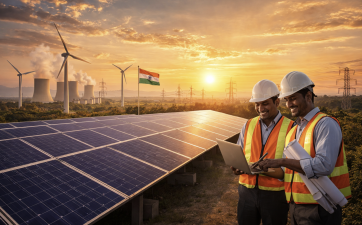
India’s power sector has witnessed transformation by 2026. The Bharat Electricity Summit 2026, held in New Delhi, showcased India’s leadership in clean energy and sustainable power systems. The summit brought together global experts to discuss innovations, challenges, and opportunities in electricity generation, transmission, and distribution.
Expansion of Power Generation Capacity
India’s total installed power capacity reached 520.51 GW by January 2026. A record 52,537 MW was added in FY 2025–26, with 39,657 MW from renewable sources. Solar power contributed 34,955 MW and wind power 4,613 MW. This growth surpasses previous records and supports rising electricity demand from households, industry, and agriculture.
Strengthening Transmission and Distribution Networks
India’s national grid is the world’s largest synchronous grid, now exceeding 5 lakh circuit kilometres of transmission lines and 1,407 GVA of transformation capacity. Investments in substations and high-capacity corridors have improved grid stability and reduced bottlenecks. Distribution utilities (DISCOMs) have been modernised under schemes like RDSS, with over 5.6 crore smart meters installed to enhance efficiency and consumer engagement.
Universal Access and Reliability Improvements
Electricity access has expanded to nearly every household. Initiatives such as Saubhagya electrified over 18,000 villages and connected 2.86 crore homes. Daily power supply in rural areas increased from 12.5 hours in 2014 to 22.6 hours in 2025. Power shortages have fallen drastically, with peak demand met reliably and shortages reduced to 0.03% by December 2025.
Policy Reforms and Financial Stability
The Electricity (Amendment) Bill, 2026, promotes cost-reflective tariffs and direct power procurement by industries. Late Payment Surcharge Rules and automatic cost adjustments have reduced dues from ₹1.4 lakh crore to ₹4,109 crore by February 2026. DISCOMs recorded a profit of ₹2,701 crore in FY 2025, reversing past losses. Technical and commercial losses declined to 15.04%.
Topics for Prelims:
Renewable Energy in India
- India’s installed renewable capacity is fourth largest globally.
- Solar capacity grew from 3 GW in 2014 to 140 GW in 2026.
- Wind energy capacity reached 54.65 GW by 2026.
- On 29 July 2025, renewables met 51.5% of daily electricity demand.
- PM Surya Ghar scheme targets 1 crore rooftop solar installations.
Power Transmission and Distribution
- India’s grid exceeds 5 lakh circuit kilometres of lines.
- Transformation capacity is 1,407 GVA as of 2026.
- RDSS scheme has a ₹3.03 lakh crore outlay for distribution reforms.
- Over 5.6 crore smart meters installed nationwide.
- National Electricity Plan (2023–2032) projects peak demand of 458 GW.
DISCOMs and Financial Reforms
- DISCOMs interface electricity supply with consumers.
- Profit after tax in FY25 was ₹2,701 crore, reversing losses.
- AT&C losses reduced from 22.62% in 2014 to 15.04% in 2025.
- Late Payment Surcharge Rules reduced outstanding dues drastically.
- Electricity (Amendment) Bill promotes market reforms and tariff rationalisation.
Questions for Mains:
- Critically discuss the role of renewable energy in India’s sustainable development and energy security. [GS-III-Economic Development]
- Analyse the challenges faced by power distribution companies in India and examine the reforms introduced to improve their financial health. [GS-III-Economic Development]
- Estimate the impact of large-scale grid expansion and smart metering on rural electrification and consumer empowerment in India. [GS-III-Science & Technology]
- Point out the significance of policy continuity and institutional strengthening in transforming India’s power sector, and discuss how these factors influence international cooperation. [GS-II-Governance]
Answer Hints:
1. Critically discuss the role of renewable energy in India’s sustainable development and energy security. [GS-III-Economic Development]
- Renewable energy drives sustainable development by reducing carbon emissions and environmental pollution.
- India ranks 4th globally in installed renewable capacity, reflecting scale and commitment.
- Solar capacity surged from 3 GW in 2014 to 140 GW in 2026, with wind energy also expanding robustly.
- Renewables met 51.5% of daily electricity demand on 29 July 2025, showcasing integration success.
- Enhances energy security by diversifying energy sources and reducing dependence on fossil fuel imports.
- Government schemes like PM Surya Ghar promote distributed solar, empowering households and decentralizing power generation.
2. Analyse the challenges faced by power distribution companies in India and examine the reforms introduced to improve their financial health. [GS-III-Economic Development]
- Challenges include high Aggregate Technical & Commercial (AT&C) losses, financial stress, and billing inefficiencies.
- DISCOMs historically faced huge losses; FY25 saw a turnaround with ₹2,701 crore profit after tax.
- Reforms like the Revamped Distribution Sector Scheme (RDSS) focus on infrastructure upgrades and smart metering.
- Late Payment Surcharge Rules reduced outstanding dues drastically from ₹1.4 lakh crore to ₹4,109 crore.
- Automatic monthly fuel and power purchase cost adjustments improve tariff cost recovery and financial stability.
- Electricity (Amendment) Bill promotes cost-reflective tariffs and market reforms, enhancing competitiveness.
3. Estimate the impact of large-scale grid expansion and smart metering on rural electrification and consumer empowerment in India. [GS-III-Science & Technology]
- India’s grid is the world’s largest synchronous grid, exceeding 5 lakh circuit kilometres, improving power reach and reliability.
- Transformation capacity increased to 1,407 GVA, enabling efficient voltage regulation and distribution.
- Smart meters (5.62 crore installed) provide real-time consumption data, enabling better consumer control and budgeting.
- Rural electricity supply improved from 12.5 to 22.6 hours daily, enhancing quality of life and economic activities.
- Last-mile connectivity schemes like Saubhagya electrified over 18,000 villages and connected 2.86 crore households.
- Smart metering reduces theft, improves billing accuracy, and enhances transparency and trust between consumers and DISCOMs.
4. Point out the significance of policy continuity and institutional strengthening in transforming India’s power sector, and discuss how these factors influence international cooperation. [GS-II-Governance]
- Consistent policies over a decade enabled sustained capacity expansion and infrastructure investment.
- Institutional strengthening improved regulatory discipline, grid management, and financial sustainability of DISCOMs.
- Policy continuity encourages investor confidence and supports large-scale projects, including renewable integration.
- Strong institutions facilitate transparent market reforms such as tariff rationalisation and cost adjustments.
- India’s leadership in global energy transition showcased at Bharat Electricity Summit 2026 encourages international collaboration.
- Cross-sector dialogue and partnerships at the summit promote technology sharing, financing, and sustainable energy goals worldwide.