
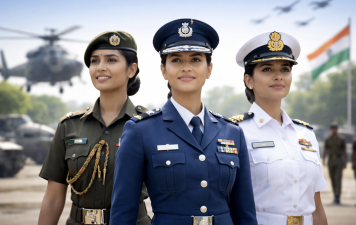
Recent developments show the growing presence and leadership of women in India’s defence sector. As of 2026, women officers serve in diverse operational, technical, and command roles across the Army, Navy, and Air Force. Progressive reforms and institutional efforts have transformed their participation from limited medical roles to frontline combat and strategic leadership positions.
Historical Evolution of Women in Defence
Women initially joined India’s Armed Forces mainly as medical staff. In 1958, women doctors received regular commissions in the Army Medical Corps. The 1990s marked a turning point with the induction of women officers in various branches. The Indian Navy and Air Force began commissioning women in flying and technical roles in 1992. These changes laid the foundation for ’s expanded roles, reflecting India’s commitment to gender equality and operational inclusivity.
Service-wise Integration and Reforms
The Army grants Permanent Commission to women in 12 arms and services beyond medical roles. Women now command units and hold leadership positions. The Navy deploys women on warships and pilots in aviation roles except submarines. Women also join as Agniveers under the Agnipath scheme. The Air Force formalised women’s combat roles in 2022 and expanded cadet intake through the NDA and NCC schemes. Women Agniveers joined the Air Force in 2023, symbolising growing inclusivity.
Women Officers Leading and Breaking Barriers
Women officers have achieved historic milestones. Lt Gen Sadhna Saxena Nair became the first woman Director General Medical Services (Army). Colonel Ponung Doming commands the highest Border Task Force. Squadron Leader Bhawana Kanth was the first woman fighter pilot in combat missions. Sub Lieutenant Aastha Poonia is the first woman naval fighter pilot. Naval officers Lt Cdr Dilna K and Roopa A completed a global circumnavigation voyage. These achievements showcase women’s expanding operational and leadership roles.
Global Recognition and Peacekeeping Contributions
India leads in deploying women in UN peacekeeping missions. Over 154 Indian women serve in six UN operations as of 2025. Major Swathi Shanthakumar won the 2025 UN Secretary-General’s Gender Award for peacekeeping work. Major Radhika Sen was named Military Gender Advocate of the Year 2023. India surpasses UN targets for women staff officers in peacekeeping, reflecting its commitment to gender-inclusive security frameworks.
Topics for Prelims:
Women in Indian Armed Forces
- First regular commission for women doctors in 1958.
- 1992 – Women inducted in Army, Navy, Air Force officer roles.
- Permanent Commission granted in 12 Army branches.
- Women deployed on Navy warships except submarines.
- Women pilots in Air Force combat roles since 2022.
Notable Women Officers and Achievements
- Lt Gen Sadhna Saxena Nair – First woman DG Medical Services.
- Colonel Ponung Doming – Commands highest Border Task Force.
- Squadron Leader Bhawana Kanth – First woman fighter pilot in combat.
- Lt Cdr Dilna K & Roopa A – Completed global naval circumnavigation.
- Women officers in UN peacekeeping missions over 154 in 2025.
Questions for Mains:
- Critically discuss the impact of gender inclusion on operational effectiveness in the Indian Armed Forces. [GS-III-Internal & External Security]
- Analyse the role of judicial interventions and policy reforms in expanding women’s roles in the Indian military and their implications for gender equity. [GS-II-Constitution of India & Polity]
- Examine India’s contribution to gender parity in United Nations peacekeeping missions and its significance for international security cooperation. [GS-II-International Relations]
- Estimate the challenges and opportunities in integrating women into combat roles in traditionally male-dominated armed forces, and point out measures to address them. [GS-IV-Ethics, Integrity and Aptitude]
Topics for Prelims:
Women in Indian Armed Forces
- First regular commission for women doctors in 1958.
- 1992 – Women inducted in Army, Navy, Air Force officer roles.
- Permanent Commission granted in 12 Army branches.
- Women deployed on Navy warships except submarines.
- Women pilots in Air Force combat roles since 2022.
Notable Women Officers and Achievements
- Lt Gen Sadhna Saxena Nair – First woman DG Medical Services.
- Colonel Ponung Doming – Commands highest Border Task Force.
- Squadron Leader Bhawana Kanth – First woman fighter pilot in combat.
- Lt Cdr Dilna K & Roopa A – Completed global naval circumnavigation.
- Women officers in UN peacekeeping missions over 154 in 2025.
Answer Hints:
1. Critically discuss the impact of gender inclusion on operational effectiveness in the Indian Armed Forces. [GS-III-Internal & External Security]
- Gender inclusion enhances diversity, leading to broader perspectives and innovative problem-solving in operations.
- Women officers hold key command and strategic roles, improving leadership quality and decision-making.
- Operational capabilities strengthened by integrating women in combat, technical, and naval roles (e.g., pilots, warships).
- Increased morale and motivation among troops through inclusive policies and representation.
- Challenges such as infrastructure adaptation and cultural change are managed through progressive reforms.
- Joint service operations (e.g., tri-services sailing expedition) demonstrate effective coordination and professionalism of women officers.
2. Analyse the role of judicial interventions and policy reforms in expanding women’s roles in the Indian military and their implications for gender equity. [GS-II-Constitution of India & Polity]
- Judicial rulings upheld women’s right to Permanent Commission, challenging gender discrimination in military service.
- Policy reforms (e.g., Women Special Entry Scheme, opening combat roles) expanded career avenues and leadership opportunities.
- Legal framework aligned with constitutional guarantees of equality and non-discrimination (Article 14, 15).
- Waivers and transitional measures ensured smooth career progression and retention for women officers.
- Judicial activism catalysed institutional reforms, promoting gender equity and operational inclusivity.
- Implications include breaking stereotypes, enhancing women’s empowerment, and setting precedents for other sectors.
3. Examine India’s contribution to gender parity in United Nations peacekeeping missions and its significance for international security cooperation. [GS-II-International Relations]
- India deployed over 154 women personnel in six UN peacekeeping missions by 2025, demonstrating leadership in gender inclusion.
- India exceeded UN targets with 22% women representation among staff officers and observers.
- Indian women peacekeepers (e.g., Major Swathi Shanthakumar, Major Radhika Sen) received global recognition for gender-responsive peacekeeping.
- India’s commitment aligns with UN Gender Parity Strategy, promoting inclusive and effective peace operations.
- Women’s participation enhances community engagement, conflict resolution, and operational effectiveness in peacekeeping.
- India’s example strengthens international cooperation by advocating gender equity as a security imperative.
4. Estimate the challenges and opportunities in integrating women into combat roles in traditionally male-dominated armed forces, and point out measures to address them. [GS-IV-Ethics, Integrity and Aptitude]
- Challenges include cultural resistance, physical standards debates, and infrastructural adjustments in combat units.
- Opportunities involve tapping into a broader talent pool, enhancing operational diversity, and promoting gender equality.
- Measures – progressive policy reforms granting Permanent Commission and opening all combat streams (IAF, Army, Navy).
- Training and mentorship programs to build confidence and competence among women officers.
- Judicial support and institutional waivers to ensure career progression and retention.
- Awareness campaigns and leadership exemplars (e.g., Lt Gen Sadhna Saxena Nair, Squadron Leader Bhawana Kanth) to change mindsets.