
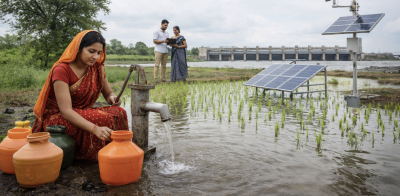
The 30th United Nations Climate Change Conference (COP 30) held in Belém, Brazil, in November 2025 marked a turning point in global climate adaptation. For the first time, water, sanitation, and hygiene (WASH) became central to climate accountability. This shift marks water’s vital role in climate resilience and survival, especially for countries like India facing severe water-related climate challenges.
Climate Change and Water Challenges
Climate change impacts are most visible through water. Floods, droughts, glacial melt, and saline intrusion threaten ecosystems and livelihoods. Agriculture contributes about 40% of human-made methane emissions, mainly from rice, livestock, and organic waste. Efficient water use, wastewater recycling, aquifer recharge, and resilient sanitation are now crucial climate strategies. The Belém Adaptation Indicators focus on water systems that can withstand extreme weather and on risk governance like early warning systems and vulnerability assessments.
India’s Water Governance and Adaptation Efforts
India has advanced water governance since 2019 by integrating it under the Ministry of Jal Shakti. The Water Vision 2047 aligns with global adaptation goals, promoting sustainability and resilience. The National Aquifer Mapping and Management Programme (NAQUIM) evolved from mapping to active aquifer management. The National Mission for Clean Ganga (NMCG) now includes biodiversity and digital monitoring to strengthen river health against climate risks. These efforts show India’s move from infrastructure to system-based resilience.
Challenges in Adaptation Implementation
Three major risks threaten progress. First, water scarcity remains uneven and severe, requiring climate-proof infrastructure and diversified water sources. Second, adaptation finance is uncertain despite global commitments, risking short-term recovery over long-term resilience. Water projects need clear climate investment status. Third, digital data integration is limited; India’s rich hydrological data lacks real-time AI-driven use in planning and governance. Effective adaptation demands convergence of data, finance, and policies.
Belém Indicators as a Framework for Climate Survival
The Belém indicators are tools for transforming adaptation into a development priority. India’s existing missions on water, sanitation, irrigation, and climate action can align with these indicators for measurable resilience. Digital public infrastructure offers a platform to integrate data, advisories, insurance, and finance for real-time decisions. India can lead the Global South by rapidly converting ambition into operational climate resilience focused on water security.
Topics for Prelims:
Belém Adaptation Indicators
- Introduced at COP 30 in 2025, Brazil.
- Integrate water, sanitation, and hygiene into climate accountability.
- Focus on climate-resilient water systems and risk governance.
- Include 59 indicators under UAE Framework for Global Climate Resilience.
- Target universal access to safe water by 2030 and early warning systems by 2027.
India’s Water Governance Initiatives
- Ministry of Jal Shakti formed in 2019 for integrated water management.
- Water Vision 2047 aligns with global climate adaptation goals.
- NAQUIM Programme 2.0 focuses on aquifer-level management plans.
- National Mission for Clean Ganga integrates biodiversity and digital tools.
- Efforts aim to build water systems resilient to climate stress.
Climate Change and Water Security
- Water is the primary medium of climate impact – floods, droughts, saline intrusion.
- Agriculture emits 40% of methane, affecting climate and water systems.
- Water use efficiency and wastewater reuse are key adaptation strategies.
- Risk governance includes multi-hazard early warning and vulnerability assessments.
- Water systems must function under climate stress, not just exist.
Questions for Mains:
- Discuss in the light of COP 30 outcomes how integrating water security into climate adaptation can enhance resilience in developing countries. [GS-III-Environment & DM]
- Analyse the challenges of financing climate adaptation projects in India and suggest measures to ensure sustainable funding. [GS-III-Economic Development]
- With suitable examples, examine the role of digital technologies and data integration in strengthening climate resilience and disaster risk management. [GS-III-Science & Technology]
- Critically discuss India’s water governance reforms since 2019 and their alignment with global climate adaptation frameworks. [GS-II-Governance]
Answer Hints:
1. Discuss in the light of COP 30 outcomes how integrating water security into climate adaptation can enhance resilience in developing countries. [GS-III-Environment & DM]
- COP 30 (Belém, 2025) made water, sanitation, and hygiene (WASH) central to climate adaptation and accountability.
- Water is the main channel of climate impact – floods, droughts, glacial melt, saline intrusion threaten livelihoods and ecosystems.
- Integrating water security means building climate-resilient water and sanitation systems that function under stress, not just infrastructure expansion.
- Focus on reducing water scarcity, flood/drought resilience, universal safe water access, and sanitation systems that withstand extreme events.
- Risk governance (early warning systems, vulnerability assessments) complements water security to enhance preparedness and response.
- Developing countries can leverage integrated water adaptation to protect agriculture, reduce methane emissions, and safeguard food security.
2. Analyse the challenges of financing climate adaptation projects in India and suggest measures to ensure sustainable funding. [GS-III-Economic Development]
- Adaptation finance globally aims for $1.3 trillion/year by 2035 but operational pathways remain unclear and unpredictable.
- In India, lack of predictable, accessible adaptation finance risks prioritizing short-term disaster recovery over long-term resilience.
- Water projects often treated as sectoral costs, not explicitly classified as climate investments, limiting dedicated funding.
- Need to mainstream climate finance into national budgets with clear classification of water/climate adaptation projects.
- Innovative financing mechanisms – green bonds, climate funds, public-private partnerships, and international climate finance channels.
- Strengthen institutional capacity for fund absorption, transparent monitoring, and alignment with adaptation indicators (e.g., Belém framework).
3. With suitable examples, examine the role of digital technologies and data integration in strengthening climate resilience and disaster risk management. [GS-III-Science & Technology]
- India has vast hydrological and meteorological data but lacks AI-driven real-time integration for planning and governance.
- Digital public infrastructure can integrate hydrological data, crop advisories, insurance, and finance into interoperable platforms.
- Examples – National Mission for Clean Ganga uses digital monitoring and biodiversity data to manage river health against climate risks.
- Multi-hazard early warning systems rely on strengthened hydrometeorological services and digital dissemination for timely alerts.
- AI and big data enable vulnerability assessments, resource optimization, and rapid disaster response improving resilience.
- Challenges include data fragmentation, interoperability issues, and need for capacity building at local governance levels.
4. Critically discuss India’s water governance reforms since 2019 and their alignment with global climate adaptation frameworks. [GS-II-Governance]
- Formation of Ministry of Jal Shakti (2019) consolidated water governance under integrated stewardship.
- Water Vision 2047 aligns with global frameworks like Belém indicators emphasizing sustainability, equity, and resilience.
- NAQUIM Programme evolved from aquifer mapping to active aquifer management, showing policy action based on hydrogeological data.
- National Mission for Clean Ganga expanded from sewage treatment to include biodiversity, digital monitoring, and international cooperation.
- Focus shifted from asset creation to system resilience ensuring water systems function under climate stress.
- Challenges remain – uneven water scarcity, fragmented digital data, and need for better adaptation finance alignment.