
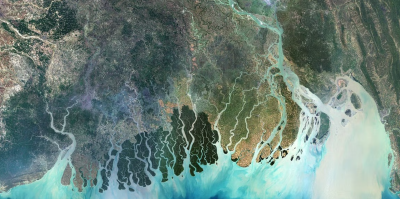
India’s major river deltas — among the most fertile, densely populated, and economically productive regions — are steadily sinking. A new global study shows that this subsidence is no longer a slow geological process but one sharply accelerated by human activity, raising serious concerns for coastal flooding, food security, and long-term habitability in eastern and southern India.
What the global study set out to examine
An international research team undertook the study to address a critical gap: despite supporting more than 340 million people worldwide, river deltas lack high-resolution, comparable data on land subsidence. Using interferometric synthetic aperture radar data from the European Space Agency’s Sentinel-1 satellite between 2014 and 2023, the researchers mapped elevation changes across 40 major deltas globally, including six in India, at a spatial resolution of 75 metres.
To understand what drives this subsidence, the team employed a random forest machine-learning model that correlated observed sinking with three stressors — groundwater storage trends, sediment flux, and urban expansion. The study was published in the journal Nature on January 14.
Which Indian deltas are sinking — and how widespread
All six Indian deltas analysed — the Ganges-Brahmaputra, Brahmani, Mahanadi, Godavari, Cauvery, and Kabani — were confirmed to be subsiding. The scale of the problem is extensive:
- Over 90% of the Ganges-Brahmaputra, Brahmani, and Mahanadi delta areas are affected.
- In the Ganges-Brahmaputra, Brahmani, Mahanadi, Godavari, and Kabani deltas, average subsidence rates exceed regional sea-level rise.
- About 77% of the Brahmani delta and 69% of the Mahanadi delta are sinking at rates greater than 5 mm per year.
Even under the worst future climate scenario, the upper-end subsidence rates projected for the Godavari delta are expected to surpass the rate of global sea-level rise, indicating that land sinking itself is a dominant risk factor.
Human actions accelerating a natural process
Deltas naturally subside over time as newly deposited sediments compact, organic material decomposes, and tectonic and isostatic adjustments take place. However, the study shows that human interventions have dramatically accelerated this otherwise slow geological process.
Distinct drivers emerge across India’s deltas:
- Unsustainable groundwater extraction is particularly severe in the Ganges-Brahmaputra and Cauvery deltas.
- Rapid urbanisation is the dominant stressor in the Brahmani delta.
- Reduced sediment supply, often due to upstream dams and river regulation, limits the deltas’ ability to naturally rebuild land.
In urban centres such as Kolkata, the combined effects of dense infrastructure, construction load, and intensive resource use have led to subsidence rates equal to or higher than the delta average, accelerating the city’s relative descent towards sea level.
Why subsidence multiplies climate and flood risks
Land subsidence intensifies the impacts of sea-level rise and extreme weather events. When the ground sinks, even modest increases in sea level translate into more severe flooding and erosion. The study highlights several consequences:
- Greater frequency and severity of coastal and riverine floods.
- Permanent loss of low-lying land, especially in deltaic agricultural zones.
- Saltwater intrusion into freshwater aquifers, degrading drinking water and soils.
- Damage to ports, transport corridors, and urban infrastructure.
- Increased competition over land and water resources, potentially driving displacement and migration.
For India, where deltas underpin food production, fisheries, and trade, these risks carry wide economic and social implications.
An institutional gap in delta governance
The study characterises the Ganges-Brahmaputra delta as having moved from a “latent threat” in the 20th century to an “unprepared diver” in the 21st. This framing reflects a sharp rise in risk exposure without a commensurate strengthening of institutional capacity, planning, or adaptation mechanisms.
The finding draws attention to gaps in groundwater regulation, urban planning, sediment management, and coordinated delta governance — areas where policy responses have lagged behind the scale of the challenge.
Study limitations but a clear warning
The researchers acknowledge that groundwater storage estimates may be less reliable for smaller deltas due to limitations of satellite gravity data, that sediment flux datasets are not fully current, and that the 40 deltas studied are not globally representative. Even so, the consistency of results across regions supports the central conclusion: human activity is transforming gradual subsidence into an urgent environmental crisis.
What to note for Prelims?
- Indian deltas affected: Ganges-Brahmaputra, Brahmani, Mahanadi, Godavari, Cauvery, Kabani.
- Main drivers of subsidence: groundwater over-extraction, reduced sediment supply, urbanisation.
- Subsidence can exceed sea-level rise in shaping flood risk.
- Use of satellite radar and machine-learning models in environmental monitoring.
What to note for Mains?
- Delta subsidence as a human-amplified environmental risk.
- Links between water governance, urban development, and climate adaptation.
- Implications for food security, infrastructure, and migration.
- Need for integrated delta management and sustainable groundwater regulation.