
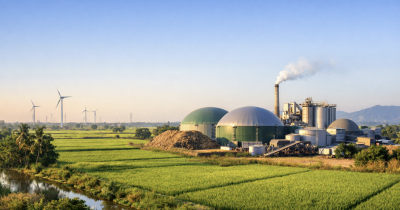
Recent developments show India’s strategic push to scale up bioenergy sectors such as Ethanol, Compressed Biogas (CBG), and Biomass. This move aims to reduce dependence on fossil fuel imports and strengthen energy security amid global supply disruptions and price volatility. Government policies and financial incentives have played very important roles in accelerating production and adoption of these renewable energy sources.
Ethanol Blending Programme Success
India’s Ethanol Blending Programme (EBP), started in 2003, has surpassed the 20% blending target ahead of schedule. Supportive policies like the National Biofuel Policy 2018, GST reduction, and interest subvention schemes boosted growth. Ethanol supply rose from 38 crore litres in 2013-14 to over 1,050 crore litres by 2025-26. This shift has saved foreign exchange worth ₹1.63 lakh crore and supported farmers with ₹1.44 lakh crore income. Feedstock diversification from molasses to sugarcane juice, surplus rice, and maize has been crucial.
Emergence of Compressed Biogas (CBG)
CBG production is gaining momentum as a natural gas substitute. It utilises agricultural residues, cattle dung, and organic waste. The SATAT initiative launched in 2018 aims for 5,000 CBG plants with 15 million tonnes annual production. As of March 2026, 201 plants are operational and 319 under construction. Government schemes provide financial aid and infrastructure support to boost the sector’s viability.
Biomass and Co-firing in Thermal Power
Biomass densification into pellets and briquettes is promoted to replace coal. The SAMARTH Mission mandates 5% co-firing in thermal plants from FY 2025-26. This could create a biomass demand of 150 million tonnes yearly. Price benchmarking and assured demand signals have improved market stability. Further incentives are needed for sustainable growth.
Policy Interventions and Future Steps
Key policy interventions include pricing mechanisms, financial assistance, and infrastructure development. The government plans to expand ethanol blending, promote Flex Fuel Vehicles, and test new biofuels like Iso Butanol and DME. Increasing biomass and biogas use in rural areas to replace LPG is also a priority.
Topics for Prelims:
Ethanol Blending Programme
- Launched in 2003 to blend ethanol with petrol.
- Achieved 20% blending target ahead of 2025-26.
- Feedstock diversification includes molasses, sugarcane juice, rice, maize.
- GST reduced from 18% to 5% for ethanol.
- Foreign exchange saving of ₹1.63 lakh crore.
Compressed Biogas (CBG)
- Produced from agricultural and organic waste.
- SATAT initiative targets 5,000 plants by 2026.
- 201 plants commissioned; 319 under construction.
- Used in transport, industry, and city gas distribution.
- Financial and infrastructure support from government schemes.
Biomass Co-firing
- Densified biomass replaces coal in thermal plants.
- SAMARTH Mission mandates 5% co-firing from 2025-26.
- Potential biomass demand of 150 million tonnes annually.
- Price benchmarking improves tendering process.
- Supports cleaner energy transition in power sector.
Questions for Mains:
- Critically discuss the role of biofuels in enhancing India’s energy security and reducing import dependency. [GS-III-Economic Development]
- Examine the challenges and opportunities in scaling up Compressed Biogas production in India and its impact on sustainable development. [GS-III-Environment & DM]
- Analyse the significance of biomass co-firing in thermal power plants with respect to India’s climate commitments and energy transition. [GS-III-Environment & DM]
- Estimate the economic and social impacts of the Ethanol Blending Programme on rural farmers and agrarian economy in India. [GS-III-Economic Development]
Answer Hints:
1. Critically discuss the role of biofuels in enhancing India’s energy security and reducing import dependency. [GS-III-Economic Development]
- Biofuels reduce dependence on imported crude oil (85% import reliance) and natural gas (50% import reliance), mitigating supply disruptions and price volatility.
- Key biofuels – Ethanol, Compressed Biogas (CBG), and Biodiesel contribute to diversified domestic energy sources.
- Ethanol Blending Programme (EBP) achieved 20% blending target early, saving ₹1.63 lakh crore in foreign exchange and substituting 277 lakh tonnes of crude oil.
- Government policy interventions – National Biofuel Policy, pricing mechanisms, GST reduction, financial incentives, and infrastructure support.
- Biofuels enhance economic resilience by supporting farmers’ income and reducing inflationary pressures from fuel price shocks.
- Challenges remain in feedstock availability, technology adoption, and scaling biodiesel; need for sustained policy support and innovation.
2. Examine the challenges and opportunities in scaling up Compressed Biogas production in India and its impact on sustainable development. [GS-III-Environment & DM]
- Opportunities – Utilizes agricultural residues, cattle dung, municipal organic waste; reduces methane emissions and waste management issues.
- SATAT initiative targets 5,000 plants with 15 MMT annual production; 201 plants commissioned, 319 under construction as of 2026.
- CBG serves as a clean fuel for transport, industry, and city gas distribution, aiding energy diversification and rural employment.
- Challenges – Feedstock collection and aggregation, financial viability, infrastructure development, and market creation.
- Government support includes Central Financial Assistance, biomass aggregation machinery, pipeline infrastructure, and market development schemes.
- CBG scaling contributes to sustainable development goals by reducing fossil fuel use, lowering greenhouse gas emissions, and promoting circular economy.
3. Analyse the significance of biomass co-firing in thermal power plants with respect to India’s climate commitments and energy transition. [GS-III-Environment & DM]
- Biomass co-firing reduces coal consumption, lowering carbon emissions and air pollutants from thermal power plants.
- SAMARTH Mission mandates 5% biomass co-firing from FY 2025-26, creating demand for ~150 million tonnes biomass annually.
- Densified biomass (pellets, briquettes) enables efficient handling, transport, and combustion in existing coal plants.
- Price benchmarking and assured demand signals improve market stability and investor confidence.
- Supports India’s climate goals under Paris Agreement by facilitating cleaner energy transition without major infrastructure overhaul.
- Challenges include feedstock availability, quality standards, and integration with coal supply chains.
4. Estimate the economic and social impacts of the Ethanol Blending Programme on rural farmers and agrarian economy in India. [GS-III-Economic Development]
- EBP increased ethanol production from 38 crore litres (2013-14) to over 1,050 crore litres (2025-26), expanding demand for multiple feedstocks.
- Income support of ₹1.44 lakh crore to farmers via diversified feedstock use – molasses, sugarcane juice, surplus rice, maize, damaged grains.
- Promotes crop diversification, reduces agricultural waste, and enhances rural employment in feedstock cultivation and distillery operations.
- Foreign exchange savings reduce macroeconomic vulnerability, indirectly benefiting rural economies.
- GST reduction and long-term offtake agreements improve supply chain stability and farmer confidence.
- Challenges include ensuring equitable benefits, addressing price volatility, and expanding benefits to smallholders.