
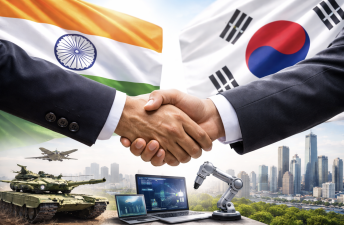
India and South Korea have reaffirmed their commitment to strengthening their Special Strategic Partnership, signalling a renewed push to expand cooperation across defence, technology, economic security and regional diplomacy. The understanding emerged during the 6th Foreign Policy and Security Dialogue (FPSD) in Seoul, where both sides agreed to sustain high-level engagements through 2026. The development reflects the growing convergence between New Delhi and Seoul in the Indo-Pacific’s evolving geopolitical landscape.
What Happened at the 6th Foreign Policy and Security Dialogue?
The 6th FPSD was co-chaired by P. Kumaran, Secretary (East) in India’s Ministry of External Affairs, and Park Yoon-joo, First Vice Foreign Minister of the Republic of Korea (ROK).
The dialogue reviewed the full spectrum of bilateral ties, including:
- Political and diplomatic cooperation.
- Defence and security engagement.
- Trade and investment flows.
- Science, technology and innovation.
- Cultural and people-to-people exchanges.
On the margins of the meeting, Kumaran also held talks with Cho Hyun and senior officials from South Korea’s National Security Office and Ministry of Foreign Affairs, underlining the importance both sides attach to sustained high-level contact.
Special Strategic Partnership: Evolution and Significance
India and South Korea elevated their relationship to a Special Strategic Partnership in 2015. Since then, cooperation has expanded beyond trade to include defence manufacturing, maritime security and emerging technologies.
The partnership gains relevance in three key contexts:
- Indo-Pacific geopolitics: Both countries support a free, open and rules-based Indo-Pacific.
- Economic diversification: Reducing overdependence on specific supply chains.
- Technological collaboration: Leveraging complementary strengths in electronics, semiconductors and digital innovation.
For India, South Korea represents a vital East Asian partner under its Act East Policy. For Seoul, India offers a large market and a strategic counterbalance in a volatile regional order.
Economic Security and Critical Technologies
A major focus of the dialogue was economic security — an increasingly important concept amid global supply chain disruptions and geopolitical rivalries.
The two sides explored cooperation in:
- Critical minerals.
- Resilient and secure supply chains.
- Semiconductors and advanced manufacturing.
- Artificial intelligence and digital technologies.
- Green hydrogen and clean energy transitions.
India also highlighted opportunities for Korean investment in shipbuilding and maritime infrastructure. Given South Korea’s global leadership in shipbuilding, collaboration could align with India’s ambitions to expand its blue economy and manufacturing capacity.
Defence and Maritime Convergence
Defence cooperation forms a cornerstone of bilateral ties. South Korean defence firms have been active in India’s procurement landscape, and both countries share concerns regarding maritime security in the Indo-Pacific.
The exchange of views on the Korean Peninsula and broader Indo-Pacific developments suggests growing strategic alignment. While India maintains strategic autonomy, it increasingly coordinates with like-minded partners to preserve stability in sea lanes and regional institutions.
Cultural and People-to-People Connect
Beyond hard security, both nations emphasised strengthening cultural and educational exchanges. Growing popularity of Korean culture in India and expanding Indian student presence in South Korea have added a societal dimension to the partnership.
Such soft power linkages help insulate bilateral ties from geopolitical fluctuations and create long-term goodwill.
Multilateral Coordination and Global Outlook
The dialogue also addressed cooperation in multilateral forums. India and South Korea have overlapping interests in:
- Reforming global supply chains.
- Strengthening climate action mechanisms.
- Ensuring stability in the Indo-Pacific.
- Promoting rules-based trade frameworks.
As middle powers with significant economic weight, both countries seek to shape regional norms without being drawn into bloc politics.
What to Note for Prelims?
- India–South Korea Special Strategic Partnership (elevated in 2015).
- Foreign Policy and Security Dialogue (FPSD) — key bilateral mechanism.
- Focus sectors: semiconductors, AI, green hydrogen, critical minerals.
- Act East Policy — India’s framework for engagement with East and Southeast Asia.
What to Note for Mains?
- Role of middle powers in Indo-Pacific geopolitics.
- Economic security and resilient supply chains in foreign policy.
- Strategic autonomy and diversified partnerships in India’s diplomacy.
- Technology partnerships as instruments of geopolitical influence.
- Maritime cooperation and blue economy prospects.