
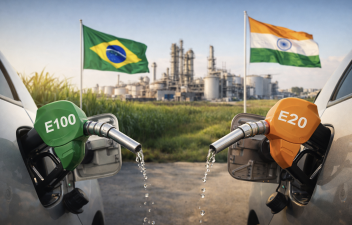
In 2026, Brazil remains a global leader in ethanol fuel use, with alcohol powering over half of its light vehicle fleet. India is increasingly looking to replicate Brazil’s successful ethanol blending programme to reduce its dependence on imported oil amid recurring global energy shocks. The ongoing geopolitical tensions in West Asia have intensified calls for India to accelerate ethanol adoption and flex-fuel vehicle promotion.
Brazil’s Ethanol Fuel Programme
Brazil launched its Proálcool programme in 1975 after the 1973 oil shock. It mandated petrol to contain at least 11% ethanol. By 1979, Brazil introduced vehicles running on 100% hydrous alcohol. In 2003, flex-fuel vehicles capable of using any ethanol-petrol blend were launched. Ethanol content in petrol increased gradually, reaching 30% by 2015. In 2024, Brazil consumed 3,492 crore litres of fuel alcohol, with over half of its vehicle fuel being ethanol-based.
India’s Ethanol Blending Progress
India’s ethanol blending rose from 1.6% in 2013-14 to 19.2% in 2024-25. Initially, ethanol was produced from molasses by sugar mills. Since 2018, production expanded to include direct sugarcane juice and grains like maize and rice. In 2024-25, 69% of ethanol supplied to oil companies came from grains. The government incentivised higher-value ethanol production by fixing differential prices for feedstocks.
Challenges and Policy Needs in India
India imports 90% of its crude oil and faces supply vulnerabilities. Despite sufficient ethanol production capacity (over 1,800 crore litres annually), blending mandates and flex-fuel vehicle availability remain limited. Experts recommend increasing ethanol blend mandates from 20% to 30%, promoting flex-fuel vehicles, and installing separate fuel pumps for higher ethanol blends. Tax reforms are also needed to bring all ethanol-blended fuels under GST for uniformity.
Future Prospects and Strategic Importance
India’s surplus production of sugarcane, rice, and maize offers potential to scale ethanol fuel use. Adoption of flex-fuel vehicles and conversion kits can accelerate transition. With internal combustion engines remaining dominant, ethanol blending offers a practical solution to reduce oil import dependence and enhance energy security amid global crises.
Topics for Prelims:
Brazil’s Proálcool Programme
- Started in 1975 to reduce oil imports.
- Mandated minimum 11% ethanol in petrol.
- Introduced 100% hydrous alcohol vehicles in 1979.
- Launched flex-fuel vehicles in 2003.
- Ethanol content in petrol reached 30% by 2015.
India’s Ethanol Production and Blending
- Blending increased from 1.6% in 2013-14 to 19.2% in 2024-25.
- Initially used molasses from sugar mills.
- Expanded to sugarcane juice and grains since 2018.
- 69% of ethanol in 2024-25 came from grains.
- Government fixes differential ex-distillery prices for feedstocks.
Flex-Fuel Vehicles and Ethanol Use
- Flex-fuel vehicles can run on petrol-ethanol blends or pure ethanol.
- Brazil pioneered flex-fuel technology in 2003.
- Electronic sensors adjust fuel injection and spark timing automatically.
- India aims to promote flex-fuel vehicles to boost ethanol use.
- Separate fuel pumps for E30 and E100 proposed for India.
Questions for Mains:
- Discuss in the light of India’s energy security challenges, the role of biofuels like ethanol in reducing dependence on imported crude oil. [GS-III-Economic Development]
- Critically examine the environmental and economic impacts of large-scale ethanol production from food crops such as sugarcane, maize, and rice. [GS-III-Environment & DM]
- Explain the technological and policy challenges in promoting flex-fuel vehicles in India and suggest measures to overcome these challenges. [GS-III-Science & Technology]
- With suitable examples, discuss the significance of tax reforms in promoting renewable energy sources like ethanol blending in India’s fuel sector. Comment on the role of GST in this context. [GS-II-Governance]
Answer Hints:
1. Discuss in the light of India’s energy security challenges, the role of biofuels like ethanol in reducing dependence on imported crude oil. [GS-III-Economic Development]
- India imports nearly 90% of its crude oil, making it vulnerable to global supply shocks and price volatility.
- Biofuels like ethanol can be produced domestically from surplus agricultural produce such as sugarcane, maize, and rice, reducing import dependence.
- Ethanol blending in petrol (currently ~19.2%) lowers crude oil consumption and improves energy self-reliance.
- Flex-fuel vehicles enable use of higher ethanol blends (E30, E100), increasing biofuel share in transportation.
- Biofuels contribute to diversification of energy sources, enhancing resilience against geopolitical crises affecting oil supply.
- Scaling ethanol use aligns with India’s commitments to sustainable development and reducing carbon footprint from fossil fuels.
2. Critically examine the environmental and economic impacts of large-scale ethanol production from food crops such as sugarcane, maize, and rice. [GS-III-Environment & DM]
- Environmental benefits include reduced greenhouse gas emissions compared to fossil fuels and lower air pollution from ethanol-blended fuels.
- Large-scale ethanol production can lead to land-use changes, water resource depletion, and monoculture farming, impacting biodiversity.
- Competition with food supply (food vs fuel debate) may raise food prices or affect food security, especially if staple crops are diverted.
- Use of agricultural residues and damaged grains can mitigate food competition and improve resource efficiency.
- Economic benefits include additional income for farmers, rural employment, and value addition in agriculture sector.
- Price incentives and government support are crucial to ensure sustainable production without adverse socio-economic impacts.
3. Explain the technological and policy challenges in promoting flex-fuel vehicles in India and suggest measures to overcome these challenges. [GS-III-Science & Technology]
- Technological challenges – Need for engines compatible with varying ethanol blends; sensors and fuel injection systems to adjust automatically.
- Limited availability and production capacity of flex-fuel vehicles in India currently restrict adoption.
- Inadequate fuel infrastructure – Lack of separate fuel pumps for higher ethanol blends (E30, E100) at retail outlets.
- Policy challenges – Absence of mandates or incentives for manufacturers to produce flex-fuel vehicles or for consumers to buy them.
- Suggested measures – Government mandates for all new vehicles to be flex-fuel compatible; subsidies or tax incentives for manufacturers and buyers.
- Developing separate dispensing infrastructure and promoting conversion kits for existing vehicles to run on higher ethanol blends.
4. With suitable examples, discuss the significance of tax reforms in promoting renewable energy sources like ethanol blending in India’s fuel sector. Comment on the role of GST in this context. [GS-II-Governance]
- Currently, ethanol attracts 5% GST while petrol is outside GST and taxed via Central excise and State VAT, leading to inconsistent taxation.
- Equal tax treatment for ethanol-blended fuels and pure petrol disincentivizes ethanol usage and blending beyond mandated levels.
- Bringing all ethanol-blended fuels (E20, E30, E100) under GST can ensure uniform tax rates and reduce cascading taxes.
- Tax reforms can lower the cost of ethanol fuels, making them more competitive and attractive to consumers and producers.
- Examples – Brazil’s ethanol programme benefited from supportive fiscal policies and tax incentives encouraging ethanol production and consumption.
- GST integration can simplify compliance, improve transparency, and encourage investments in renewable fuel infrastructure.