
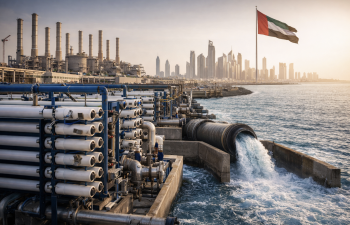
Recent tensions in West Asia have spotlighted the critical role of water desalination plants in the Gulf Cooperation Council (GCC) countries. Following threats by Iran to target desalination infrastructure in retaliation for attacks on its energy sector, the importance of these plants for regional water security has gained global attention. The GCC countries—Bahrain, Kuwait, Oman, Qatar, Saudi Arabia, and the UAE—depend heavily on desalination due to scarce freshwater sources.
Importance of Desalination Plants in the Gulf
The Gulf region has very low rainfall, ranging from 4 to 30 cm annually. It lacks rivers and relies on limited groundwater, mostly non-renewable. Desalination of seawater is vital to meet the water needs of over 57 million people in these countries. Qatar and Bahrain source more than half their water from desalination, while Kuwait and the UAE meet 40-50% of their demand this way. Saudi Arabia and Oman also have high reliance on this technology.
Desalination Infrastructure and Capacity
As of 2018, GCC countries had 172 desalination plants. Oman leads with 65 stations, followed by Saudi Arabia (44), UAE (40), Qatar (9), Kuwait (8), and Bahrain (6). These plants produce about 6,053 billion litres of freshwater annually, with a combined capacity of 22 billion litres per day. Saudi Arabia’s Saline Water Conversion Corporation (SWCC) manages major plants like Ras Al-Khair and Jeddah. The AlKhafji plant is the world’s largest solar-powered desalination facility, producing 90,000 cubic metres daily.
Environmental and Security Concerns
Most plants use reverse osmosis, which generates large volumes of salty brine discharged into the sea, harming marine ecosystems. The geopolitical conflict in West Asia has increased risks to these plants. Iran has warned that attacks on its energy infrastructure will provoke strikes on desalination facilities used by the US and Israel. Recent drone attacks have damaged plants in Bahrain and Iran, raising fears of water shortages and regional instability.
Water Demand and Population Pressure
The GCC population is about 57 million, with Saudi Arabia the most populous (35 million). Rapid urbanisation and economic growth have increased water demand. The scarcity of natural freshwater sources makes desalination indispensable for sustaining life and development in the Gulf region.
Topics for Prelims:
Gulf Cooperation Council (GCC)
- Comprises Bahrain, Kuwait, Oman, Qatar, Saudi Arabia, UAE.
- Region with low rainfall and no major rivers.
- Population about 57 million (2020).
- Hosts key US military bases.
- Relies heavily on desalination for water security.
Desalination Plants in the Gulf
- Total 172 plants as of 2018.
- Oman has the most (65 plants).
- Saudi Arabia’s SWCC runs major plants.
- AlKhafji is world’s largest solar-powered plant.
- Produce over 6,000 billion litres of freshwater yearly.
Water Security and Environmental Concerns
- Reverse osmosis generates harmful brine waste.
- Brine discharged into oceans affects marine life.
- Gulf countries face water scarcity due to low rainfall.
- Geopolitical tensions threaten desalination infrastructure.
- Water demand rising with population and urbanisation.
Questions for Mains:
- Critically analyse the role of desalination technology in addressing water scarcity in arid regions, with examples from the Gulf Cooperation Council countries. [GS-III-Environment & DM]
- Explain the geopolitical significance of water infrastructure in West Asia and its impact on regional security. [GS-II-International Relations]
- With suitable examples, comment on the environmental challenges posed by large-scale desalination plants and suggest sustainable alternatives. [GS-III-Environment & DM]
- What are the implications of population growth and urbanisation on water resources in water-scarce regions? How can policy frameworks address these challenges effectively? [GS-II-Governance]
Answer Hints:
1. Critically analyse the role of desalination technology in addressing water scarcity in arid regions, with examples from the Gulf Cooperation Council countries. [GS-III-Environment & DM]
- GCC countries face extreme water scarcity due to low rainfall (4-30 cm) and absence of rivers; rely heavily on desalination for freshwater.
- 172 desalination plants in GCC (2018); Oman (65), Saudi Arabia (44), UAE (40) leading in infrastructure and capacity.
- Desalination meets >50% water demand in Qatar, Bahrain; 40-50% in Kuwait, UAE; high dependency in Saudi Arabia and Oman.
- Technologies used mainly reverse osmosis and thermal methods; desalination provides reliable, drought-proof water supply in arid zones.
- Example – Saudi Arabia’s SWCC plants (Ras Al-Khair, AlKhafji solar-powered plant) demonstrate scale and innovation in desalination.
- Limitations – high energy consumption, cost, environmental impact (brine discharge), necessitating integrated water management.
2. Explain the geopolitical significance of water infrastructure in West Asia and its impact on regional security. [GS-II-International Relations]
- Water desalination plants critical for GCC countries’ survival; located near coasts hosting key US military bases, making them strategic assets.
- Iran’s threats to target desalination infrastructure in retaliation to attacks on its energy sector show water infrastructure as a security target.
- Recent attacks (e.g., Bahrain desalination plant drone strike) escalate tensions, risk disrupting water supply to millions, affecting civilian life.
- Water infrastructure vulnerability can be exploited in hybrid warfare, impacting regional stability and international relations.
- Control over water resources and infrastructure influences power dynamics between GCC states, Iran, US, and Israel in West Asia.
- Ensuring protection of water infrastructure is key to preventing humanitarian crises and maintaining geopolitical balance.
3. With suitable examples, comment on the environmental challenges posed by large-scale desalination plants and suggest sustainable alternatives. [GS-III-Environment & DM]
- Reverse osmosis desalination produces large volumes of highly saline brine discharged into oceans, harming marine ecosystems and biodiversity.
- Thermal desalination consumes fossil fuel energy, contributing to greenhouse gas emissions and climate change.
- Example – Gulf plants discharge brine into sensitive marine habitats, threatening fisheries and coral reefs.
- Sustainable alternatives include solar-powered desalination (e.g., Saudi Arabia’s AlKhafji plant) to reduce carbon footprint.
- Integrated water resource management – combining desalination with water recycling, rainwater harvesting, and demand management.
- Research into zero-liquid discharge technologies and brine valorization (extracting minerals) can mitigate environmental harm.
4. What are the implications of population growth and urbanisation on water resources in water-scarce regions? How can policy frameworks address these challenges effectively? [GS-II-Governance]
- Population growth and rapid urbanisation increase water demand, straining limited freshwater resources in arid regions like GCC.
- Urban expansion leads to higher domestic, industrial, and agricultural water consumption, escalating pressure on desalination and groundwater.
- Unsustainable groundwater abstraction causes depletion and salinization, threatening long-term water security.
- Effective policy frameworks include promoting water conservation, efficient usage, and pricing reforms to reduce wastage.
- Investment in infrastructure for wastewater treatment and reuse, along with public awareness campaigns, is essential.
- Governance should integrate climate resilience, cross-sector coordination, and incentivize adoption of sustainable technologies (e.g., solar desalination).