
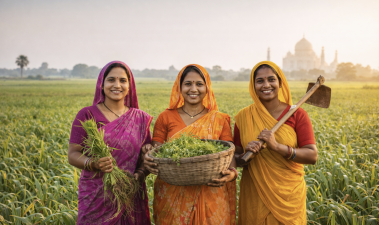
Agriculture remains vital to India’s economy and rural livelihoods. In 2026, the United Nations declared it the International Year of the Woman Farmer (IYWF 2026). This recognises the critical role women play in agriculture globally. In India, 80% of rural women work in agriculture and allied sectors. Their roles span crop production, livestock, agroforestry, fisheries, post-harvest processing, and marketing. The year aims to promote gender-inclusive policies and empower women farmers through access to land, resources, technology, finance, and markets.
Global and National Initiatives Supporting Women Farmers
The Global Conference on Women in Agri-Food Systems (GCWAS-2026) was held in New Delhi in March 2026. It gathered over 700 experts, policymakers, entrepreneurs, and women farmers. The conference focused on gender-responsive policies, women’s leadership, economic inclusion, and climate-smart innovations. It also showcased women-centred technologies and start-ups. The event aimed to create actionable recommendations for inclusive and sustainable agri-food systems.
Key Government Schemes Empowering Women in Agriculture
India’s government promotes women’s participation through multiple schemes: – Agriculture Infrastructure Fund (AIF) – Provides loans with interest subvention for post-harvest infrastructure; over 8,000 projects for women approved. – Integrated Scheme for Agricultural Marketing (ISAM) – Offers subsidies for storage and marketing infrastructure to women farmers. – Namo Drone Didi – Distributes drones to women Self-Help Groups (SHGs) to promote modern farming technology. – National Beekeeping and Honey Mission (NBHM) – Supports women in scientific beekeeping and honey production. – Deendayal Antyodaya Yojana–National Rural Livelihood Mission (DAY-NRLM) – Empowers women through self-employment and training. – Modified Interest Subvention Scheme (MISS) – Provides affordable short-term credit via Kisan Credit Cards. – Mission for Integrated Development of Horticulture (MIDH) – Supports women in horticulture production and post-harvest management. – Pradhan Mantri Kisan Samman Nidhi (PM-KISAN) – Direct income support, with 25% benefits going to women.
Institutional and Community Support for Women Farmers
Several institutions provide training and research to empower women: – MANAGE, Hyderabad – Trains extension workers on gender-inclusive agriculture. – National Gender Resource Centre in Agriculture (NGRCA) – Coordinates gender-focused policies and programmes. – ICAR-Central Institute for Women in Agriculture (CIWA) – Develops women-friendly technologies and farming models. – Farm Machinery Training and Testing Institutes (FMTTIs) – Train women on mechanisation tools. Community-based programmes like Krishi Sakhis (women para-extension workers) provide grassroots support. Mahila Kisan Sashaktikaran Pariyojana (MKSP) and Agricultural Technology Management Agency (ATMA) promote skill development and food security groups. Farmer Producer Organizations (FPOs) unite women farmers for collective production, processing, and marketing, enhancing income and market access.
Transformational Stories and Impact
Women like Kamini Nathsharma from Odisha illustrate the success of integrated farming and training. With limited land, she diversified into vegetables, poultry, and dairy, increasing income and nutrition. Such models inspire rural women and demonstrate how institutional support improves livelihoods and sustainability.
Topics for Prelims:
International Year of the Woman Farmer (IYWF) 2026
- Declared by the United Nations to show women’s role in agriculture.
- Focuses on gender equity in land, resources, technology, and markets.
- Promotes global cooperation and policy reforms.
- Encourages sustainable and inclusive agri-food systems.
- Supports women’s economic empowerment in farming.
Key Government Schemes for Women Farmers in India
- Agriculture Infrastructure Fund (AIF) – Loans with interest subvention for infrastructure.
- Pradhan Mantri Kisan Samman Nidhi (PM-KISAN) – Direct income support.
- Namo Drone Didi – Drone technology for women SHGs.
- Deendayal Antyodaya Yojana (DAY-NRLM) – Poverty alleviation via women’s self-employment.
- Mission for Integrated Development of Horticulture (MIDH) – Supports horticulture sector.
Institutions Supporting Women in Agriculture
- MANAGE – Capacity building for extension professionals.
- NGRCA – National gender coordination in agriculture.
- ICAR-CIWA – Research and women-friendly technologies.
- FMTTIs – Training on farm machinery and mechanisation.
- Krishi Sakhis – Women para-extension workers at grassroots.
Questions for Mains:
- Critically analyse the impact of government schemes like PM-KISAN and Agriculture Infrastructure Fund on women’s empowerment in Indian agriculture. With suitable examples, discuss challenges faced by women farmers in accessing these schemes. [GS-III-Economic Development]
- Point out the role of Farmer Producer Organizations (FPOs) in enhancing women farmers’ income and market access. Estimate the potential of women-led FPOs in transforming rural agricultural economies. [GS-III-Economic Development]
- Underline the importance of gender-responsive agricultural extension services in India. How do programmes like Krishi Sakhis and institutions like ICAR-CIWA contribute to sustainable rural development? [GS-II-Governance]
- With suitable examples, critically analyse how technology adoption (e.g., drones, mechanisation) is reshaping women’s participation in agriculture. What are the socio-economic implications of such changes? [GS-III-Science & Technology]
Answer Hints:
1. Critically analyse the impact of government schemes like PM-KISAN and Agriculture Infrastructure Fund on women’s empowerment in Indian agriculture. With suitable examples, discuss challenges faced by women farmers in accessing these schemes. [GS-III-Economic Development]
- PM-KISAN provides direct income support (Rs 6,000/year) with 25% benefits reaching women, enhancing their economic security.
- Agriculture Infrastructure Fund (AIF) offers loans with interest subvention for post-harvest infrastructure, enabling women farmers to improve storage and reduce losses.
- Examples – Over 8,190 AIF projects sanctioned to women; Rs 1.01 lakh crore disbursed to women under PM-KISAN.
- Challenges include limited land ownership, lack of awareness, digital illiteracy, and procedural complexities in scheme access.
- Social barriers and limited collateral restrict women’s credit access despite subsidies and interest subvention.
- Need for gender-sensitive outreach, simplified procedures, and capacity building to improve scheme uptake by women.
2. Point out the role of Farmer Producer Organizations (FPOs) in enhancing women farmers’ income and market access. Estimate the potential of women-led FPOs in transforming rural agricultural economies. [GS-III-Economic Development]
- FPOs collectivize small, marginal, and landless women farmers for joint production, processing, and marketing, increasing bargaining power.
- Women-led FPOs (1,175 fully women shareholders; 1,084 with 50-99% women members) promote inclusivity and leadership.
- FPOs improve access to credit, technology, inputs, and markets, stabilizing income and reducing exploitation by intermediaries.
- Government support with Rs 6,865 crore budget and equity grants boosts formation and sustainability of FPOs.
- Potential to transform rural economies by enhancing women’s economic participation, encouraging entrepreneurship, and promoting rural employment.
- FPOs enable diversification of livelihoods, value addition, and resilience against market fluctuations.
3. Underline the importance of gender-responsive agricultural extension services in India. How do programmes like Krishi Sakhis and institutions like ICAR-CIWA contribute to sustainable rural development? [GS-II-Governance]
- Gender-responsive extension addresses women farmers’ specific needs, knowledge gaps, and socio-cultural constraints.
- Krishi Sakhis are trained women para-extension workers providing doorstep advisory on natural farming, soil health, and sustainable practices.
- ICAR-CIWA develops women-friendly technologies, drudgery-reducing tools, and gender-sensitive farming models enhancing productivity and livelihoods.
- These initiatives empower women, improve adoption of climate-smart and nutrition-sensitive agriculture, and strengthen rural food security.
- Community-based extension enhances participation, skill development, and leadership among rural women.
- Such services promote inclusive governance, better resource access, and sustainable agricultural development aligned with gender equity.
4. With suitable examples, critically analyse how technology adoption (e.g., drones, mechanisation) is reshaping women’s participation in agriculture. What are the socio-economic implications of such changes? [GS-III-Science & Technology]
- Technologies like drones (Namo Drone Didi Scheme) and mechanisation (FMTTIs training) increase efficiency, reduce drudgery, and expand women’s roles beyond traditional tasks.
- Drone services by women SHGs promote precision agriculture, pest management, and timely interventions enhancing productivity.
- Mechanisation training empowers women to operate farm machinery, improving access to Custom Hiring Centres and reducing gender gaps.
- Socio-economic benefits include increased income, entrepreneurship opportunities, and enhanced decision-making power for women.
- Challenges – digital divide, initial investment costs, and need for sustained training and support.
- Overall, technology adoption encourages empowerment, rural economic growth, and modernization of women’s agricultural participation.