
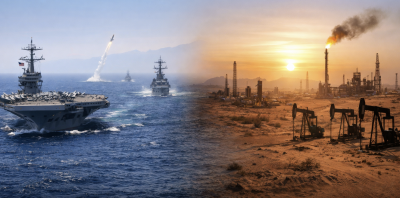
The ongoing conflict in West Asia has brought into light the deep interconnections between the Indo-Pacific region and its western neighbours. For years, Indo-Pacific discussions have focused mainly on East Asian flashpoints like Taiwan and the South China Sea. However, the current crisis reveals that West Asia’s instability directly affects energy security, maritime trade, and geopolitics across the Indo-Pacific.
Energy Security Challenges
About 80% of oil and liquefied natural gas (LNG) passing through the Strait of Hormuz is destined for Asia-Pacific countries. The war has disrupted this flow, threatening affordable and predictable energy supplies. This disruption risks household energy access and complicates inflation control and macroeconomic stability in the region. Nations are now forced to seek alternative supplies, pushing them beyond their comfort zones.
Maritime Trade Disruptions
Shipping costs have surged due to higher insurance premiums and tanker shortages. Delivery delays and adjustments to different crude oil grades have impacted not only fuel but also industries dependent on aviation, fertilisers, petrochemicals, and food supply chains. These ripple effects threaten industrial continuity and production across Indo-Pacific economies.
Geopolitical Repercussions
The conflict has diverted US military focus and assets towards West Asia. This shift has raised concerns among Indo-Pacific allies about weakened deterrence in East Asia. Examples include the redeployment of THAAD missile components from Korea and repositioning of US carriers from Japan to the Gulf. Regional powers like Japan, South Korea, and Southeast Asian countries have adopted emergency energy measures to cope with the crisis. India has maintained naval operations under Operation Sankalp to secure vital maritime routes.
Strategic Implications
The crisis puts stress on the need to integrate West Asia into Indo-Pacific strategies. It calls for accelerated energy diversification with a security focus and enhanced maritime cooperation among India, Japan, Australia, and ASEAN. Some countries with refining flexibility may gain commercial advantages by supplying deficit markets. The Indian Ocean remains central to global power dynamics, linking West Asia to East Asia and Africa.
Topics for Prelims:
Strait of Hormuz
- Key maritime chokepoint in West Asia.
- Over 80% of Gulf oil exports pass through it.
- Vital for Asia-Pacific energy supply.
- Frequent geopolitical tensions affect shipping.
- Disruptions impact global energy prices and trade.
Operation Sankalp
- India’s naval mission in the Gulf of Oman.
- Started after 2019 tanker attacks.
- Aims to protect Indian commercial vessels.
- Ensures maritime security in critical sea lanes.
- Reflects India’s strategic interests in West Asia.
THAAD System
- Terminal High Altitude Area Defense missile system.
- US deployed in South Korea for missile defence.
- Redeployed partially to West Asia amid crisis.
- Key in regional deterrence strategies.
- Its movement signals shifting US military priorities.
Questions for Mains:
- Critically analyse the impact of West Asian conflicts on Indo-Pacific energy security and economic stability. [GS-III-Economic Development]
- Explain the strategic importance of the Strait of Hormuz and its implications for maritime security in the Indo-Pacific region. [GS-III-Internal & External Security]
- With suitable examples, comment on how shifting US military focus affects regional security dynamics in East Asia and West Asia. [GS-II-International Relations]
- What are the challenges and opportunities in enhancing maritime cooperation among Indo-Pacific countries to secure critical sea lanes? Underline the role of India in this context. [GS-II-Governance]
Answer Hints:
1. Critically analyse the impact of West Asian conflicts on Indo-Pacific energy security and economic stability. [GS-III-Economic Development]
- Dependence on Strait of Hormuz – ~80% of Gulf oil and LNG exports to Asia-Pacific pass through it, making energy supply vulnerable.
- Energy supply disruption – Causes volatility in oil prices, inflationary pressures, and threatens household energy access.
- Macroeconomic instability – Inflation control difficulties, increased production costs, and risk to industrial continuity.
- Shift to alternative suppliers – Raises costs, supply uncertainties, and pressures energy diversification efforts.
- Ripple effects beyond energy – Impact on aviation, fertilisers, petrochemicals, and food supply chains due to shipping delays and higher insurance.
- Long-term strategic lesson – Need to integrate energy security with geopolitical stability and renewables investment under a security lens.
2. Explain the strategic importance of the Strait of Hormuz and its implications for maritime security in the Indo-Pacific region. [GS-III-Internal & External Security]
- Key global chokepoint – Connects Persian Gulf to Arabian Sea and Indian Ocean, critical for energy exports.
- ~80% of Gulf oil exports and LNG pass through it, vital for Asia-Pacific economies.
- Frequent geopolitical flashpoint – Regional conflicts and tensions threaten free passage.
- Disruptions affect global energy prices, supply chains, and industrial production in Indo-Pacific.
- Necessitates enhanced maritime security cooperation among Indo-Pacific nations.
- Ensuring safe navigation essential for regional economic stability and strategic balance.
3. With suitable examples, comment on how shifting US military focus affects regional security dynamics in East Asia and West Asia. [GS-II-International Relations]
- US redeployment of assets – THAAD components moved from Korean Peninsula; carriers shifted from Japan to Gulf.
- Perceived dilution of deterrence in East Asia, raising concerns among allies like South Korea and Japan.
- Increased US focus on West Asia due to ongoing conflicts, energy security, and geopolitical interests.
- Regional responses – Japan tapping strategic reserves, South Korea increasing nuclear and coal power use, Southeast Asia adopting fuel-saving measures.
- India’s Operation Sankalp reflects regional efforts to fill security gaps and protect maritime interests.
- Shift marks interconnectedness of Indo-Pacific and West Asia security environments.
4. What are the challenges and opportunities in enhancing maritime cooperation among Indo-Pacific countries to secure critical sea lanes? Underline the role of India in this context. [GS-II-Governance]
- Challenges – Diverse political interests, trust deficits, varying naval capabilities, and external power competition.
- Opportunities – Shared interest in securing sea lanes, joint exercises, intelligence sharing, and coordinated patrols.
- India’s role – Leading Operation Sankalp, sustaining naval presence in Gulf, and encouraging cooperation with Japan, Australia, ASEAN.
- Enhances regional stability, safeguards trade routes, and counters threats like piracy and blockade risks.
- Maritime cooperation supports economic continuity and geopolitical balance in Indo-Pacific.
- Potential for selective commercial gains through refining/export flexibility amidst crisis-induced trade shifts.