
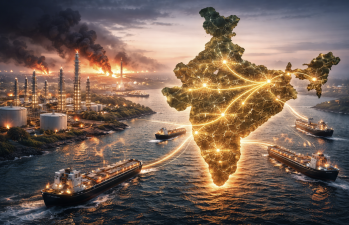
Recent military operations in the Persian Gulf have raised concerns about India’s energy supplies. The region is crucial as it provides a large share of India’s oil and gas imports. The conflict has led to a blockade of the Strait of Hormuz, a vital shipping route, affecting the flow of energy resources. This situation demands close monitoring due to its potential impact on India’s economy and energy security.
India’s Dependence on Persian Gulf Energy
India imports about 90% of its LPG, 40% of LNG, and 35% of crude oil from the Persian Gulf. With reduced oil imports from Russia, dependence on the Gulf is expected to increase. The Strait of Hormuz is the main passage for these shipments. Current military tensions have halted shipping through this route temporarily. India holds stockpiles to manage short-term disruptions. A prolonged blockade, however, could cause supply issues and price spikes.
Strait of Hormuz and Global Energy Flow
The Strait of Hormuz handles nearly 25% of the world’s oil and gas supply. Any closure disrupts global energy markets. Past conflicts, like the 1980s Tanker War, showed that despite attacks on vessels, global flow was maintained through military protection. Today’s technological advances improve surveillance and defence but also increase risks. Restoring safe navigation is a priority for all stakeholders to avoid long-term economic damage.
Alternatives and Mitigation Measures
There are limited alternatives to the Strait of Hormuz. Saudi Arabia can reroute crude oil via a pipeline from the Persian Gulf to the Red Sea. However, exports through the Red Sea face threats from regional conflicts. LPG and LNG cannot be easily diverted due to their special transport needs. Global spare production capacity and upcoming LNG projects may help reduce long-term risks but cannot replace the Gulf supplies immediately.
Potential Long-Term Effects
So far, attacks on Gulf production facilities are minimal. Major damage would be needed to disrupt supply . The global oil market has a buffer of 3-4 million barrels per day in spare capacity. New LNG projects in the US and other countries will add supplies soon. However, prolonged conflict or internal instability in Iran could worsen the situation. Political developments in Iran will heavily influence the conflict’s duration and impact.
Topics for Prelims:
Strait of Hormuz
- Vital shipping route between Persian Gulf and Gulf of Oman.
- Handles about 25% of global oil and gas trade.
- Blockades disrupt global energy markets.
- Strategically important for global economy.
- Past conflicts like Tanker War affected shipping security.
India’s Energy Imports
- 90% of LPG imports from Persian Gulf.
- 40% of LNG imports from Persian Gulf.
- 35% of crude oil imports from Persian Gulf.
- Stockpiles maintained for short-term supply disruptions.
- Increasing dependence due to reduced Russian oil imports.
Alternatives to Strait of Hormuz
- Saudi pipeline from Ras Tanura to Yanbu on Red Sea.
- Limited use due to regional security threats.
- No alternative routes for LPG and LNG due to transport needs.
- Global spare capacity helps mitigate supply shocks.
- New LNG projects expected to increase supply soon.
Questions for Mains:
- Estimate the impact of disruptions in the Strait of Hormuz on India’s energy security and analyse India’s strategic options to mitigate such risks. [GS-III-Economic Development]
- Critically discuss the role of geopolitical conflicts in the Persian Gulf in shaping global energy markets and examine their implications for India’s foreign policy. [GS-II-International Relations]
- Point out the challenges and opportunities in diversifying India’s energy import sources and how it aligns with India’s energy security goals. [GS-III-Economic Development]
- Analyse the significance of the Strait of Hormuz in global trade and energy security and examine the potential consequences of its prolonged closure. [GS-I-World & Physical Geography]
Answer Hints:
1. Estimate the impact of disruptions in the Strait of Hormuz on India’s energy security and analyse India’s strategic options to mitigate such risks. [GS-III-Economic Development]
- India imports 90% of LPG, 40% of LNG, and 35% of crude oil from the Persian Gulf, mainly via the Strait of Hormuz.
- Disruptions cause immediate supply stoppages, leading to price spikes despite existing stockpiles that cover short-term needs.
- Prolonged blockade risks physical scarcity, affecting industrial, transport, and household energy consumption.
- Strategic mitigation options include maintaining strategic petroleum reserves and diversifying suppliers.
- Limited alternatives to the Strait exist; Saudi pipeline to Red Sea is constrained by regional security issues; LNG/LPG rerouting is difficult.
- Enhancing diplomatic engagement to ensure safe navigation and investing in renewable energy to reduce import dependence are long-term strategies.
2. Critically discuss the role of geopolitical conflicts in the Persian Gulf in shaping global energy markets and examine their implications for India’s foreign policy. [GS-II-International Relations]
- Persian Gulf conflicts disrupt a vital artery handling ~25% of world oil and gas, causing global price volatility and supply uncertainty.
- Past conflicts (e.g., Tanker War) showed military and diplomatic efforts maintain flow despite hostilities.
- Geopolitical tensions influence global energy security, compelling India to balance relations with Gulf countries, Iran, US, and Russia.
- India’s foreign policy focuses on safeguarding energy imports while maintaining strategic autonomy and regional stability.
- Conflict-induced price shocks affect India’s economy, necessitating proactive diplomacy and multilateral engagement for conflict resolution.
- India must hedge risks by strengthening ties with alternate suppliers and participating in global energy governance forums.
3. Point out the challenges and opportunities in diversifying India’s energy import sources and how it aligns with India’s energy security goals. [GS-III-Economic Development]
- Challenges – Heavy dependence on Persian Gulf; limited pipeline and transport alternatives for LNG/LPG; geopolitical risks in alternate regions.
- Opportunities – Increasing imports from Russia (though fluctuating), US, Africa, and Central Asia; expanding domestic renewable energy capacity.
- Diversification reduces vulnerability to regional disruptions and price shocks, enhancing energy security.
- Development of strategic petroleum reserves and infrastructure for alternate supply routes supports diversification.
- Aligns with India’s goals of affordable, reliable, and sustainable energy supply for economic growth.
- Requires policy focus on investment, technology, and international cooperation to realize diversification benefits.
4. Analyse the significance of the Strait of Hormuz in global trade and energy security and examine the potential consequences of its prolonged closure. [GS-I-World & Physical Geography]
- Strait of Hormuz is a narrow chokepoint linking Persian Gulf to Gulf of Oman, handling about 25% of global oil and gas exports.
- Its strategic location makes it critical for global energy markets and international trade routes.
- Prolonged closure would severely disrupt global energy supply, causing price spikes and economic instability worldwide.
- Global spare production capacity and alternative supply routes are limited and cannot fully compensate quickly.
- Long-term closure could trigger geopolitical realignments, increased military presence, and intensified regional conflicts.
- Ensuring safe navigation remains a top priority for global economic stability and energy security strategies.