
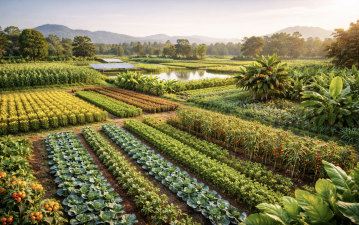
Indian agriculture is facing a critical moment in 2026. NITI Aayog Member Ramesh Chand has urged farmers to reduce the cultivation of paddy and wheat. These crops have dominated farming since the Green Revolution but now pose environmental and economic challenges. The call aims to promote crop diversification for sustainability and better resource use.
Overdependence on Paddy and Wheat
Since the 1960s, paddy and wheat acreage grew from 36 million hectares to 85 million hectares by 2024-25. These two crops now cover about 38% of India’s gross cropped area. They consume a large share of water, fertilisers, pesticides, electricity, and subsidies. Paddy and wheat absorb 56% of subsidised urea fertiliser. Excessive use harms soil health and increases environmental risks. Irrigation for these crops is heavily groundwater-dependent, causing water tables to fall sharply in states like Punjab, Haryana, Maharashtra, Gujarat, and Tamil Nadu.
Environmental and Fiscal Impacts
The high water requirement of paddy and wheat strains groundwater resources. Over 95% of wheat and 69% of paddy areas are irrigated. Falling groundwater levels force farmers to use more electricity for pumping water. This increases electricity subsidies, costing the government about ₹90,000 crore annually. Heavy pesticide use raises health and environmental concerns. Soil degradation and water contamination are widespread in regions growing these crops intensively.
Policy Bias and Procurement Support
The Minimum Support Price (MSP) system mainly favours paddy and wheat. Between 2014-15 and 2024-25, ₹20.20 lakh crore was spent on procuring these crops compared to ₹93,554 crore on pulses. This skews incentives, discouraging farmers from growing pulses, oilseeds, and coarse cereals. These other crops are more resource-efficient and nutritionally beneficial but lack reliable procurement support.
Need for Crop Diversification and Sustainable Farming
India must shift towards nutrient-rich, water-efficient crops like millets, pulses, and oilseeds. These crops improve soil health and reduce pressure on water and subsidies. Diversification also addresses nutritional deficiencies by providing proteins, vitamins, and minerals. The government should signal a gradual reduction in MSP and input subsidies for paddy and wheat over 5 to 10 years. This would encourage farmers to adopt sustainable cropping patterns with assured procurement support.
Topics for Prelims:
Paddy and Wheat Cultivation in India
- Green Revolution led to paddy and wheat dominance.
- These crops cover 38% of cropped area as of 2024-25.
- Consume 56% of subsidised urea fertiliser.
- Require heavy irrigation, mainly groundwater-based.
- Lead to soil degradation and groundwater depletion.
Minimum Support Price (MSP) and Crop Procurement
- MSP system mainly supports paddy and wheat.
- ₹20.20 lakh crore spent on paddy and wheat procurement (2014-25).
- Pulses and oilseeds receive minimal procurement support.
- Procurement bias influences cropping patterns.
- Calls for MSP rationalisation to promote diversification.
Environmental Impact of Crop Choices
- Paddy is highly water-intensive; wheat also requires irrigation.
- Excess fertiliser and pesticide use harm soil and water.
- Groundwater depletion in Punjab, Haryana, Maharashtra, Gujarat, Tamil Nadu.
- Electricity subsidies rise due to deeper groundwater pumping.
- Diversification can reduce environmental and fiscal stress.
Questions for Mains:
- Critically analyse the environmental and economic consequences of India’s reliance on paddy and wheat cultivation. Suggest policy measures to address these issues. [GS-III-Economic Development]
- Comment on the role of the Minimum Support Price system in shaping cropping patterns in India and its impact on agricultural sustainability. [GS-II-Governance]
- Explain the importance of crop diversification in Indian agriculture and its potential benefits for food security and environmental conservation. Illustrate with examples. [GS-III-Environment & DM]
- With suitable examples, underline the challenges of groundwater depletion in India and evaluate the link between agricultural practices and water management policies. [GS-III-World & Physical Geography]
Answer Hints:
1. Critically analyse the environmental and economic consequences of India’s reliance on paddy and wheat cultivation. Suggest policy measures to address these issues. [GS-III-Economic Development]
- Over 38% of cropped area dedicated to paddy and wheat, causing resource overuse.
- High water consumption leading to groundwater depletion, especially in Punjab, Haryana, Tamil Nadu.
- Excessive use of subsidised urea fertilizer (56% share) and pesticides causes soil degradation and environmental pollution.
- Rising electricity subsidies (~₹90,000 crore annually) due to deeper groundwater pumping for irrigation.
- Economic burden on government due to skewed subsidies and procurement towards these crops.
- Policy measures – promote crop diversification, rationalise MSP and input subsidies, enhance procurement support for pulses, millets, and oilseeds, and incentivise sustainable farming practices.
2. Comment on the role of the Minimum Support Price system in shaping cropping patterns in India and its impact on agricultural sustainability. [GS-II-Governance]
- MSP system heavily biased towards paddy and wheat, encouraging their dominance.
- ₹20.20 lakh crore spent on paddy and wheat procurement (2014-25) vs ₹93,554 crore on pulses.
- This procurement bias discourages cultivation of nutrient-rich, resource-efficient crops like pulses and millets.
- Leads to environmental stress due to over-cultivation of water and input-intensive crops.
- Need for MSP rationalisation and transparent policy signalling to gradually reduce support for paddy/wheat.
- Strengthening procurement for diversified crops to promote sustainability and farmer income diversification.
3. Explain the importance of crop diversification in Indian agriculture and its potential benefits for food security and environmental conservation. Illustrate with examples. [GS-III-Environment & DM]
- Diversification reduces dependency on paddy and wheat, lowering pressure on groundwater and fertilizers.
- Crops like millets, pulses, and oilseeds are water-efficient and improve soil health by nitrogen fixation and reduced chemical use.
- Enhances nutritional security by providing proteins, vitamins, and minerals (e.g., pulses for protein, millets for micronutrients).
- Reduces environmental degradation by lowering pesticide use and preventing soil contamination.
- Improves farmers’ income resilience by diversifying market risks and input costs.
- Example – Increased millet cultivation in dry regions reduces water use and improves livelihoods.
4. With suitable examples, underline the challenges of groundwater depletion in India and evaluate the link between agricultural practices and water management policies. [GS-III-World & Physical Geography]
- Groundwater levels have declined sharply in Punjab, Haryana, Maharashtra, Gujarat, and Tamil Nadu due to intensive irrigation for paddy and wheat.
- Over 95% wheat and 69% paddy areas are irrigated, heavily reliant on groundwater extraction.
- Excessive groundwater pumping increases electricity consumption and subsidies, creating fiscal stress.
- Current water management policies incentivise water-intensive cropping through free/subsidised power and procurement support.
- Need for integrated water management policies promoting efficient irrigation (drip, micro-irrigation) and crop diversification.
- Example – Punjab’s groundwater crisis linked to paddy cultivation and power subsidies; policy reforms needed to encourage sustainable water use.