
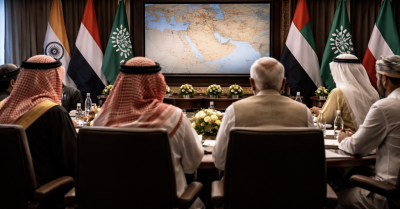
India’s position in the 2026 Gulf war has sparked debate on whether it has tilted towards one side. Traditionally, India’s foreign policy was based on non-alignment, meaning it would not join blocs but take independent stands on issues. However, India’s record shows a complex pattern of sometimes supporting one side, sometimes shifting positions with government changes.
India’s Non-Alignment and Foreign Policy
India’s non-alignment was never strict neutrality. It allowed India to judge each conflict independently. During the Cold War, India often criticised the West but was cautious about condemning the Soviet Union. This was due to strategic ties with Russia, especially for security. India’s muted response to Soviet invasions in Hungary, Czechoslovakia, and Afghanistan showed this ambivalence. Yet brief deviations occurred, such as India’s initial criticism of the Soviet invasion of Afghanistan in 1979 under the Janata government.
Historical Shifts in India’s Middle East Policy
India’s stance on Middle East conflicts has been shaped by strategic and economic interests. In the 1950s, India supported China’s position during the Korean War to build Asian partnerships. In 1990, India avoided condemning Iraq’s invasion of Kuwait because Iraq was a key oil supplier and supported India on Pakistan-related issues. India’s Middle East policy has balanced US-Arab tensions and Israel-Arab disputes, often overlooking internal regional rivalries like those between Gulf Arabs and Iran.
India’s Current Stakes in the Gulf
India’s current approach is driven by deep economic and social ties with the Gulf. Trade with the Gulf is about $200 billion annually. Nearly nine million Indians live and work there. Energy dependence and citizen safety are top priorities. India’s security and prosperity are now closely linked with the Gulf Arab states. This interdependence shapes Delhi’s diplomatic choices in the ongoing Gulf conflict.
Challenges Ahead for India
India must manage its complex ties with the Gulf amid shifting alliances and regional rivalries. Balancing relations with the US, Gulf states, Russia, and Iran requires careful diplomacy. India’s foreign policy will continue evolving as its stakes in the Middle East grow. About historical shifts and current realities is key to analysing India’s role in global conflicts.
Topics for Prelims:
India’s Non-Alignment Policy
- Founded post-Independence to avoid Cold War blocs.
- Allowed independent judgement on international issues.
- Often criticised the West but was cautious on Soviet actions.
- Shifted positions with changes in government.
- Not strict neutrality but flexible diplomacy.
India-Gulf Relations
- Trade worth around $200 billion annually.
- Nearly nine million Indians work in Gulf states.
- Gulf is a major energy supplier to India.
- Strategic interdependence in security and economy.
- Diplomatic balancing act amid regional conflicts.
Cold War Era Conflicts and India
- India’s muted response to Soviet invasions in Hungary, Czechoslovakia, Afghanistan.
- Janata government briefly criticised Soviet Afghanistan invasion.
- Supported China during Korean War intervention.
- Shifted position on Cambodia to counter China via Vietnam.
- Foreign policy influenced by anti-colonial sentiments and strategic needs.
Questions for Mains:
- Critically discuss the evolution of India’s non-alignment policy and its impact on India’s foreign relations during the Cold War. [GS-II-Constitution of India & Polity]
- Analyse India’s strategic interests in the Gulf region and how they shape its contemporary foreign policy. Examine the challenges arising from regional rivalries in the Middle East. [GS-II-International Relations]
- Estimate the role of economic interdependence in shaping India’s diplomatic stance in conflict zones, with reference to the Gulf crisis. Discuss the implications for India’s energy security. [GS-III-Economic Development]
- Point out the ethical dilemmas faced by India in balancing moral positions and strategic interests in international conflicts. How should India navigate these dilemmas in future foreign policy decisions? [GS-IV-Ethics, Integrity and Aptitude]
Answer Hints:
1. Critically discuss the evolution of India’s non-alignment policy and its impact on India’s foreign relations during the Cold War. [GS-II-Constitution of India & Polity]
- Non-alignment defined as independent judgement, not strict neutrality or bloc abstention.
- Early post-Independence emphasis on avoiding Cold War polarization, promoting peaceful coexistence.
- Consistent criticism of Western powers, rooted in anti-colonial sentiment and Cold War contradictions.
- Reluctance to condemn Soviet actions (Hungary 1956, Czechoslovakia 1968, Afghanistan 1979) due to strategic reliance on USSR.
- Policy shifts with government changes – Janata government’s brief criticism of USSR vs. Congress’s pro-Moscow stance.
- Impacted relations by balancing ties with superpowers, maintaining strategic autonomy but inviting accusations of double standards.
2. Analyse India’s strategic interests in the Gulf region and how they shape its contemporary foreign policy. Examine the challenges arising from regional rivalries in the Middle East. [GS-II-International Relations]
- India’s $200 billion annual trade and energy dependence on Gulf states shape policy priorities.
- Nearly 9 million Indian expatriates in Gulf create socio-political stakes in regional stability.
- Strategic interdependence with Gulf Arab states makes their security integral to India’s prosperity.
- India balances relations amid US-Gulf security ties and evolving Israel-Arab normalisation.
- Challenges include managing rivalries between Gulf Arabs and Iran, and conservative monarchies vs. republican Islamic forces.
- Policy constrained by need to maintain cordial ties with conflicting regional powers and external actors like the US and Russia.
3. Estimate the role of economic interdependence in shaping India’s diplomatic stance in conflict zones, with reference to the Gulf crisis. Discuss the implications for India’s energy security. [GS-III-Economic Development]
- Economic stakes in Gulf (trade, remittances, energy imports) drive cautious diplomatic positions.
- India’s reluctance to take sides reflects priority on protecting trade routes and diaspora safety.
- Energy security depends heavily on uninterrupted Gulf oil and gas supplies.
- Conflict-induced instability threatens energy prices and supply chains, impacting India’s growth.
- Economic interdependence necessitates balancing competing regional interests, limiting overt condemnation or alignment.
- Long-term implication – need for diversified energy sources and resilient foreign policy to safeguard economic interests.
4. Point out the ethical dilemmas faced by India in balancing moral positions and strategic interests in international conflicts. How should India navigate these dilemmas in future foreign policy decisions? [GS-IV-Ethics, Integrity and Aptitude]
- Conflict between upholding universal norms (e.g., sovereignty, human rights) and protecting strategic interests (security, economy).
- Historical ambivalence towards Soviet actions vs. strong moral critiques of the West reflects ethical double standards.
- Balancing diaspora safety and economic ties against condemnation of aggression creates moral complexity.
- Ethical dilemma intensified by India’s aspiration as a responsible global actor versus pragmatic diplomacy.
- Future navigation requires transparency, consistent principles aligned with international law, and calibrated diplomacy.
- Emphasize multilateral engagement, conflict resolution, and long-term strategic autonomy to reconcile ethics with interests.