
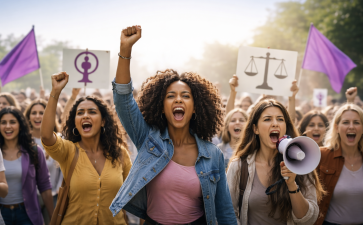
International Women’s Day (IWD) is celebrated globally every year on 8 March. In 2026, the United Nations (UN) marked the day with the theme Rights, Justice, Action – For All Women and Girls. This theme marks the ongoing struggle for women’s equality and justice worldwide. However, the current global scenario of conflicts, displacement, and political instability makes achieving these goals difficult. Women and children remain the most vulnerable groups affected by wars and crises.
Impact of Conflicts on Women and Children
Wars and conflicts continue to rage in many regions. These situations cause severe harm to women and children. They face increased gender-based violence, food shortages, forced displacement, loss of livelihood, and disruption of education and healthcare. Sexual violence is often used as a weapon of war to intimidate and humiliate. Mental health issues like depression and anxiety are common among survivors. Women’s voices are often excluded from peace negotiations and rebuilding efforts, limiting their role in shaping solutions.
International Efforts and Challenges
The UN Security Council adopted Resolution 1325 on Women, Peace, and Security in 2000. It called for the protection of women in conflicts and their active involvement in peace processes. Despite this, many countries have failed to implement effective national action plans. The gap between promises and ground realities remains wide. In many conflict zones, conditions for women and children have worsened, with growing inequality and weakened institutions.
The Significance of International Women’s Day 2026
IWD serves as a platform to celebrate women’s achievements and demand urgent actions for gender equality. The 2026 theme emphasises that rights and justice are not privileges but fundamental human rights. It calls for concrete steps to protect women and girls, especially in conflict-affected areas. The day also reminds the world of the need to include women in peacebuilding and governance for lasting solutions.
Key Areas for Focus
– Ending gender-based violence in conflict zones – Ensuring access to education and healthcare for displaced women and children – Strengthening legal and social institutions to protect women’s rights – Promoting women’s participation in peace negotiations and governance
Topics for Prelims:
United Nations Security Council Resolution 1325
- Adopted unanimously on 31 October 2000.
- Focuses on women’s protection in armed conflicts.
- Calls for women’s participation in peace processes.
- Encourages national action plans by member states.
- Implementation remains uneven globally.
Impact of Armed Conflict on Women and Children
- Increased risk of gender-based violence.
- Forced displacement and loss of livelihood.
- Disruption of education and healthcare services.
- Use of sexual violence as a war tactic.
- Mental health challenges like PTSD and anxiety.
International Women’s Day
- Observed annually on 8 March worldwide.
- Officially recognised by the UN since 1977.
- Originated from early 20th-century labour movements.
- Focuses on women’s rights, achievements, and equality.
- 2026 theme – Rights, Justice, Action – For All Women and Girls.
Questions for Mains:
- Discuss the role of United Nations Security Council Resolution 1325 in promoting women’s participation in peacebuilding and its challenges in implementation. [GS-II-International Relations]
- Critically examine the impact of armed conflicts on gender equality and women’s rights globally, with examples from recent conflicts. [GS-I-Modern World History]
- Explain how political instability affects the protection of women’s rights and access to essential services in conflict zones. Discuss with examples. [GS-II-Governance]
- With suitable examples, discuss the importance of International Women’s Day in advancing gender justice and the challenges it faces in conflict-affected regions. [GS-I-Indian Society]
Answer Hints:
1. Discuss the role of United Nations Security Council Resolution 1325 in promoting women’s participation in peacebuilding and its challenges in implementation. [GS-II-International Relations]
- UNSCR 1325 (2000) emphasizes protection of women in armed conflicts and their active role in peace processes.
- Calls for inclusion of women in peace negotiations, post-conflict reconstruction, and decision-making bodies.
- Encourages member states to develop National Action Plans for implementing the resolution.
- Challenges include lack of political will, insufficient funding, and cultural resistance to women’s participation.
- Many countries show poor implementation; women remain sidelined in peace talks and reconstruction.
- Gap between commitments and ground realities leads to continued gender-based violence and exclusion.
2. Critically examine the impact of armed conflicts on gender equality and women’s rights globally, with examples from recent conflicts. [GS-I-Modern World History]
- Armed conflicts increase gender-based violence, including rape used as a weapon of war (e.g., conflicts in DRC, Syria).
- Forced displacement disrupts women’s access to education, healthcare, and livelihood.
- Conflict zones witness breakdown of social support systems, worsening inequalities.
- Mental health issues like PTSD, anxiety, and depression rise among women survivors.
- Women’s exclusion from peace processes reduces their ability to influence protective policies.
- Example – Syrian civil war and Ukraine conflict show intensified risks and rights violations for women and girls.
3. Explain how political instability affects the protection of women’s rights and access to essential services in conflict zones. Discuss with examples. [GS-II-Governance]
- Political instability weakens governance and legal institutions protecting women’s rights.
- Essential services like healthcare, education, and social welfare become inaccessible or disrupted.
- Women and children face increased vulnerability to violence, exploitation, and poverty.
- Example – Afghanistan post-Taliban takeover saw severe rollback of women’s rights and education access.
- Instability leads to displacement, further limiting women’s mobility and access to support.
- Weak law enforcement allows impunity for gender-based violence and human rights abuses.
4. With suitable examples, discuss the importance of International Women’s Day in advancing gender justice and the challenges it faces in conflict-affected regions. [GS-I-Indian Society]
- International Women’s Day (IWD) marks women’s achievements and calls for gender equality globally.
- UN theme 2026 – Rights, Justice, Action stresses fundamental human rights for all women and girls.
- Acts as a platform to raise awareness about ongoing discrimination and violence, especially in conflict zones.
- Challenges include ongoing wars, displacement, and political instability limiting real progress.
- Example – Women in war-torn regions (e.g., Syria, Yemen) face exclusion despite global advocacy.
- IWD promotes inclusion of women in peacebuilding and governance for sustainable change.