
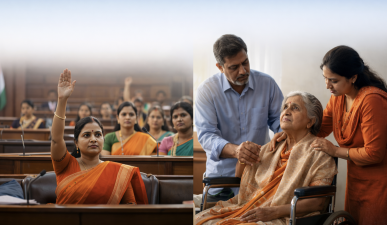
India is set to have its most gender-representative Parliament in 2029. The Women’s Reservation Act will reserve one-third of Lok Sabha seats for women. This is the largest expansion of political representation in India’s history. However, representation alone is not enough. The issues important to women must be clearly defined and pushed into political priority now, not after 2029. One critical issue is elder care, especially for women, which lacks a clear policy framework.
Women’s Reservation Act And Political Representation
The Act reserves 33% of Lok Sabha seats for women by 2029. This will increase women’s presence in Parliament . But mere presence does not ensure change. Women representatives need to have clear agendas. Political parties must prepare candidates who understand women’s full life cycle issues. These include elder care, health, and economic security. Without this, the Act will not fulfil its promise.
Challenges Of Elder Care For Women In India
India’s elderly population is growing fast. Over 100 million people are above 60 years now. By 2040, this will cross 250 million. Women live longer but face more hardships. They have less savings, fewer assets, and broken work histories. Many live alone without caregivers. Current policies like the National Policy for Older Persons and pension schemes do not address gender-specific needs. Women’s elder care remains invisible in public policy.
State Initiatives And The Need For Political Will
Maharashtra’s menopause clinics show how states can act fast when they recognise women’s health needs. Over 31,000 women accessed these clinics in five weeks. This success marks the demand for elder care services too. Political parties must include elder care in manifestos. They should use gender- and age-disaggregated data for policy planning. Transparent budgets and public commitments are essential.
Preparing For The 2029 Parliament
Political parties are preparing women candidates for reserved seats. But these candidates must be ready to address elder care and ageing with dignity. Voters like Gauri, caring for elderly parents, expect Parliament to prioritise these issues. The next three years are crucial to build awareness and policy frameworks. This will ensure that the most representative Parliament delivers meaningful change.
Topics for Prelims:
Women’s Reservation Act
- Reserves one-third Lok Sabha seats for women by 2029.
- Largest political representation expansion in India.
- Requires political agenda beyond representation.
- Candidate preparation crucial for impact.
- Supports gender equality in politics.
Elder Care in India
- India’s elderly population to exceed 250 million by 2040.
- Women live longer but face economic insecurity.
- National Policy for Older Persons lacks gender focus.
- Dementia affects 8.8 million elderly, mostly women.
- State support and public infrastructure for elder care needed.
Maharashtra’s Menopause Clinics
- Launched in 580 government facilities in 2026.
- Over 31,000 women accessed clinics in five weeks.
- Result of decades of advocacy for women’s health.
- Demonstrates state’s role in addressing women’s issues.
- Model for elder care policy initiatives.
Questions for Mains:
- Critically analyse the impact of the Women’s Reservation Act on gender equality in Indian politics and its potential limitations. [GS-II-Constitution of India & Polity]
- Explain the challenges of elder care in India with a focus on gender disparities and suggest policy measures to address them. [GS-III-Economic Development]
- With suitable examples, comment on the role of state governments in advancing women’s health and social welfare in India and how it complements central policies. [GS-II-Governance]
- What are the implications of an ageing population on India’s socio-economic fabric? Critically analyse how political representation can influence policy priorities in this context. [GS-III-Economic Development]
Answer Hints:
1. Critically analyse the impact of the Women’s Reservation Act on gender equality in Indian politics and its potential limitations. [GS-II-Constitution of India & Polity]
- Reserves one-third of Lok Sabha seats for women by 2029, largest such expansion in India’s history.
- Increases women’s political representation, promoting gender equality in politics.
- Presence alone insufficient; requires women representatives with clear agendas addressing women’s issues.
- Potential limitation – political parties may field women candidates without empowerment or issue awareness.
- Does not guarantee intersectional representation (caste, class, region) or address deeper socio-political barriers.
- Success depends on preparatory work—candidate training, political will, and public awareness before 2029.
2. Explain the challenges of elder care in India with a focus on gender disparities and suggest policy measures to address them. [GS-III-Economic Development]
- India’s elderly population is rapidly growing; expected to cross 250 million by 2040.
- Women live longer but face economic insecurity – lower savings, broken employment, no assets in own name.
- Existing policies (National Policy for Older Persons, pension schemes) lack gender sensitivity.
- High prevalence of dementia among elderly, disproportionately affecting women living alone.
- Policy measures – gender-sensitive elder care framework, public infrastructure for elder care, caregiver support systems.
- Use age- and gender-disaggregated data, transparent budget allocations, and integrate elder care in political manifestos.
3. With suitable examples, comment on the role of state governments in advancing women’s health and social welfare in India and how it complements central policies. [GS-II-Governance]
- State governments can act swiftly and innovatively, as Maharashtra did by launching menopause clinics in 580 facilities in 2026.
- Over 31,000 women accessed these clinics in five weeks, showing latent demand and effective state intervention.
- Such initiatives complement central policies by addressing specific local needs and gaps.
- States serve as laboratories for social welfare models that can be scaled nationally.
- Effective state action requires political will, advocacy, and resource allocation aligned with central schemes.
- Example shows how state-level recognition of women’s health issues can catalyse broader policy focus on elder care and dignity.
4. What are the implications of an ageing population on India’s socio-economic fabric? Critically analyse how political representation can influence policy priorities in this context. [GS-III-Economic Development]
- Ageing population increases demand for healthcare, pensions, elder care infrastructure, and social security.
- Women disproportionately affected due to longer life expectancy but greater economic and social vulnerabilities.
- Strain on families and public resources without adequate policy support.
- Political representation (especially women) can prioritize ageing and elder care in legislative agendas.
- Women representatives with lived experience can push for gender-sensitive policies and budget transparency.
- Without informed representation, elder care remains invisible in Parliament, delaying policy action despite demographic urgency.