
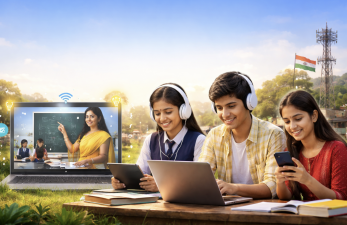
India’s PM e-Vidya initiative has become a key digital education platform. Launched in 2020 during the COVID-19 lockdown, it ensures learning continuity for over 24 crore school children and millions of higher education students. The programme aligns with the National Education Policy 2020 (NEP 2020), aiming for inclusive, technology-enabled education for all learners, including those in remote areas and with special needs.
Background and Evolution
PM e-Vidya started as an emergency response in May 2020. It combined TV, radio, and online platforms to reach students during school closures. Later, it was formalised under Atmanirbhar Bharat Abhiyan. The initiative integrates multiple government digital education efforts like DIKSHA, SWAYAM, and SWAYAM Prabha. It builds on earlier schemes such as Digital India and NMEICT, creating a unified digital education infrastructure.
Key Components and Platforms
PM e-Vidya has six main pillars – – SWAYAM – Offers 4,400+ free online courses with video lectures, reading materials, quizzes, and forums. It supports credit transfer in universities. – SWAYAM Prabha – 48 DTH TV channels broadcasting educational content, including a special Indian Sign Language (ISL) channel. – DIKSHA – A national portal with curriculum-linked digital content for K-12 students and teachers, including interactive and accessible resources. – Radio and Podcasts – Mukta Vidya Vani web radio and Shiksha Vani podcasts provide curriculum-based audio learning. – Special Content for Children with Special Needs (CwSN) – Inclusive materials like DAISY audiobooks, ISL videos, tactile maps, and accessible e-books. – SATHEE – A platform for competitive exam preparation with live lectures, mock tests, and AI-based personalised learning.
Inclusion and Accessibility
PM e-Vidya prioritises equitable education for all, especially differently-abled learners and those in remote regions. It offers sign language videos, text-to-speech tools, and tactile learning aids. The Barkha reading series provides multilingual, accessible storybooks with audio and visual support. These efforts promote Universal Design for Learning and help bridge educational divides.
Impact and Future Outlook
PM e-Vidya has transformed India’s education landscape by providing multi-modal access to quality education. It supports foundational literacy, teacher training, and lifelong learning. The initiative reduces geographic and socio-economic barriers. As India aims for Viksit Bharat@2047, PM e-Vidya sets a global example of inclusive, technology-driven education.
Topics for Prelims:
PM e-Vidya Initiative
- Launched in May 2020 during COVID-19 lockdown.
- Integrates TV, radio, and online education platforms.
- Aligned with National Education Policy 2020.
- Focus on inclusive and equitable education.
- Supports over 24 crore school children and higher education students.
SWAYAM Platform
- Offers free online courses across multiple disciplines.
- More than 4,400 courses developed by premier institutions.
- Supports credit transfer in universities up to 40% of courses.
- Includes video lectures, reading materials, quizzes, and discussion forums.
- Certificates awarded after proctored exams.
DIKSHA Portal
- National digital platform for school education K-12.
- Curriculum-linked interactive content for multiple boards.
- Includes AR, 3D animations, virtual labs, and sign language videos.
- Supports teachers’ professional development and student learning.
- Provides accessible content for differently-abled learners.
Questions for Mains:
- Critically discuss the role of digital education initiatives like PM e-Vidya in bridging the rural-urban education divide in India. [GS-I-Indian Society]
- Examine the impact of National Education Policy 2020 on promoting inclusive education and how technology supports this vision. [GS-II-Governance]
- Analyse the challenges and opportunities of integrating online learning platforms such as SWAYAM into formal higher education systems in India. [GS-III-Economic Development]
- Estimate the effectiveness of multi-modal education delivery (TV, radio, online) in ensuring continuous learning during emergencies like pandemics. How can these models be improved for future resilience? [GS-III-Science & Technology]
Answer Hints:
1. Critically discuss the role of digital education initiatives like PM e-Vidya in bridging the rural-urban education divide in India. [GS-I-Indian Society]
- PM e-Vidya integrates TV, radio, and online platforms, ensuring multi-modal access for remote and rural learners lacking internet connectivity.
- Initiative addresses teacher shortages and irregular attendance by delivering quality content directly to learners’ homes.
- Special focus on inclusive education through sign language channels, accessible content for Children with Special Needs (CwSN), and multilingual resources.
- Bridges socio-economic barriers by providing free or low-cost digital education and competitive exam preparation tools (e.g., SATHEE).
- Promotes equity by standardizing curriculum delivery across regions via DIKSHA and SWAYAM platforms.
- Challenges remain in last-mile connectivity, digital literacy, and infrastructure, but PM e-Vidyly narrows the rural-urban educational gap.
2. Examine the impact of National Education Policy 2020 on promoting inclusive education and how technology supports this vision. [GS-II-Governance]
- NEP 2020 emphasizes equitable, barrier-free education catering to diverse learner needs including differently-abled and socio-economically disadvantaged groups.
- Technology-enabled platforms like DIKSHA and PM e-Vidya provide accessible, curriculum-aligned content with features such as Indian Sign Language, DAISY audiobooks, and text-to-speech.
- Universal Design for Learning (UDL) principles embedded in resources like Barkha reading series encourage early inclusion and multi-sensory learning.
- Teacher training modules (NISHTHA) enhance educator capacity to handle inclusive classrooms using digital tools.
- Technology facilitates personalized learning paths, adaptive assessments, and timely remediation, supporting holistic development per NEP goals.
- Governance focus on integrating digital infrastructure with policy ensures scalable, sustainable inclusive education models nationwide.
3. Analyse the challenges and opportunities of integrating online learning platforms such as SWAYAM into formal higher education systems in India. [GS-III-Economic Development]
- Opportunities include expanded access to quality education, flexible learning schedules, and credit transferability (up to 40% courses) enhancing academic flexibility.
- SWAYAM’s free courses and certification promote lifelong learning and skill development aligned with economic growth needs.
- Challenges involve digital divide, lack of internet access in rural areas, and limited digital literacy among some student groups.
- Institutional resistance and infrastructure gaps hinder seamless integration and acceptance of online credits and exams.
- Need for robust proctored exam systems and quality assurance to maintain academic standards.
- Potential for blended learning models combining traditional and online education to optimize outcomes and resource utilization.
4. Estimate the effectiveness of multi-modal education delivery (TV, radio, online) in ensuring continuous learning during emergencies like pandemics. How can these models be improved for future resilience? [GS-III-Science & Technology]
- Multi-modal delivery ensured uninterrupted education to over 24 crore learners during COVID-19 lockdown despite internet limitations.
- TV channels (SWAYAM Prabha), radio (Mukta Vidya Vani), and podcasts (Shiksha Vani) effectively reached rural, remote, and differently-abled learners.
- Offline and on-air modes bridged digital divide, supporting students without smartphones or internet connectivity.
- Limitations include lack of interactivity, difficulty in personalized learning, and challenges in assessing learner progress remotely.
- Future improvements – enhanced interactive features, AI-driven personalized content, broader device compatibility, and expanded last-mile infrastructure.
- Integration of community digital access points and teacher facilitation can strengthen engagement and learning outcomes in emergencies.