
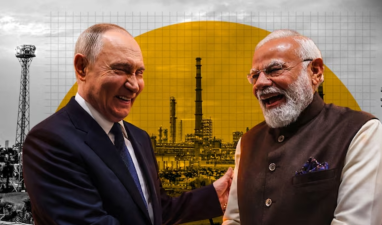
US President Donald Trump’s claim that India has agreed to stop buying Russian crude as part of a tariff deal has triggered sharp questions about energy security, feasibility, and strategic autonomy. While Washington has lowered tariffs on Indian goods, New Delhi has remained notably silent on any commitment to halt Russian oil imports — and for good reason. A complete break from Russian crude is neither technically simple nor strategically desirable in the near term.
What Trump claimed, and India’s careful response
Announcing a sharp reduction in tariffs on Indian exports to the US, Trump asserted that India would stop purchasing crude from Russia, its largest oil supplier, and instead buy more from the US and Venezuela. The Indian government has not endorsed this claim. No directive has been issued to refiners, and official statements have reiterated a familiar line: India’s primary objective is the energy security of 1.4 billion people.
The Ministry of External Affairs underlined that diversification of energy sourcing will continue, but only in line with market realities and evolving global conditions. This carefully worded position leaves room for gradual adjustment — not abrupt policy shifts.
Why Russian oil matters so much to India
Since the Ukraine war, Russia has emerged as India’s single largest crude supplier, largely because of steep discounts on its flagship Urals crude. Even after recent declines, Russian oil accounted for about 22% of India’s total oil imports in January 2026.
Crucially, Indian refiners have already locked in Russian oil cargoes through March and parts of April. These contracts cannot simply be cancelled without financial and logistical consequences. Industry analysts therefore expect any reduction to be gradual rather than immediate.
The Nayara Energy constraint
One major structural obstacle is , which processes about 400,000 barrels per day. Nayara is almost entirely dependent on Russian crude because it has been sanctioned by the European Union, while its key shareholder, Russia’s state oil giant Rosneft, is sanctioned by both the US and the EU.
With these sanctions in place, Nayara has limited access to non-Russian crude. Asking it to stop buying Russian oil would effectively mean shutting down a large refinery — an outcome that is economically and politically untenable.
How much can imports realistically fall?
Energy analysts suggest that while India is unlikely to slash Russian oil imports to zero, volumes could decline meaningfully over time. Imports that averaged around 1.6 million barrels per day in 2025 could fall to roughly 500,000 barrels per day in the medium term.
Even at that level, Russian crude would still make up about 10% of India’s oil imports — enough to ensure refinery stability while significantly reducing Moscow’s export revenues.
US sanctions and the recent decline
India’s Russian oil imports have already fallen to a three-year low, declining from a peak of over 2 million barrels per day in mid-2025 to about 1.16 million barrels per day in January 2026. This drop followed US sanctions on major Russian producers such as Rosneft and Lukoil, rather than any voluntary policy shift by India.
This distinction matters. New Delhi has reduced imports when constrained by sanctions, not because of political pressure.
Can US oil replace Russian crude?
In theory, India can buy more oil from the US — and it already has been doing so. In practice, there are constraints. Shipping crude from the US to India is significantly more expensive than sourcing oil from West Asia or Russia. Moreover, US crude is generally lighter and sweeter, while Indian refineries are optimised for medium-sour grades like those from Russia and the Middle East.
While Indian refineries are technically capable of processing a wide range of crude, large-scale substitution is neither seamless nor cost-neutral.
What about Venezuelan oil?
Venezuela, which Trump also mentioned, offers heavy crude that is closer in quality to Russian oil. However, its production is limited to about 1 million barrels per day and is already in demand in the US. Any Indian imports would therefore be opportunistic rather than structural.
Scaling up Venezuelan output would take years and billions of dollars in investment, making it an unreliable substitute in the short to medium term.
The question of strategic autonomy
India has consistently resisted being told whom it can or cannot trade with. Even when Washington imposed an additional 25% tariff last year over Russian oil purchases, New Delhi did not publicly concede ground.
Maintaining some Russian oil imports aligns with India’s broader foreign policy principle of strategic autonomy — especially given Russia’s long-standing role as a defence and geopolitical partner.
Why a partial cut may suit everyone
Interestingly, a reduction — not elimination — of Russian oil imports could satisfy multiple objectives. For India, it preserves energy security and autonomy. For the US, a fall from over 1.5 million barrels per day to around 500,000 would still significantly hurt Russia’s export revenues, especially if excess barrels cannot be easily diverted to China.
In that sense, a calibrated decline may exert more pressure on Moscow than additional sanctions alone.
What lies ahead
A sharp, politically driven halt to Russian oil imports is highly unlikely. Any deeper reduction would require a clear policy shift by the Indian government — something that appears improbable given current geopolitical and economic conditions.
What is more likely is a slow rebalancing of India’s oil basket: less Russia than at the peak, more diversification over time, but no abrupt abandonment of a key supplier.
What to note for Prelims?
- Russia became India’s top crude supplier after the Ukraine war due to discounts.
- US sanctions, not policy shifts, drove recent declines in Russian oil imports.
- Nayara Energy is heavily dependent on Russian crude due to EU sanctions.
What to note for Mains?
- Discuss the concept of strategic autonomy using India’s oil trade as an example.
- Analyse the feasibility of replacing Russian oil with US and Venezuelan crude.
- Examine how sanctions shape global energy trade flows.
- Evaluate the trade-offs between energy security and geopolitical alignment.