
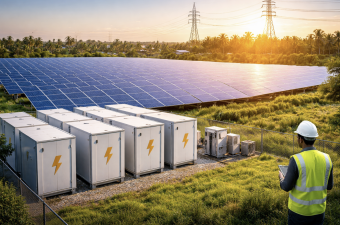
India is on the verge of a major transformation in its power sector. Recent analysis shows that battery storage has become affordable enough to allow solar energy to meet up to 90% of the country’s electricity demand at a competitive cost. This marks shift in India’s energy economics and offers a path to reduce dependence on fossil fuels.
Battery Storage and Solar Potential
Battery costs have dropped sharply, by 40% in 2024 and 31% in 2025. This enables solar power to supply electricity reliably day and night by storing excess energy generated during the day. India’s feasible solar capacity is estimated at 3,343 GW, more than three times what is needed to meet 90% of demand. However, large-scale deployment requires around 930 GW of solar and 2,560 GWh of battery storage. Only 5% of solar energy would need curtailment even at this scale.
Current Challenges in Power System
Despite rapid growth in solar capacity, India faces hurdles like grid inflexibility, transmission bottlenecks, and slow battery storage scale-up. Financially stressed distribution companies hesitate to sign long-term storage contracts. Seasonal variations, especially during monsoons, reduce solar availability, limiting solar plus battery to about 66% of demand then. Complementary clean energy sources like wind and hydro remain essential.
Economic and Policy
Solar-plus-battery systems are already cheaper than coal in many states. Recent auctions show tariffs as low as Rs 2.9-3.5/kWh for solar with storage, compared to Rs 5-6.3/kWh for new coal power. Policy support includes viability gap funding and storage tenders, but domestic manufacturing and project execution need improvement. Expanding transmission infrastructure and system planning are critical for integrating high shares of solar power.
Future Outlook
India’s solar revolution can enhance energy security and reduce fossil fuel reliance. Besides ground-mounted solar, rooftop and floating solar add to the potential. Scaling battery storage and diversifying clean energy sources will be key to achieving round-the-clock renewable power and meeting rising electricity demand.
Topics for Prelims:
Battery Storage Technology
- Battery costs fell 40% in 2024 and 31% in 2025.
- Enables solar energy to supply power after sunset.
- Requires 2,560 GWh storage for 90% solar supply.
- Supports round-the-clock electricity supply.
- Limited domestic manufacturing capacity in India.
India’s Solar Power Potential
- Feasible solar capacity estimated at 3,343 GW.
- Installed solar capacity reached 143 GW in FY26.
- Solar accounts for 9.4% of electricity generation in 2025.
- Rajasthan and Gujarat are high solar resource states.
- Rooftop and floating solar add 900 GW potential.
Energy Transition Challenges
- Grid inflexibility and transmission constraints.
- Seasonal solar variability limits supply during monsoon.
- Financially stressed distribution companies delay storage contracts.
- Coal still used for peak demand balancing.
- Need for diversified clean energy mix including wind and hydro.
Questions for Mains:
- Discuss in the light of India’s energy transition how battery storage can transform renewable energy integration and what challenges remain. [GS-III-Economic Development]
- Analyse the role of solar energy and battery storage in achieving India’s energy security and climate goals, with examples from recent policy measures. [GS-III-Environment & DM]
- Critically discuss the impact of transmission infrastructure and grid flexibility on the large-scale adoption of renewable energy in India. How can policy reforms address these issues? [GS-II-Governance]
- Examine the economic and environmental implications of shifting from coal-based power to solar-plus-battery systems in India, considering global energy market dynamics. [GS-III-Economic Development]
Answer Hints:
1. Discuss in the light of India’s energy transition how battery storage can transform renewable energy integration and what challenges remain. [GS-III-Economic Development]
- Battery cost decline (40% in 2024, 31% in 2025) enables reliable solar power day and night.
- Enables 90% of electricity demand to be met by solar with 2,560 GWh storage and 930 GW solar capacity.
- Addresses solar intermittency and curtailment issues, allowing round-the-clock power supply.
- Challenges – grid inflexibility, transmission bottlenecks, seasonal solar variability (monsoon), and slow storage scale-up.
- Financial constraints of DISCOMs hinder long-term storage contracts and project execution.
- Need for complementary clean energy sources (wind, hydro) to manage variability and seasonal demand.
2. Analyse the role of solar energy and battery storage in achieving India’s energy security and climate goals, with examples from recent policy measures. [GS-III-Environment & DM]
- Solar potential of 3,343 GW (ground-mounted) plus 900 GW rooftop & floating solar enhances energy independence.
- Battery storage enables round-the-clock solar power, reducing reliance on fossil fuels and imports (e.g., LNG from Qatar).
- Policy support – viability gap funding, dedicated storage tenders, and transmission charge waivers.
- Solar-plus-battery tariffs (Rs 2.9-3.5/kWh) cheaper than coal (Rs 5-6.3/kWh), promoting cleaner energy transition.
- Supports India’s climate targets by lowering emissions and providing stable renewable energy supply.
- Challenges remain in domestic battery manufacturing and integrating large-scale storage.
3. Critically discuss the impact of transmission infrastructure and grid flexibility on the large-scale adoption of renewable energy in India. How can policy reforms address these issues? [GS-II-Governance]
- Transmission bottlenecks limit transport of solar power from resource-rich states (Rajasthan, Gujarat) to demand centres.
- Grid inflexibility causes renewable curtailment and inability to balance intermittent supply effectively.
- Policy waivers on transmission charges partially mitigate costs but long-term infrastructure expansion required.
- Need for advanced grid management, flexible dispatch mechanisms, and investment in smart grids.
- Reforms – streamline regulatory approvals, incentivize transmission upgrades, encourage open access, and promote decentralized generation.
- Improved coordination between central and state agencies for integrated system planning.
4. Examine the economic and environmental implications of shifting from coal-based power to solar-plus-battery systems in India, considering global energy market dynamics. [GS-III-Economic Development]
- Solar-plus-battery tariffs (Rs 2.9-3.5/kWh) undercut rising coal power costs (Rs 5-6.3/kWh) due to fuel and compliance risks.
- Reduces dependence on volatile global fossil fuel markets (e.g., LNG supply disruptions from Middle East conflicts).
- Environmental benefits – lower greenhouse gas emissions, reduced air pollution, and compliance with climate commitments.
- Economic benefits – inflation-proof, local renewable resources reduce import bills and enhance energy security.
- Challenges – upfront capital costs, manufacturing capacity, and ensuring reliable power during low solar output periods.
- Global trends of battery cost decline and renewable adoption support India’s transition and investment attractiveness.