
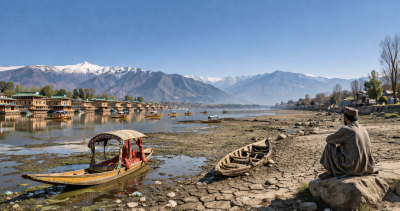
A 2026 audit by India’s Comptroller and Auditor General (CAG) reveals alarming loss of lakes in Jammu and Kashmir. Nearly half of the lakes recorded in 1967 have disappeared or shrunk . This decline threatens biodiversity, ecosystem services, and regional environmental stability.
Extent of Lake Loss
Out of 697 lakes recorded in 1967, 315 have vanished covering 1,537 hectares. Another 203 lakes have shrunk by 1,314 hectares. Overall, 518 lakes lost 2,851 hectares of water spread. Only 150 lakes increased in size while 29 remained unchanged. Sixty-three lakes have lost over half their water area and face extinction risk.
Management and Oversight Challenges
Lake management is fragmented across forest, revenue, agriculture, wildlife, and local authorities. About 75% of vanished lakes were under revenue and agriculture departments, and the rest under forest authorities. Shrinking lakes have multiple custodians leading to weak monitoring and conservation. No unified regulatory framework exists.
Conservation Efforts and Gaps
Only six lakes—Dal, Wular, Hokersar, Manasbal, Surinsar, and Mansar—received focused conservation. No comprehensive plans exist for the remaining 691 lakes. Central government schemes’ benefits remain largely untapped. Budget allocation for lake conservation was just 1% of Jammu and Kashmir’s capital expenditure between 2017-22. Key scientific measures like pollution control, biodiversity assessment, and public awareness were poorly implemented.
Case Studies of Major Lakes
Dal Lake suffers from land-use changes, sewage issues, and poor restoration efforts. Wular Lake lacks a functional oversight body, blocking policy decisions and central funding. Hokersar Lake faces pollution, altered water flows, biodiversity loss, and encroachment on over 2,500 kanal land. National schemes like the National Lake Conservation Programme were inadequately executed.
Topics for Prelims:
Jammu and Kashmir Lakes
- Recorded 697 lakes in 1967; 315 vanished by 2022.
- 518 lakes shrunk by 2,851 hectares.
- 63 lakes at high risk of extinction.
- Major lakes – Dal, Wular, Hokersar, Manasbal, Surinsar, Mansar.
- Lake ecosystems affected biodiversity and services.
Lake Management and Conservation
- Multiple authorities manage lakes – forest, revenue, agriculture.
- Fragmented responsibility causes weak monitoring.
- Only 1% budget spent on lake conservation (2017-22).
- National Lake Conservation Programme implementation weak.
- Key conservation activities largely unimplemented.
Questions for Mains:
- Discuss the impacts of fragmented governance on environmental conservation in India with reference to lake management in Jammu and Kashmir. [GS-II-Governance]
- Critically examine the challenges in implementing central environmental schemes at the regional level, citing examples from Jammu and Kashmir’s lake conservation efforts. [GS-III-Environment & DM]
- Explain the ecological importance of wetlands and lakes in maintaining biodiversity and ecosystem services, and discuss the consequences of their degradation. [GS-III-Environment & DM]
- With suitable examples, discuss the role of public awareness and community participation in the conservation of natural water bodies in India. Comment on the limitations faced in Jammu and Kashmir. [GS-IV-Ethics, Integrity and Aptitude]
Topics for Prelims:
Dal Lake
- Located in Srinagar, Jammu and Kashmir.
- Famous for tourism and houseboats.
- Facing land-use change and pollution issues.
- Restoration hampered by sewage and poor monitoring.
- Part of National Lake Conservation Programme.
Wular Lake
- One of Asia’s largest freshwater lakes.
- Located in Kashmir Valley.
- Lacks functional oversight body.
- Threatened by encroachment and pollution.
- Needs comprehensive conservation plan.
Comptroller and Auditor General of India (CAG)
- Supreme audit institution of India.
- Audits government expenditure and performance.
- Reports submitted to Parliament and state legislatures.
- Ensures accountability and transparency.
- Conducted Jammu and Kashmir lake audit 2017-22.
Answer Hints:
1. Discuss the impacts of fragmented governance on environmental conservation in India with reference to lake management in Jammu and Kashmir. [GS-II-Governance]
- Multiple authorities (forest, revenue, agriculture, wildlife, local bodies) manage lakes causing overlapping jurisdiction.
- Fragmented responsibility leads to weak monitoring, poor data sharing, and lack of unified action.
- Absence of a unified regulatory framework hampers coordinated conservation efforts.
- Examples – 315 vanished lakes mostly under revenue/agriculture; shrinking lakes managed by multiple agencies.
- Result – ineffective implementation of conservation measures, delayed policy decisions, and resource misallocation.
- Need for integrated governance models and clear institutional roles to improve environmental outcomes.
2. Critically examine the challenges in implementing central environmental schemes at the regional level, citing examples from Jammu and Kashmir’s lake conservation efforts. [GS-III-Environment & DM]
- Poor execution of schemes like National Lake Conservation Programme and Prime Minister’s Reconstruction Plan.
- Lack of comprehensive management plans for most lakes (only 6 lakes focused out of 697).
- Inadequate budget allocation (only ~1% of capital expenditure for lake conservation).
- Absence of functional oversight bodies (e.g., Wular Lake) blocks policy decisions and central funding.
- On-ground challenges – pollution control, land encroachment, altered water flows not addressed.
- Weak institutional coordination and local capacity constraints hinder scheme success.
3. Explain the ecological importance of wetlands and lakes in maintaining biodiversity and ecosystem services, and discuss the consequences of their degradation. [GS-III-Environment & DM]
- Wetlands and lakes support rich biodiversity, including endemic and migratory species.
- Provide ecosystem services – water purification, flood control, groundwater recharge, carbon sequestration.
- Support livelihoods (fisheries, tourism) and cultural values.
- Degradation leads to loss of habitat, reduced water quality, and ecosystem imbalance.
- Decline affects regional climate regulation and increases vulnerability to disasters.
- Example – Jammu & Kashmir’s lake shrinkage impacting biodiversity and ecosystem services.
4. With suitable examples, discuss the role of public awareness and community participation in the conservation of natural water bodies in India. Comment on the limitations faced in Jammu and Kashmir. [GS-IV-Ethics, Integrity and Aptitude]
- Public awareness encourages stewardship, pollution control, and sustainable use of water bodies.
- Community participation enables monitoring, restoration activities, and local enforcement.
- Successful examples – community-led conservation in Kerala’s Vembanad Lake, Odisha’s Chilika Lake.
- In Jammu & Kashmir, limited public engagement due to weak awareness campaigns and political instability.
- Authorities failed to raise adequate public awareness or involve local stakeholders effectively.
- Need for inclusive approaches integrating local knowledge and ethics to enhance conservation ethics.