
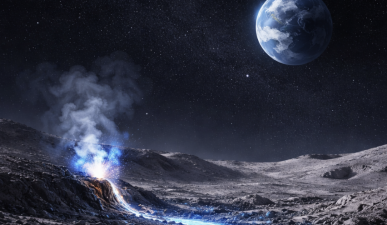
Recent research by IIT-Kharagpur and PRL Ahmedabad has explained how the moon’s surface contains volcanic rocks with unusually high titanium dioxide (TiO2) levels. Unlike Earth’s basalts, lunar basalts can have up to 18% TiO2. This study offers vital information about the moon’s interior processes and aids future missions like Chandrayaan-4 planned for 2028, which will collect lunar rock samples.
Lunar Basalts and Titanium Mystery
Lunar basalts differ from Earth’s by having very high titanium content. Scientists struggled to explain this for decades. The moon’s interior has a dense layer called the ilmenite-bearing cumulate (IBC) rich in iron and titanium. This layer sank into the moon’s mantle due to gravity, partially melted, and produced titanium-rich melts. Earlier lab experiments failed to replicate the exact composition of these basalts.
Experimental Approach and Findings
Researchers used a piston-cylinder apparatus simulating moon’s interior conditions (pressure up to 3 GPa and 1500 °C). Two experiments were done – one with separate layers representing the IBC and mantle, another mixing them. The first produced melts with correct titanium but low magnesium. The second gave high magnesium but low titanium. Combining these processes explained the formation of titanium-rich basalts.
Implications for Lunar Geology and Missions
The study suggests a two-stage model where titanium-rich melts formed deep inside the moon and mixed with fresh magma later. This explains volcanic activity on the moon lasting billions of years. The findings help select landing sites for Chandrayaan-4 and improve mineral identification using advanced spectroscopic instruments. Indian labs are now capable of high-pressure planetary experiments, boosting indigenous space science.
Technological Tools and Future Exploration
Advanced tools like X-ray fluorescence, Raman spectroscopy, and microscopic cameras can identify minerals and chemical composition of lunar rocks. These instruments, used in Mars missions, will be vital for Chandrayaan-4’s sample collection. ESA’s Lunar Volatile and Mineralogy Mapping Orbiter will also study water and ilmenite on the moon in 2028, complementing these efforts.
Topics for Prelims:
Ilmenite-Bearing Cumulate (IBC) Layer
- Dense lunar interior layer rich in iron and titanium.
- Formed during crystallisation of the lunar magma ocean.
- Sinks into mantle by cumulate overturn.
- Partially melts to produce titanium-rich basalts.
- Key to understanding lunar volcanic activity.
Chandrayaan-4 Mission
- ISRO mission planned for 2028.
- Aims to collect and return lunar rock samples.
- Landing site selection influenced by recent studies.
- Uses advanced mineral identification instruments.
- Focuses on lunar south pole regions like Shiv Shakti.
Titanium-Rich Basalts
- Contain up to 18% titanium dioxide.
- Different from Earth’s basalts with <2% TiO2.
- Formed by melting and mixing inside the moon.
- Explain prolonged lunar volcanic activity.
- Help understand moon’s geological evolution.
Questions for Mains:
- Discuss in the light of recent research how high-pressure experiments have enhanced our understanding of lunar geology and volcanic processes. [GS-III-Science & Technology]
- Analyse the role of mineralogical studies in planetary exploration missions with examples from Chandrayaan and Mars missions. [GS-III-Science & Technology]
- With suitable examples, discuss the significance of indigenous scientific capabilities in advancing space research and exploration. [GS-II-Governance]
- Critically discuss the impact of geological processes on the evolution of planetary bodies, taking the moon’s titanium-rich basalts as a case study. [Optional Paper
Geology]
Answer Hints:
1. Discuss in the light of recent research how high-pressure experiments have enhanced our understanding of lunar geology and volcanic processes. [GS-III-Science & Technology]
- High-pressure experiments simulate moon’s interior conditions (up to 3 GPa, 1500 °C) using piston-cylinder apparatus.
- Revealed formation processes of titanium-rich basalts via melting of ilmenite-bearing cumulate (IBC) layer and interaction with mantle.
- Explained why lunar basalts have unusually high TiO2 (up to 18%) unlike Earth’s basalts (<2%).
- Demonstrated two-stage melting and mixing model explaining volcanic activity and basalt composition on moon.
- Resolved previous experimental discrepancies in magnesium and titanium content of lunar melts.
- Enhanced predictive capability for lunar geology aiding mission planning and sample analysis (e.g., Chandrayaan-4).
2. Analyse the role of mineralogical studies in planetary exploration missions with examples from Chandrayaan and Mars missions. [GS-III-Science & Technology]
- Mineralogical tools (X-ray fluorescence, X-ray diffraction, Raman spectroscopy) identify mineral phases and chemical composition in situ.
- Chandrayaan missions use high-resolution microscopic cameras and spectroscopic instruments to analyze lunar rocks before collection.
- Mars missions successfully employed similar instruments to confirm mineralogy remotely and on surface.
- Accurate mineral identification guides sample selection and understanding of planetary geology and evolution.
- Helps detect key resources like ilmenite and water ice, critical for future exploration and habitation.
- Improves mission landing site selection and scientific return by targeting geologically areas.
3. With suitable examples, discuss the significance of indigenous scientific capabilities in advancing space research and exploration. [GS-II-Governance]
- Indian labs (IIT-Kharagpur, PRL Ahmedabad, ISRO centers) developed high-pressure experimental setups simulating planetary interiors.
- Enables in-country research on lunar geology, reducing dependence on foreign facilities and enhancing scientific autonomy.
- Supports ISRO’s ambitious missions like Chandrayaan-4 with indigenous technology and expertise.
- Promotes capacity building in advanced planetary science and instrumentation within India.
- Strengthens India’s position in global space research collaborations and technology development.
- Example – Experimental study explaining lunar titanium-rich basalts conducted entirely in India.
4. Critically discuss the impact of geological processes on the evolution of planetary bodies, taking the moon’s titanium-rich basalts as a case study. [Optional Paper Geology]
- Moon’s magma ocean crystallisation formed stratified layers including ilmenite-bearing cumulate (IBC) rich in Ti and Fe.
- Cumulate overturn caused dense IBC layer to sink and partially melt, producing titanium-rich melts.
- Two-stage melting and mixing processes explain prolonged volcanic activity and basalt diversity on moon.
- Titanium-rich basalts reveal internal differentiation, mantle-crust interaction, and thermal evolution of moon.
- Geological processes like crystallisation, overturn, partial melting shape planetary surface composition and evolution.
- Case study marks how internal dynamics govern volcanic rock chemistry and planetary geological history.