
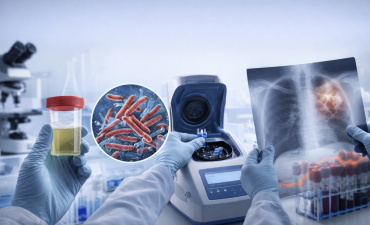
Recent developments in tuberculosis (TB) diagnosis have transformed global and Indian efforts to eliminate the disease. The World Health Organization (WHO) recently endorsed new near point-of-care molecular tests, tongue swab sampling, and sputum pooling to improve TB detection. India is adopting portable chest X-rays (CXR) with artificial intelligence (AI) for community screening under the National Tuberculosis Elimination Programme (NTEP). These innovations aim to make diagnosis faster, more accessible, and accurate.
Innovations in TB Diagnostic Tools
Molecular tests like Cartridge-based Nucleic Acid Amplification Test (CBNAAT) and indigenous Truenat have expanded India’s TB diagnostic capacity. WHO’s approval of near point-of-care molecular tests allows testing closer to patients, reducing dependence on central labs. Tongue swabs offer a non-invasive option for those unable to produce sputum. Portable CXR machines with AI help detect TB and other lung diseases in remote areas. Combining these tools creates a comprehensive diagnostic approach.
Role of Artificial Intelligence and Portable X-rays
AI algorithms integrated with portable digital X-rays enable rapid screening outside hospitals. Mobile vans equipped with these technologies reach vulnerable populations in urban and tribal areas. AI helps identify suspicious lung lesions instantly, reducing delays. This system supports opportunistic screening during routine X-rays for other health issues. Capacity building is crucial to effectively use AI in public health settings.
Challenges in TB Diagnosis and Research Priorities
Despite advances, sputum collection and transport remain hurdles, especially for elderly and disabled patients. Diagnosing TB in children and extra-pulmonary TB (EP-TB) is difficult due to sample collection and low bacterial load. Research is needed on saliva and stool testing and AI-enabled portable ultrasound for EP-TB. Cost-effective biomarkers to predict TB progression and improve preventive therapy uptake are a priority. Systematic implementation research will guide scaling new tools.
Strengthening Health Systems and Diagnostic Networks
India must optimise diagnostic networks to ensure timely drug resistance testing and treatment initiation. The Indian Council of Medical Research (ICMR) oversees evidence review for procurement. Coordinated public and private sector efforts are essential to expand access. Early diagnosis reduces transmission, treatment costs, and long-term health impacts. Scaling up AI and molecular diagnostics can accelerate India’s goal of TB elimination.
Topics for Prelims:
Cartridge-based Nucleic Acid Amplification Test (CBNAAT)
- Rapid molecular test for TB detection.
- Detects drug resistance.
- Used widely in India since 2016.
- Requires specialised equipment and trained staff.
- Improves accuracy over sputum smear microscopy.
Artificial Intelligence in TB Screening
- AI algorithms interpret chest X-rays.
- Enables rapid detection of lung abnormalities.
- Used in portable X-ray machines and mobile vans.
- Supports active case finding in communities.
- Reduces dependency on radiologists.
Extra-Pulmonary Tuberculosis (EP-TB)
- TB infection outside the lungs.
- Accounts for nearly 25% of TB cases in India.
- Difficult to diagnose and treat.
- Often requires expensive tests.
- Delay in diagnosis leads to poor outcomes.
Questions for Mains:
- Critically analyse the role of artificial intelligence in improving tuberculosis diagnosis and its challenges in India. [GS-III-Science & Technology]
- Explain the significance of near point-of-care molecular tests in tuberculosis control and discuss the barriers to their widespread adoption in rural areas. [GS-III-Health]
- With suitable examples, comment on the importance of early diagnosis in infectious disease control and how health system strengthening can aid this process. [GS-II-Governance]
- What are the challenges in diagnosing extra-pulmonary tuberculosis in India? How can emerging technologies and research address these challenges? [GS-III-Science & Technology]
Answer Hints:
1. Critically analyse the role of artificial intelligence in improving tuberculosis diagnosis and its challenges in India. [GS-III-Science & Technology]
- AI algorithms integrated with portable digital chest X-rays enable rapid, accurate detection of TB and other lung abnormalities outside hospital settings.
- Mobile vans equipped with AI-enabled X-rays facilitate active TB case finding in vulnerable urban and tribal populations, improving accessibility.
- AI reduces dependence on scarce radiologists and technicians, enabling opportunistic screening during routine X-rays for other health issues.
- Challenges include the need for capacity building at service delivery points to effectively use AI tools and interpret outputs.
- Infrastructure limitations, data privacy concerns, and variability in AI accuracy across diverse populations pose implementation hurdles.
- Ensuring referral and treatment linkage for non-TB findings detected by AI (e.g., lung cancer) is essential for comprehensive care.
2. Explain the significance of near point-of-care molecular tests in tuberculosis control and discuss the barriers to their widespread adoption in rural areas. [GS-III-Health]
- Near point-of-care (nPOC) molecular tests provide rapid, accurate TB diagnosis closer to patients, reducing reliance on central labs and long turnaround times.
- They enable early detection of drug resistance, facilitating timely initiation of appropriate treatment regimens.
- Use of non-sputum samples like tongue swabs improves diagnosis in patients unable to produce sputum, including children.
- Barriers include uneven access due to limited infrastructure, lack of trained personnel, and weak sputum/sample collection and transport systems in rural areas.
- Financial constraints, supply chain issues, and lack of awareness hinder scale-up and sustained use in remote settings.
- Strengthening diagnostic networks and integrating with general health systems are needed to overcome these challenges.
3. With suitable examples, comment on the importance of early diagnosis in infectious disease control and how health system strengthening can aid this process. [GS-II-Governance]
- Early diagnosis of infectious diseases like TB reduces transmission, improves treatment outcomes, and prevents long-term complications.
- Example – AI-enabled portable chest X-rays and molecular tests in India facilitate early TB detection, even in hard-to-reach populations.
- Health system strengthening—such as expanding diagnostic infrastructure, training human resources, and improving sample transport—ensures timely testing and treatment initiation.
- Coordinated public-private partnerships enhance access and reduce out-of-pocket expenses for affected families.
- Robust surveillance and referral mechanisms enable effective case management and reduce disease burden.
- Investment in implementation research guides scale-up of innovative diagnostics aligned with local needs.
4. What are the challenges in diagnosing extra-pulmonary tuberculosis in India? How can emerging technologies and research address these challenges? [GS-III-Science & Technology]
- Extra-pulmonary TB (EP-TB) is difficult to diagnose due to its varied presentation and inaccessibility of affected sites.
- Diagnosis often requires expensive, invasive tests, leading to delays and misdiagnosis, worsening patient outcomes.
- Low bacterial loads in EP-TB make conventional sputum-based tests ineffective.
- Emerging technologies like AI-enabled portable ultrasound combined with molecular testing show promise for non-invasive, rapid diagnosis.
- Research on cost-effective biomarkers and alternative sample types (e.g., saliva, stool) can improve detection, especially in children and extrapulmonary cases.
- India-specific implementation studies and health technology assessments are needed to validate and scale these innovations effectively.