
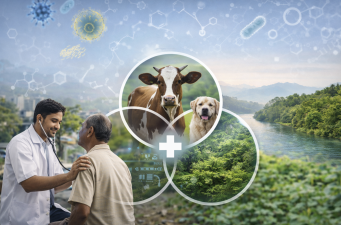
The recent World Health Day 2026 emphasised the urgent need for a One Health approach. This concept links human, animal, and environmental health to prevent and control diseases. The COVID-19 pandemic showed the world the importance of coordinated scientific efforts and global cooperation in managing health crises.
Origins and Evolution of One Health
The term ‘One Health’ was first used in the early 2000s during outbreaks like SARS and avian influenza H5N1. It gained prominence through the 2004 Manhattan Principles, which brought into light the connection between human and animal health and the risks posed by environmental changes. Most new infectious diseases originate from animals due to human activities like deforestation, urbanisation, and global travel.
Global Collaboration and Policies
One Health is driven internationally by the Quadripartite alliance of WHO, FAO, UNEP, and the World Organisation for Animal Health. They launched the One Health Joint Plan of Action in 2022 to tackle health threats including zoonotic diseases and antimicrobial resistance. The WHO Pandemic Agreement of 2025 legally binds countries to share pathogen data and ensure fair vaccine access.
India’s One Health Initiatives
India has launched the National One Health Mission to integrate human, animal, and environmental health sectors. This aims to improve disease surveillance, pandemic preparedness, and zoonotic disease control. State-level efforts like Odisha’s Climate Budget and Tamil Nadu’s Cool Roof Project complement these efforts by addressing climate impacts on health.
Challenges and Future Directions
Despite growing political support, practical implementation of One Health remains slow. The ongoing One Health Summit in Lyon focuses on infectious diseases, sustainable food systems, and pollution exposure. Strengthening health systems and international cooperation is vital to meet One Health goals in an interconnected world.
Topics for Prelims:
One Health Concept
- Integrates human, animal, and environmental health.
- Originated from SARS and avian influenza outbreaks.
- Manhattan Principles (2004) formalised the approach.
- Addresses zoonotic diseases and ecosystem health.
- Promoted by WHO, FAO, UNEP, and OIE.
WHO Pandemic Agreement 2025
- Legally binding treaty for pandemic preparedness.
- Focuses on equitable vaccine and treatment access.
- Includes Pathogen Access and Benefit-Sharing system.
- Encourages rapid sharing of pathogen data.
- Strengthens global health cooperation.
India’s National One Health Mission
- Integrates health sectors for better disease control.
- Enhances pandemic preparedness and surveillance.
- Supports zoonotic disease management.
- Works alongside state-level climate and health projects.
- Addresses challenges from climate change impacts.
Questions for Mains:
- Critically analyse the role of the One Health approach in preventing future pandemics with examples from recent global health crises. [GS-III-Economic Development]
- Explain the significance of the WHO Pandemic Agreement 2025 in global health governance and how it addresses equity issues in vaccine distribution. [GS-II-International Relations]
- With suitable examples, comment on the challenges faced by India in implementing the National One Health Mission and suggest measures to improve its effectiveness. [GS-II-Governance]
- Underline the impact of climate change on zoonotic diseases and analyse how integrated health approaches can mitigate these effects. [GS-III-Environment & DM]
Answer Hints:
1. Critically analyse the role of the One Health approach in preventing future pandemics with examples from recent global health crises. [GS-III-Economic Development]
- One Health integrates human, animal, and environmental health to detect and prevent zoonotic spillovers early.
- COVID-19 exemplified failure and potential of One Health – lack of coordination delayed response; genetic data sharing accelerated vaccine development.
- Manhattan Principles (2004) formalised recognition of zoonotic disease risks linked to human activities like deforestation and urbanisation.
- Quadripartite collaboration (WHO, FAO, UNEP, OIE) promotes multisectoral pandemic preparedness and AMR control.
- Examples – SARS (2003), Avian Influenza H5N1, Ebola outbreaks—highlight need for integrated surveillance and response.
- Challenges – bureaucratic silos, funding gaps, uneven global commitment slow practical implementation despite political consensus.
2. Explain the significance of the WHO Pandemic Agreement 2025 in global health governance and how it addresses equity issues in vaccine distribution. [GS-II-International Relations]
- Legally binding international treaty enhancing pandemic prevention, preparedness, and response globally.
- Establishes Pathogen Access and Benefit-Sharing system ensuring rapid sharing of pathogen data worldwide.
- Focuses on equitable access to vaccines, diagnostics, and treatments, addressing vaccine nationalism and disparities seen in COVID-19.
- Strengthens global cooperation, transparency, and accountability among nations and stakeholders.
- Facilitates collective responsibility and resource pooling for future pandemics.
- Represents a shift from voluntary to enforceable commitments in global health governance.
3. With suitable examples, comment on the challenges faced by India in implementing the National One Health Mission and suggest measures to improve its effectiveness. [GS-II-Governance]
- Challenges – inter-departmental coordination issues among health, animal husbandry, environment sectors.
- Resource constraints and uneven capacity across states hamper surveillance and rapid response.
- Lack of widespread awareness and trained workforce in One Health principles.
- Examples – State initiatives like Odisha’s Climate Budget and Tamil Nadu’s Cool Roof Project show potential but limited replication.
- Measures – strengthen institutional frameworks, increase funding, promote cross-sectoral training and data sharing platforms.
- Engage local communities and states in participatory planning; integrate climate resilience into health strategies.
4. Underline the impact of climate change on zoonotic diseases and analyse how integrated health approaches can mitigate these effects. [GS-III-Environment & DM]
- Climate change alters habitats, vector distribution, and animal migration, increasing zoonotic spillover risk.
- Extreme weather events disrupt ecosystems, intensify human-animal contact, and stress wildlife immune systems.
- Integrated One Health approaches enable early detection, surveillance, and coordinated response across sectors.
- State examples – Kerala’s carbon-neutral plan and Odisha’s Climate Budget demonstrate climate-health integration.
- Mitigation includes sustainable land use, reducing deforestation, and promoting ecosystem health to reduce disease emergence.
- Strengthening health systems and adaptive policies enhances resilience to climate-driven health threats.