
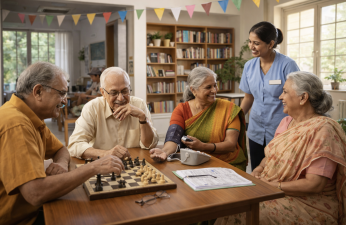
The Ministry of Social Justice and Empowerment recently brought into light the Integrated Programme for Senior Citizens (IPSrC). This programme runs under the AtalVayoAbhyudayYojana (AVYAY) scheme. It supports the welfare of elderly citizens through various projects managed by Non-Governmental Organisations (NGOs) and Voluntary Organisations.
Overview of IPSrC and AVYAY
IPSrC is a key component of AVYAY. It provides financial aid to NGOs for senior citizen welfare projects. These include Senior Citizen Homes, Continuous Care Homes, Mobile Medicare Units, Physiotherapy Units, and Regional Resource and Training Centres (RRTCs). The programme aims to improve living conditions and healthcare for senior citizens.
Role of Regional Resource and Training Centres
RRTCs play important role in IPSrC. They conduct advocacy and awareness activities on senior citizen issues. They also provide training and capacity building for stakeholders. RRTCs engage in research, documentation, and maintaining databases. They inspect and monitor projects and coordinate with State Governments and Union Territories to strengthen elderly care.
Financial Support and Monitoring
Each RRTC receives an annual grant of Rs. 19.58 lakh. The Ministry monitors projects through its Project Monitoring Unit (PMU). Regular field inspections verify project authenticity and proper functioning. NGOs must submit progress reports, Utilisation Certificates, and audited accounts. This ensures funds are used as per scheme guidelines.
Current Status and Clarifications
Help Age India is designated as one of the RRTCs under IPSrC. The Age Well Foundation does not receive any grant under AVYAY. No new proposals under AVYAY are currently under consideration. The Ministry maintains transparency and accountability in programme implementation.
Topics for Prelims:
Integrated Programme for Senior Citizens (IPSrC)
- Component of AtalVayoAbhyudayYojana (AVYAY) scheme.
- Provides grants to NGOs for elderly welfare projects.
- Supports Senior Citizen Homes, Continuous Care Homes, Mobile Medicare Units.
- Includes Physiotherapy Units and Regional Resource and Training Centres.
- Aims to improve care and support for senior citizens.
Regional Resource and Training Centres (RRTCs)
- Designated centres under IPSrC for training and advocacy.
- Conduct awareness programs related to senior citizen issues.
- Engage in research, documentation, and database development.
- Inspect and monitor projects funded under IPSrC.
- Coordinate with State Governments and UT administrations.
Project Monitoring and Financial Management
- Annual grant of Rs. 19.58 lakh per RRTC.
- Project Monitoring Unit conducts field inspections.
- NGOs submit progress reports and Utilisation Certificates.
- Audited accounts required for transparency.
- Ensures proper use of funds and scheme compliance.
Questions for Mains:
- Critically discuss the role of government schemes in improving elderly care in India and examine the challenges faced in their implementation. [GS-II-Social Justice]
- Analyse the significance of NGOs in social welfare programmes and estimate their impact on policy outcomes in India. [GS-II-Governance]
- Point out the importance of monitoring and evaluation mechanisms in public welfare schemes and discuss how they contribute to transparency and accountability. [GS-II-Governance]
- Examine the demographic changes in India and critically discuss how these changes influence the design of social security policies for senior citizens. [GS-I-Indian Society]
Answer Hints:
1. Critically discuss the role of government schemes in improving elderly care in India and examine the challenges faced in their implementation. [GS-II-Social Justice]
- Government schemes like IPSrC under AVYAY provide targeted financial aid for elderly welfare projects (Senior Citizen Homes, Continuous Care Homes, Mobile Medicare Units, Physiotherapy Units).
- These schemes aim to improve healthcare, living conditions, and social support for senior citizens, addressing rising elderly population needs.
- Implementation challenges include inadequate coverage, limited awareness among beneficiaries, and uneven geographical reach.
- Dependence on NGOs for execution may lead to variable quality and accountability issues.
- Monitoring mechanisms exist but face constraints in timely inspections and fund utilization verification.
- Need for integrated policy approach combining healthcare, social security, and community engagement for holistic elderly care.
2. Analyse the significance of NGOs in social welfare programmes and estimate their impact on policy outcomes in India. [GS-II-Governance]
- NGOs act as implementing partners for government schemes, bringing grassroots reach and local knowledge (e.g., IPSrC projects run by NGOs).
- They contribute to innovation, flexibility, and community participation in welfare delivery.
- NGOs help fill gaps in government capacity, especially in remote or underserved areas.
- Their involvement enhances accountability through regular reporting (progress reports, utilization certificates, audited accounts).
- However, disparities in NGO capacity and possible dependency on government grants can affect outcomes.
- Effective NGO-government coordination is crucial for scaling impact and aligning with policy goals.
3. Point out the importance of monitoring and evaluation mechanisms in public welfare schemes and discuss how they contribute to transparency and accountability. [GS-II-Governance]
- Monitoring units (like Project Monitoring Unit under IPSrC) conduct field inspections to verify authenticity and proper functioning of projects.
- Periodic submission of progress reports, Utilisation Certificates, and audited accounts ensures financial discipline.
- Evaluation helps assess scheme effectiveness, identify gaps, and guide policy adjustments.
- Transparency in fund flow and utilization builds public trust and deters misuse of funds.
- Monitoring encourages accountability among implementing NGOs and government agencies.
- Challenges include resource constraints for monitoring and delays in report submissions affecting timely corrective actions.
4. Examine the demographic changes in India and critically discuss how these changes influence the design of social security policies for senior citizens. [GS-I-Indian Society]
- India is witnessing a rising elderly population due to increased life expectancy and declining fertility rates.
- Growing proportion of senior citizens increases demand for healthcare, social security, and elderly care services.
- Demographic shift necessitates schemes like IPSrC focusing on health, housing, and social support for elderly.
- Policies must address diverse needs – financial security, healthcare access, social inclusion, and protection against abuse.
- Urbanization and nuclear families reduce traditional family support, increasing reliance on formal care systems.
- Design of social security must be inclusive, sustainable, and adaptable to regional demographic variations.