
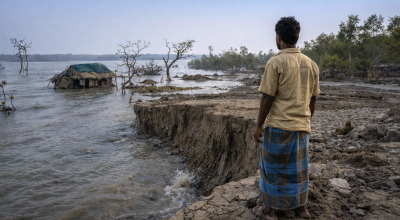
The Sundarbans, a UNESCO World Heritage Site spanning India and Bangladesh, is showing decline in its resilience to environmental stresses. A recent study covering 2000 to 2024 reveals that 10-15% of the forest, about 610 to 990 sq km, has lost its ability to recover from disturbances. This decline is linked to climate change, cyclones, and human activities.
Impact of Cyclones on Forest Resilience
Major cyclones like Sidr, Rashmi and Aila (2007-2009) severely affected the Sundarbans. Large areas shifted from resilient to moderately or weakly resilient categories. The central and south-eastern Sundarbans, especially seaward areas from Satkhira to Sharankhola, are the worst affected. The Shala River corridor is another vulnerable hotspot due to frequent cyclone exposure. In India’s western Sundarbans, resilience is lower than in Bangladesh, particularly near northern boundaries.
Climate Change and Ecological Stress
Rising temperatures and erratic rainfall patterns are weakening the mangrove ecosystem. Freshwater flow reduction increases salinity, forcing plants to expend more energy on survival. Diverse mangrove species like Avicennia officinalis and Heritiera fomes are under stress. Canopy height and species richness are declining, making forests more uniform and less diverse. Higher rainfall usually reduces water stress and supports growth but is becoming unpredictable.
Human Activities and Forest Degradation
Upstream dams reduce freshwater, raising salinity levels. Nutrient imbalances from excess phosphorus and oxygen-poor soils further harm mangroves. Illegal logging, shrimp farming and encroachment degrade forest structure and recovery. The dominant Sundari tree suffers from top dying disease, reducing timber value and turning carbon sinks into emission sources. Annual timber loss is estimated at $16.72 million.
Conservation and Management Strategies
Protecting mature trees and enhancing patrolling are vital. Involving local communities in awareness programmes can help. Policies must integrate climate risk and human impact mitigation. Strengthening forest management is key to restoring resilience and preserving the Sundarbans.
Topics for Prelims:
Sundarbans
- Largest mangrove forest in the world, spanning India and Bangladesh.
- UNESCO World Heritage Site since 1997.
- Home to diverse flora and fauna including the Royal Bengal Tiger.
- Highly vulnerable to cyclones and sea-level rise.
- Important carbon sink and biodiversity hotspot.
Mangrove Ecosystem
- Coastal forests adapted to saline water and tidal conditions.
- Provide habitat for many species and protect shorelines from erosion.
- Help in carbon sequestration and maintaining water quality.
- Species diversity includes Avicennia, Heritiera, Bruguiera and Excoecaria.
- Threatened by climate change, pollution and human encroachment.
Critical Slowing Down
- Indicator of ecosystem resilience loss.
- Shows longer recovery times from disturbances.
- Increased fluctuations in productivity and instability.
- Signals approaching ecological tipping points.
- Used to assess health of forests and coral reefs globally.
Questions for Mains:
- Critically discuss the impact of climate change and human activities on mangrove ecosystems with reference to the Sundarbans. [GS-III-Environment & DM]
- Analyse the role of mangroves in coastal protection and carbon sequestration and discuss the challenges in their conservation. [GS-III-Environment & DM]
- With examples, examine how natural disasters like cyclones influence ecosystem resilience and the importance of ecosystem-based disaster risk reduction. [GS-III-Internal & External Security]
- Discuss in the light of forest management practices how community involvement and policy integration can enhance resilience of vulnerable ecosystems like the Sundarbans. [GS-II-Governance]
Answer Hints:
1. Critically discuss the impact of climate change and human activities on mangrove ecosystems with reference to the Sundarbans. [GS-III-Environment & DM]
- Climate change effects – rising temperatures, erratic rainfall, increased salinity, and extreme weather events (cyclones) reducing mangrove resilience.
- Ecological impacts – decline in species richness, canopy height, and functional traits; increased forest uniformity and vulnerability.
- Human activities – upstream dams reducing freshwater flow, increasing salinity; illegal logging, shrimp farming, encroachment degrading forest structure.
- Top dying disease affecting dominant Sundari tree, reducing timber value and turning carbon sink into emission source.
- Combined stressors causing critical slowing down – longer recovery times and ecosystem instability.
- Long-term consequences – loss of biodiversity, reduced carbon sequestration, economic losses (e.g., $16.72 million timber value annually).
2. Analyse the role of mangroves in coastal protection and carbon sequestration and discuss the challenges in their conservation. [GS-III-Environment & DM]
- Coastal protection – mangroves stabilize shorelines, reduce erosion, buffer storm surges and cyclones.
- Carbon sequestration – mangroves store carbon in biomass and sediments, acting as important carbon sinks.
- Biodiversity hotspot – support diverse flora and fauna including endangered species like Royal Bengal Tiger.
- Challenges – climate change (sea-level rise, salinity increase), human pressures (illegal logging, shrimp farming, upstream dams), disease (Sundari top dying).
- Management issues – lack of effective patrolling, insufficient community involvement, inadequate policy integration of climate risks.
- Need for restoration and protection strategies to maintain ecosystem services and resilience.
3. With examples, examine how natural disasters like cyclones influence ecosystem resilience and the importance of ecosystem-based disaster risk reduction. [GS-III-Internal & External Security]
- Cyclones Sidr, Rashmi, and Aila (2007-2009) caused large-scale resilience loss in Sundarbans (over 2,600 sq km moved to lower resilience categories).
- Effects – physical damage to mangrove stands, shifting from resilient to weakly resilient states, especially in seaward and vulnerable zones.
- Critical slowing down – ecosystems take longer to recover, increased fluctuations and instability post-disaster.
- Ecosystem-based disaster risk reduction (Eco-DRR) – mangroves as natural buffers reducing cyclone impact and coastal flooding.
- Maintaining mangrove health enhances resilience, reducing disaster vulnerability for coastal communities.
- Integrating Eco-DRR in policy and forest management strengthens climate adaptation and disaster preparedness.
4. Discuss in the light of forest management practices how community involvement and policy integration can enhance resilience of vulnerable ecosystems like the Sundarbans. [GS-II-Governance]
- Community involvement – local awareness programs, participatory monitoring, and protection against illegal logging and encroachment.
- Policy integration – incorporating climate change impacts and human pressures into forest management plans and disaster risk policies.
- Strengthening patrolling and protection of mature, dominant trees to maintain structural complexity and ecosystem functions.
- Promoting sustainable livelihoods (e.g., eco-tourism, regulated resource use) to reduce dependency on destructive practices.
- Collaborative governance involving government, NGOs, and local communities for adaptive management.
- Long-term resilience depends on integrated approaches combining science, policy, and grassroots action.