
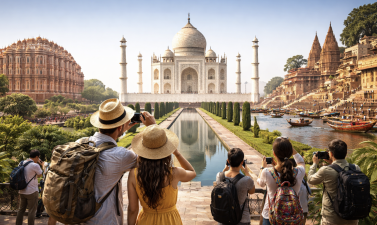
On February 17, 2023, the world observed the first Global Tourism Resilience Day, instituted through a United Nations resolution led by Jamaica. The message was clear: tourism must move beyond recovery and toward resilience. For India, this shift is increasingly visible. Tourism is no longer viewed merely through the lens of foreign exchange earnings and arrival statistics; it is being treated as national infrastructure — economic, ecological, and cultural. The emphasis is gradually shifting from volume to durability.
From Visitor Numbers to System Strength
The concept of resilience in tourism implies the ability to absorb shocks — pandemics, climate events, geopolitical disruptions — without systemic collapse. Traditional tourism models focused on:
- International arrival figures.
- Hotel occupancy rates.
- Foreign exchange inflows.
Resilient tourism instead focuses on diversified flows, digital readiness, climate-proof infrastructure, and local livelihood integration. This systemic approach reduces overdependence on a single source market or destination cluster.
Domestic Tourism as Shock Absorber
One of the most important resilience buffers has been the Dekho Apna Desh initiative. By promoting year-round domestic travel across regions and cultural niches, India reduced its vulnerability to international travel disruptions.
Domestic tourism:
- Sustains local economies during global crises.
- Encourages geographic dispersion of visitors.
- Builds cultural familiarity and repeat travel patterns.
When global mobility halted during the pandemic, domestic tourism became the primary stabilising force.
Crisis Response and Institutional Coordination
The Ministry of Tourism has institutionalised public-private task forces involving airlines, hospitality chains, technology firms, and local governments. These mechanisms ensure:
- Real-time traveller communication systems.
- Standardised safety protocols during health emergencies.
- Coordinated responses during climate-induced disruptions.
Such structured coordination prevents fragmented responses that often worsen crises.
Visa Reform and Digital Facilitation
4
Expansion of India’s e-Visa regime has reduced friction for international visitors. Digital visa processing and AI-assisted facilitation centres ensure smoother entry flows even when global travel norms evolve.
Simplified visa systems contribute to:
- Faster post-crisis recovery.
- Greater competitiveness in global tourism markets.
- Reduced administrative bottlenecks.
Ease of entry becomes a structural advantage.
Climate-Resilient Infrastructure Investments
Through programmes such as the National Tourism Infrastructure Development Programme (NTIDP), the government has supported:
- Flood-resilient coastal facilities.
- Climate-proof walkways in eco-sensitive areas.
- Earthquake-resistant restoration in heritage zones.
- Fire safety upgrades in cultural complexes.
Such investments acknowledge that climate risks are no longer exceptional events but recurring realities.
Green Tourism Certification and Sustainability
India’s Green Tourism Certification Programme incentivises sustainability practices among hotels and tour operators. Certification parameters include:
- Energy and water efficiency.
- Waste management systems.
- Community participation.
- Climate adaptation measures.
By making sustainability a competitive differentiator, environmental responsibility becomes economically viable.
Digital Documentation as Insurance
4
The proposed National Destination Digital Knowledge Grid aims to digitally document cultural, spiritual, and heritage assets. Digital archiving performs multiple functions:
- Preserves cultural memory.
- Creates employment for researchers and technologists.
- Maintains destination visibility during physical disruptions.
- Supports faster marketing campaigns post-crisis.
When physical access is constrained, digital engagement sustains demand.
Nature-Based Diversification of Tourism Geography
4
Budget proposals emphasise ecologically sustainable mountain trails in Himachal Pradesh, Uttarakhand, Jammu & Kashmir, Araku Valley, and Podhigai Malai, alongside turtle trails in Odisha, Karnataka, and Kerala, and bird corridors near Pulicat Lake.
This strategy:
- Reduces pressure on saturated destinations.
- Distributes tourism income across ecosystems.
- Mitigates over-tourism risks.
- Builds adaptive capacity across regions.
Diversification spreads risk geographically.
Archaeology as Experiential Economy
4
Fifteen archaeological sites — including Dholavira, Rakhigarhi, Sarnath, and Leh Palace — are being developed as experiential destinations.
Curated walkways, interpretation centres, and immersive storytelling technologies enhance visitor engagement. Tourism rooted in identity fosters repeat visitation and stable revenue streams.
Climate Adaptation and Community Buffers
By linking eco-tourism to local livelihoods — guides, homestays, conservation workers — tourism income diversifies rural economies. A community that earns from both agriculture and eco-tourism is better positioned to withstand droughts or crop failures.
Embedding climate adaptation into tourism planning reduces long-term ecological degradation — a core pillar of sustainable resilience.
What to Note for Prelims?
- Global Tourism Resilience Day – observed February 17.
- Dekho Apna Desh – domestic tourism promotion initiative.
- Green Tourism Certification – sustainability assessment framework.
- National Tourism Infrastructure Development Programme (NTIDP).
- Key heritage sites: Dholavira, Rakhigarhi, Sarnath, Leh Palace.
What to Note for Mains?
- Tourism as economic and climate infrastructure.
- Role of diversification in reducing sectoral vulnerability.
- Digital documentation and crisis recovery.
- Community-based tourism and livelihood resilience.
- Balancing growth, sustainability, and cultural preservation.