
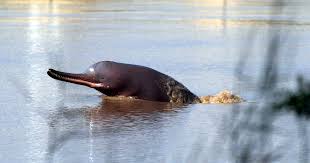
The Indus river dolphin, locally called bhulan, was rediscovered in the Beas river, Punjab, in 2007 after decades of presumed extinction in India. It inhabits a 70-km stretch between Beas bridge and Harike. The species is protected under Schedule I of the Wild Life (Protection) Act, 1972. In 2018, the Government of Punjab declared the Beas River Conservation Reserve (BRCR), the largest riverine conservation reserve in India, to protect this population.
Distribution and Habitat
The Indus river dolphin historically ranged across the Indus and its tributaries in Pakistan and northwestern India. Its current easternmost population is confined to the Beas river. The species prefers braided river channels and deeper, dynamic river stretches. It lives mostly solitary or in small groups, typically mother-calf pairs.
Biological Characteristics
The dolphin is functionally blind with highly reduced eyes lacking lenses. It navigates and hunts using echolocation in turbid waters. It exhibits a unique side-swimming behaviour to probe the riverbed with its elongated snout for prey. This side-swimming is rare among cetaceans.
Threats and Conservation Measures
The species’ range has contracted due to flow regulation, pollution, loss of connectivity, climate change, and fishing gear entanglement. Punjab Forest Department, Wildlife Institute of India (WII), and WWF-India conduct ecological studies and prey assessments. A local volunteer network called Dolphin Mitras monitors sightings, habitat conditions, and threats, functioning as an early-warning system for distress or mortality events.
Legal and Institutional Framework
The Indus river dolphin is protected under Schedule I of the Wild Life (Protection) Act, 1972. The Beas River Conservation Reserve was established under Section 36A of the same Act. Conservation involves collaboration among Punjab Forest Department, WII, WWF-India, academic institutions, and local communities.
What to Study for UPSC Exams?
- Freshwater Biodiversity Conservation
- Community-Based Wildlife Management
- Riverine Ecosystem Services
- Wild Life (Protection) Act, 1972
Freshwater Biodiversity Conservation
Freshwater biodiversity includes species in rivers, lakes, and wetlands, comprising less than 1% of Earth’s water but hosting about 10% of all species. It faces the highest extinction rates due to habitat loss, pollution, and invasive species. Conservation efforts focus on habitat protection, pollution control, and sustainable water management to maintain ecosystem functions.
Community-Based Wildlife Management
Community-Based Wildlife Management (CBWM) involves local people in protecting wildlife and habitats, often integrating traditional knowledge. It enhances conservation outcomes by aligning ecological goals with community welfare. CBWM reduces conflicts, promotes sustainable resource use, and is recognized by international frameworks like the Convention on Biological Diversity.
Riverine Ecosystem Services
Riverine ecosystems provide services such as water purification, flood regulation, nutrient cycling, and habitat for biodiversity. They support fisheries, agriculture, and cultural values. These ecosystems are highly dynamic and sensitive to changes in land use, climate, and water flow, impacting their ability to deliver services.
Wild Life (Protection) Act, 1972
The Wild Life (Protection) Act, 1972, is India’s primary legislation for wildlife conservation and protection of endangered species. It establishes schedules listing protected species and regulates hunting, trade, and habitat preservation. The Act also enables creation of protected areas like national parks and wildlife sanctuaries.
Last Modified: April 12, 2026