
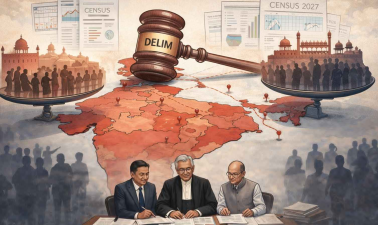
India’s approach to its next Census has revived a sensitive constitutional question: how should political representation be recalibrated when population growth has diverged sharply across regions? At one level, the issue appears technical. At another, it strikes at the heart of India’s federal compact, testing whether democracy can remain fair not only in numbers, but also in trust.
Why Delimitation Has Returned to the Centre Stage
Delimitation refers to the redrawing of electoral boundaries and the redistribution of parliamentary seats to reflect demographic changes. In principle, it is a democratic necessity. A republic cannot indefinitely freeze representation while society evolves. India, however, suspended delimitation for parliamentary seats based on population first until 2001, and later until 2026, to avoid penalising states that successfully implemented population control measures.
As the next Census approaches, this pause is nearing its end. The question is no longer whether delimitation should occur, but how its consequences should be managed.
Uneven Demography, Uneven Political Anxiety
Population growth in India has not been uniform. Southern and western states stabilised fertility earlier, while several northern and central states continue to grow faster. This divergence has produced two competing, yet legitimate, claims:
- States with lower population growth fear a loss of political voice despite better governance outcomes.
- States with higher growth argue that representation must reflect present demographic realities.
Framing this debate as a moral contest between “responsible” and “lagging” states oversimplifies what is fundamentally a constitutional design problem. Delimitation is not about rewarding virtue or punishing failure; it is about balancing equality of citizens with equality of states.
Representation Is Not Just Arithmetic
In a diverse federal system like India, representation performs a dual role. It reflects citizens as individuals, but it also safeguards states as political units within the Union. A purely population-based redistribution of seats in the Lok Sabha may satisfy numerical equality, but it risks tilting the federal balance decisively in favour of a few regions.
If large population states come to dominate parliamentary outcomes, smaller or demographically stable states may perceive the Union as structurally unfair, even if the process is constitutionally valid. Federal systems survive less on mathematical symmetry and more on perceived fairness.
Expanding the Lok Sabha as a Middle Path
One proposed solution is to increase the overall strength of the Lok Sabha instead of redistributing existing seats. This would allow states with growing populations to gain representation without forcing others to lose seats.
Concerns about legislative efficiency are real, but not insurmountable. Large democracies have adapted to bigger legislatures through stronger committee systems, tighter procedures, and greater reliance on parliamentary specialization. Expansion, in this sense, becomes a moderating tool rather than a disruptive one.
The Continuing Role of the Upper House
As representation in the lower house becomes more population-driven, the importance of the Rajya Sabha increases. The Upper House exists precisely to protect the federal principle by giving states an assured constitutional presence that is not entirely tied to population.
In an era of increasing fiscal and administrative centralisation, this role becomes even more significant. Comparative federations, such as the United States, rely on institutions like the US Senate to counterbalance demographic dominance in the lower house.
Revisiting the Size of States
Another, more structural, argument concerns the administrative scale of Indian states themselves. Several states now govern populations larger than most countries. Smaller political units can enhance administrative responsiveness and diffuse excessive concentration of parliamentary power.
However, state reorganisation must follow political consensus and administrative logic, not short-term electoral calculations. Without trust, such exercises risk deepening regional suspicion.
Why Perception Matters as Much as Procedure
What India must avoid is a winner-takes-all narrative. If delimitation is projected as a transfer of power from one region to another, it will harden identities and convert demography into a permanent source of political grievance.
The Constitution of India was never intended to function mechanically. It was designed to evolve through negotiation, accommodation, and restraint. Delimitation will test whether that constitutional spirit still endures.
What to Note for Prelims?
- Delimitation is linked to Census data and governed by constitutional provisions.
- The freeze on parliamentary seat redistribution is currently valid until after the 2026 Census.
- Lok Sabha reflects population; Rajya Sabha reflects federal balance.
What to Note for Mains?
- Analyse delimitation as a federal issue, not merely a demographic one.
- Discuss expansion of the Lok Sabha as a compromise solution.
- Examine the balancing role of the Rajya Sabha in an asymmetric federation.
- Link representation debates with trust, fairness, and cooperative federalism.