
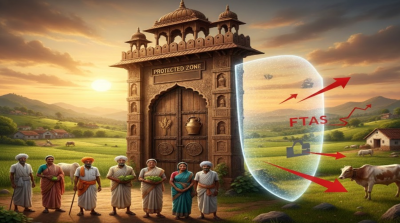
Agriculture has emerged as the most stubborn fault line in India’s ongoing free trade negotiations, particularly with the United States and the European Union. Even as India and the EU move close to finalising what has been described as a landmark trade deal, agriculture is widely expected to remain excluded. This caution reflects not protectionism alone, but deep structural realities of Indian farming that make full trade liberalisation politically and economically risky.
The Livelihood Question at the Heart of Indian Agriculture
The foremost reason for India’s reluctance lies in the sheer scale of livelihoods dependent on farming. The US has fewer than two million farms, while the EU has just over nine million. India, by contrast, had over 146 million operational landholdings as per the last Agriculture Census, with nearly 100 million farmer families currently receiving income support under the PM-Kisan Samman Nidhi.
This magnitude fundamentally alters the political economy of trade. Any sharp exposure to subsidised imports risks income shocks for tens of millions of small and marginal farmers. For successive Indian governments, this has made agriculture a sector where trade openness must be calibrated far more cautiously than in manufacturing or services.
Why Even the EU Is Politically Wary of Farm Trade
India’s caution is reinforced by recent events within Europe itself. An interim trade agreement signed by the EU with Mercosur countries — Argentina, Brazil, Paraguay and Uruguay — ran into resistance from European farmers, especially in France. Concerns over cheaper imports of beef, sugar and poultry led the European Parliament to refer the deal to judicial scrutiny.
This episode underlines a larger point: agriculture remains politically sensitive even in advanced economies with far fewer farmers than India. If liberalisation provokes unrest in Europe, the risks in India are magnified manifold.
Subsidies and the Uneven Playing Field
The second, and more technical, concern relates to farm subsidies. Data from the Organisation for Economic Co-operation and Development highlights stark asymmetries.
The EU’s Producer Support Estimate (PSE) averaged about $97 billion annually in recent years, equivalent to over 16% of gross farm receipts. The US supported its farmers to the tune of $38 billion annually, around 7% of gross receipts. These supports come through a mix of direct income payments, input subsidies, and policies that keep domestic prices above global levels.
India’s picture is fundamentally different.
India’s Paradox: High Subsidies, Net Taxation
On paper, India spends heavily on agriculture. Input subsidies on fertilisers, electricity, irrigation, credit and machinery averaged nearly $48 billion annually in 2022–24 — higher than any country tracked by the OECD. However, direct income support to farmers was relatively modest at under $8 billion.
The most striking figure is India’s negative commodity price support. Due to export curbs, stocking limits, and market restrictions, Indian farmers often receive prices below international export parity levels. OECD estimates suggest this amounted to an implicit taxation of about $129 billion annually.
When combined, India emerges as a net taxer of its farmers, with a negative PSE of over $70 billion — an outcome unmatched by any major economy. This makes sudden exposure to heavily subsidised imports politically indefensible.
Why the EU Is Less Threatening Than the US
Despite these concerns, India views the EU differently from the US. American agriculture is globally competitive in crops such as corn, soyabean, cotton and ethanol — products that could flood Indian markets under a liberalised regime.
The EU, by contrast, is less cost-competitive in most bulk agricultural commodities. Imports, if any, are more likely to be confined to niche or premium products such as cheese, wine, spirits or olive oil, which do not directly compete with mass Indian farm output.
Export Opportunities for Indian Farmers
An agriculture-inclusive FTA with the EU could even offer upside for India in selected segments. Indian exports of seafood, rice, spices, beverages, fruits and vegetables to the EU already run into billions of dollars annually. Improved market access and regulatory alignment could strengthen these export channels without exposing domestic staples to destabilising competition.
Managing Risk Through Trade Remedies
India also retains policy tools to manage residual risks. Countervailing or “sterilisation” duties can be used to neutralise the impact of foreign farm subsidies if imports surge. Such instruments provide a safety valve that allows selective engagement without full exposure.
What to Note for Prelims?
- Producer Support Estimate (PSE) measures total transfers to farmers.
- India has a negative PSE due to suppressed farm gate prices.
- EU and US heavily subsidise agriculture compared to India.
What to Note for Mains?
- Analyse agriculture as a political economy issue in FTAs.
- Compare subsidy structures of India, EU and US.
- Explain why India differentiates between EU and US farm trade risks.
- Discuss how trade remedies can balance openness and farmer protection.