
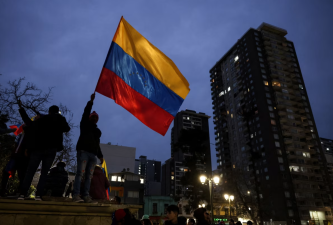
When Donald Trump announced U.S. military action against Venezuela from Mar-a-Lago, the language he employed left little ambiguity about the political tone or strategic intent. Framing the operation as a “spectacular assault” against “narco-terrorism,” he declared that the U.S. would effectively run the country and tap its oil wealth to compensate American companies nationalised decades ago. Beneath the rhetoric of law enforcement and security, the episode raises deeper questions about international law, balance of power, and the emerging structure of global politics.
Narco-terrorism or strategic resource grab?
The stated justification for U.S. action was the arrest of Nicolas Maduro and his wife, Cilia Flores, on charges of narco-terrorism. Yet the factual basis of this claim appears weak when placed in context.
Since 2000, drug overdoses have claimed over a million lives in the United States, but nearly 69% of these deaths are linked to fentanyl, whose precursor chemicals largely originate in China. Venezuela, by contrast, is only a modest source of cocaine entering the U.S. market. What Venezuela does possess, however, is the world’s largest proven oil reserves — a fact underscored by Mr. Trump’s open declaration that U.S. oil companies would now enter the country.
A clear breach of international law
The U.S. military intervention represents a stark violation of the United Nations Charter. Article 2(4) explicitly prohibits the threat or use of force against the territorial integrity or political independence of any state, except in cases of self-defence under Article 51 or with authorisation from the UN Security Council.
Neither condition was met. The action therefore strikes at the heart of the post-1945 international legal order and reinforces concerns that power, rather than law, increasingly governs international conduct.
The breakdown of the balance of power
The episode signals a deeper erosion of the balance-of-power system. Historically, this concept emerged in Europe to prevent domination by any single power and evolved into a bipolar structure after the Second World War, with the United States and the Soviet Union acting as mutual constraints.
During the Cold War, neither superpower could employ force without reckoning with the other. This uneasy equilibrium, though dangerous, prevented outright unilateralism.
Historical parallels from South Asia and West Asia
The Venezuela intervention recalls earlier moments when countervailing power restrained unilateral action. During the 1971 Bangladesh War, the U.S. administration under Richard Nixon attempted to pressure India by deploying the U.S. Seventh Fleet (Task Force 74). A swift Soviet naval counter-deployment neutralised the threat, preserving India’s strategic space.
Similarly, during the 1973 Yom Kippur War, when Israel threatened to annihilate Egypt’s Third Army, Soviet leader Leonid Brezhnev moved airborne divisions to staging areas. The U.S., alarmed, raised its alert level to DEFCON 3, forcing Israel to halt its advance. These episodes exemplified classical balance-of-power dynamics in action.
The unipolar moment and its consequences
The collapse of the Soviet Union in 1991 removed the only effective counterweight to U.S. power. Since then, Washington has increasingly embraced the doctrine of pre-emptive intervention, contributing to regime change in Iraq, Libya, Syria, and elsewhere — either directly or through proxy forces.
The Venezuela episode fits this pattern. In a unipolar world, the absence of credible deterrence has enabled repeated violations of sovereignty, often justified through moral or security narratives.
Who can counterbalance the United States now?
In the near term, only China possesses the economic and strategic capacity to emerge as a counterbalance. A loose alignment between China and Russia could challenge U.S. dominance, but structural mistrust and competing interests may limit the durability of such an axis.
For India, the implications are sobering. Despite closer ties with Washington, U.S. actions continue to display insensitivity to Indian security concerns, reinforcing the limits of strategic dependence.
India’s strategic dilemma and the way ahead
The Venezuela crisis underlines a larger lesson for India: true strategic autonomy requires credible power. New Delhi cannot act as a counter-balancer without significantly strengthening its military-industrial complex, defence manufacturing, and technological base.
This demands:
- Long-term investment in indigenous defence production
- Reduced reliance on external suppliers
- Innovative strategic thinking beyond alignment politics
In an international system drifting away from rules toward raw power, India’s security and autonomy will depend less on diplomacy alone and more on its capacity to deter, withstand, and shape geopolitical pressures.
What to note for Prelims?
- Article 2(4) of the UN Charter prohibits use of force against sovereign states.
- Balance of power was central to Cold War international stability.
- Venezuela holds the world’s largest proven oil reserves.
What to note for Mains?
- Critically examine the erosion of international law in a unipolar world.
- Analyse balance of power with historical examples (1971 Bangladesh War, 1973 Yom Kippur War).
- Discuss implications of U.S. unilateralism for India’s strategic autonomy.