
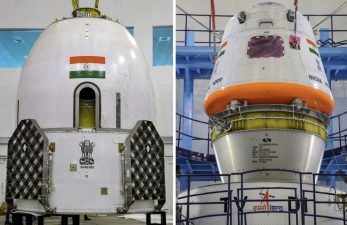
Recent advancements in space technology have improved the safety of crewed space missions. The Indian Space Research Organisation (ISRO) is set to demonstrate these with the Gaganyaan mission. This mission marks key principles of atmospheric re-entry, thermal protection, and controlled landing of space capsules.
Atmospheric Re-Entry Challenges
Re-entry involves slowing a spacecraft from orbital speed to land safely on Earth. The main challenge is intense heat from atmospheric friction. Early scientists thought no material could survive this heat. The blunt body theory changed this by showing a rounded capsule deflects heat into surrounding air. Over 98% of the energy is dissipated as heat in the atmosphere. Heatshields protect the capsule by either ablating or insulating against this heat.
Re-Entry Corridor and Trajectory Control
The re-entry corridor is a narrow path in the atmosphere for safe descent. Too shallow an angle causes the capsule to skip off the atmosphere. Too steep an angle causes extreme heat and forces that can destroy the capsule. Capsules like Gaganyaan use a semi-ballistic design. By offsetting the centre of gravity, the capsule creates lift to steer and adjust its path. This helps reach the designated landing zone precisely.
Communication Blackout and Solutions
During re-entry, ionised plasma forms around the capsule due to extreme heat. This plasma blocks radio signals causing a communication blackout. To manage this, data is sent via relay satellites using high-frequency signals that can penetrate the plasma sheath. This ensures mission control stays connected during critical phases.
Landing Using Parachutes
Atmospheric drag slows the capsule but not enough for a safe landing. Parachutes deploy in stages to reduce speed further. Gaganyaan uses a three-stage parachute system for controlled descent. The crew module lands safely in the Bay of Bengal after separating from the service module, which burns up in the atmosphere.
Topics for Prelims:
Blunt Body Theory
- Rounded forebody deflects heat during re-entry.
- Reduces heat load on the capsule.
- Key to surviving extreme atmospheric friction.
- Used in modern spacecraft thermal protection.
- Enables controlled descent and landing.
Re-Entry Corridor
- Safe atmospheric entry path for spacecraft.
- Too shallow causes atmospheric bounce back.
- Too steep causes lethal heat and forces.
- Precise angle critical for crew safety.
- Managed by thruster firings in semi-ballistic bodies.
Communication Blackout
- Caused by plasma sheath around capsule.
- Blocks radio waves during re-entry.
- Lasts until capsule slows down.
- Relay satellites help bypass blackout.
- Essential for mission control contact.
Questions for Mains:
- Critically analyse the importance of thermal protection systems in crewed space missions with examples from recent space programmes. [GS-III-Science & Technology]
- Explain the concept of the re-entry corridor and discuss its significance in ensuring safe spacecraft landings. [GS-III-Science & Technology]
- What are the challenges posed by communication blackouts during spacecraft re-entry, and how do modern technologies mitigate these issues? Comment with suitable examples. [GS-III-Science & Technology]
- With reference to semi-ballistic bodies, analyse how aerodynamic forces are used to control spacecraft trajectory during atmospheric re-entry and its implications for mission success. [GS-III-Science & Technology]
Answer Hints:
1. Critically analyse the importance of thermal protection systems in crewed space missions with examples from recent space programmes. [GS-III-Science & Technology]
- Thermal protection systems (TPS) shield spacecraft from extreme heat generated by atmospheric re-entry (up to thousands of degrees Celsius).
- Blunt body theory enables TPS design by deflecting heat into surrounding air, reducing heat load on the capsule.
- TPS types – ablative (material chars and erodes to carry heat away) and insulative (low thermal conductivity materials prevent heat transfer).
- Examples – ISRO’s CARE and SRE missions validated TPS for Gaganyaan; NASA’s Apollo and SpaceX Crew Dragon use ablative and reusable TPS respectively.
- TPS is critical for crew safety, structural integrity, and mission success by preventing melting or structural failure.
- Advancements in TPS enable longer missions, reusability, and safer human spaceflight.
2. Explain the concept of the re-entry corridor and discuss its significance in ensuring safe spacecraft landings. [GS-III-Science & Technology]
- Re-entry corridor is a narrow atmospheric entry angle window for safe spacecraft descent.
- Too shallow an angle (overshoot boundary) causes the capsule to bounce off the atmosphere, failing re-entry.
- Too steep an angle (undershoot boundary) causes excessive heat and deceleration forces, risking capsule destruction and crew fatality.
- Precise entry angle balances aerodynamic forces and heat load for survivability.
- Controlled by thruster firings and semi-ballistic trajectory adjustments to stay within corridor limits.
- Ensures spacecraft reaches targeted landing zone safely and avoids mission failure.
3. What are the challenges posed by communication blackouts during spacecraft re-entry, and how do modern technologies mitigate these issues? Comment with suitable examples. [GS-III-Science & Technology]
- Communication blackout occurs due to ionised plasma sheath formed by extreme heat around the capsule, blocking radio signals.
- Blackout duration lasts until capsule slows down and plasma dissipates, causing loss of contact with ground control.
- This poses risks in monitoring, command, and crew safety during critical re-entry phases.
- Mitigation – use of orbital relay satellites (e.g., NASA’s TDRSS) to relay signals through less dense plasma regions.
- High-frequency signals and antenna placement exploit plasma sheath asymmetry to maintain partial communication.
- Examples – NASA’s shuttle missions, ISRO’s Gaganyaan plan use relay networks to manage blackout periods.
4. With reference to semi-ballistic bodies, analyse how aerodynamic forces are used to control spacecraft trajectory during atmospheric re-entry and its implications for mission success. [GS-III-Science & Technology]
- Semi-ballistic bodies offset their centre of gravity to create an angle of attack, generating aerodynamic lift besides drag.
- Asymmetric airflow creates lift perpendicular to velocity, enabling controlled gliding and banking maneuvers.
- This lift allows capsules to steer within the re-entry corridor, adjusting trajectory toward precise landing zones.
- Improves cross-range capability, enhancing landing accuracy and mission flexibility.
- Reduces reliance on parachutes alone for landing precision, improving crew safety and recovery operations.
- Used in Gaganyaan’s crew module and other modern capsules to enhance re-entry control and mission reliability.