
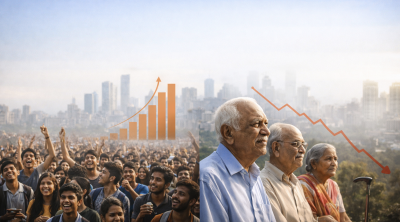
India’s population is expected to grow slower than before. From 1.36 billion in 2021, it will reach about 1.59 billion by 2051. This shift marks the end of rapid population growth and the start of a more balanced and ageing population. These changes affect education, workforce, healthcare, and economy.
Slowing Population Growth and Education
The number of young children (0-4 years) will fall sharply from 113.5 million in 2021 to 8.6 million by 2051. This means fewer children will need schooling. Many government schools may close due to low enrolment, as seen in Kerala. Private schools, however, are growing because families prefer them for better quality education. The total government schools have dropped by 90,000 in the last decade, while private schools increased by 43,000.
Shifts in Workforce and Economic Impact
The working-age population (15-59 years) will peak around 2041 and then decline. It will rise from 834 million in 2021 to 1 billion in 2041, then fall slightly to 998 million by 2051. This shrinking workforce signals the end of India’s demographic dividend, the period of economic growth driven by a young population. To maintain growth, more women must join formal jobs and employment quality must improve.
Ageing Population and Healthcare Needs
India’s elderly population (60+) will grow from 130 million (9.6%) in 2021 to 325 million (20.5%) in 2051. The median age will rise from 28 to 40 years. This ageing trend will increase demand for healthcare and social security. Geriatric care must improve to support this large elderly group. At the same time, a silver economy can develop, offering new economic opportunities.
Policy Directions and Future Preparedness
Declining birth rates allow better teacher-student ratios and improved healthcare resources. Family planning and reproductive health services remain crucial. Education and skill training must adapt to prepare youth for future challenges. Policy must focus on gender inclusion in the workforce and redesign social systems for the ageing population. This will help India harness its demographic changes for sustainable growth.
Topics for Prelims:
India’s Population Growth
- Population to rise from 1.36 billion (2021) to 1.59 billion (2051).
- Annual growth rate slows to 0.5%.
- Decline in pre-primary children from 113.5 million to 8.6 million.
- Government schools decline; private schools increase.
- Demographic dividend peaks around 2041.
Ageing Population and Economy
- Elderly population to grow from 130 million to 325 million by 2051.
- Median age rises from 28 to 40 years.
- Increased demand for healthcare and social security.
- Need for improved geriatric care and silver economy growth.
- Workforce participation to decline after 2041.
Questions for Mains:
- Critically analyse the implications of India’s ageing population on healthcare and social security systems with suitable examples. [GS-III-Economic Development]
- Point out the challenges and opportunities arising from the decline in India’s fertility rate and its impact on education infrastructure. [GS-I-Indian Society]
- Estimate the role of female workforce participation in offsetting the decline of the working-age population and discuss policy measures to enhance this participation. [GS-II-Governance]
- Underline the demographic dividend concept and critically analyse how India can sustain economic growth post the demographic dividend period. [GS-III-Economic Development]
Topics for Prelims:
Demographic Dividend
- Period when working-age population is high relative to dependents.
- Leads to faster economic growth if harnessed well.
- India’s dividend window peaks around 2041.
- Requires investments in education and employment.
- Decline after 2041 poses economic challenges.
Silver Economy
- Economic opportunities created by ageing population.
- Includes healthcare, leisure, housing, and services for elderly.
- Can boost economic growth despite ageing.
- Requires policy focus on elderly needs.
- India’s silver economy potential grows with elderly population rise.
Education Trends in India
- Declining child population reduces demand for new schools.
- Government schools closing due to low enrolment.
- Private schools increasing due to quality concerns.
- Better teacher-pupil ratios expected.
- Need for skill development to match future job markets.
Answer Hints:
1. Critically analyse the implications of India’s ageing population on healthcare and social security systems with suitable examples. [GS-III-Economic Development]
- India’s elderly (60+) population to rise from 130.5 million (9.6%) in 2021 to 325.3 million (20.5%) by 2051.
- Median age increase from 28 to 40 years indicates advanced demographic transition and ageing society.
- Rising demand for healthcare services, especially geriatric care, will strain existing medical infrastructure and finances.
- Increased pressure on social security systems (pensions, old-age benefits) requiring policy redesign and budgetary allocation.
- Examples – Kerala’s experience with ageing population and healthcare challenges; need for long-term care and chronic disease management.
- Opportunity to develop a ‘silver economy’ focusing on elderly care, leisure, housing, and related services.
2. Point out the challenges and opportunities arising from the decline in India’s fertility rate and its impact on education infrastructure. [GS-I-Indian Society]
- Pre-primary population (0-4 years) projected to fall sharply from 113.5 million (2021) to 8.6 million (2051), reducing demand for schooling facilities.
- Closure of uneconomic government schools due to low enrolment, as seen in Kerala, leading to potential teacher job losses.
- Shift in enrolment patterns with private schools increasing (43,000 added in last decade) due to perceived better quality and affordability in smaller families.
- Improved teacher-pupil ratios and potential for better quality education due to smaller cohorts.
- Challenges include managing infrastructure rationalization and ensuring equitable access to quality education.
- Opportunity to focus on skill development and quality improvements aligned with future job market needs.
3. Estimate the role of female workforce participation in offsetting the decline of the working-age population and discuss policy measures to enhance this participation. [GS-II-Governance]
- Working-age population peaks around 2041 (~1 billion) then declines slightly by 2051, risking demographic dividend loss.
- Increasing female labour force participation (gender dividend) can partially offset workforce decline and boost economic growth.
- Barriers to female participation include social norms, safety concerns, skill gaps, and lack of flexible work options.
- Policy measures – Promote women’s education and skill development, ensure workplace safety, implement flexible work policies, provide childcare support.
- Encourage formal sector jobs for women with equal pay and anti-discrimination laws.
- Government schemes and reforms to incentivize female employment and entrepreneurship.
4. Underline the demographic dividend concept and critically analyse how India can sustain economic growth post the demographic dividend period. [GS-III-Economic Development]
- Demographic dividend – period when working-age population is high relative to dependents, enabling faster economic growth.
- India’s demographic dividend expected to peak around 2041, after which working-age population declines.
- Sustaining growth requires investments in education, skill development, and quality employment generation.
- Need to increase female workforce participation and improve labor productivity to maximize dividend benefits.
- Post-dividend growth depends on adapting to ageing population challenges via healthcare innovation, social security reforms, and silver economy development.
- Policy focus on technology adoption, innovation, and inclusive growth to maintain economic momentum beyond demographic window.