
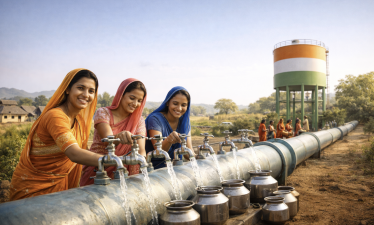
The Jal Jeevan Mission (JJM) continues to transform rural India’s drinking water landscape in 2026. Since its launch in 2019, the mission has expanded tap water connections from 3.23 crore to over 15.82 crore rural households. The Union Budget 2026–27 allocates ₹67,670 crore for JJM, extending it until 2028. The mission’s success lies not only in infrastructure but also in strong community participation across states.
Infrastructure and Community Roles
JJM focuses on providing Functional Household Tap Connections (FHTCs). Infrastructure such as pipelines, pumps and storage tanks form the backbone. However, local people operate, monitor and maintain these systems daily. Gram Panchayats, frontline workers, self-help groups and trained volunteers play vital roles. Monthly user charges collected from households support routine maintenance and repairs, ensuring sustainability.
Local Leadership and Inclusive Governance
In villages like Mankuwar (UP), leadership by Gram Pradhan and inclusive Village Water and Sanitation Committees ensure transparency and community oversight. Women and Scheduled Caste members are encouraged to participate actively. Regular meetings help monitor billing, revenue and service quality. Such governance strengthens trust and collective responsibility.
Challenges and Solutions in Difficult Terrains
In high-altitude areas such as Matho village (Ladakh), technical personnel work under harsh conditions to maintain water supply systems. Skilled linemen and local institutions collaborate to keep water flowing. Community efforts complement technical support to overcome geographical challenges and ensure reliable access.
Water Quality and Public Health Awareness
Villages like Manekpor (Gujarat) have established Village Water Quality Teams. Women volunteers regularly test water using Field Test Kits and promote safe practices like home chlorination. Awareness campaigns and transparent sharing of results help maintain water safety. Integration with health workers enhances community mobilisation.
Topics for Prelims:
Jal Jeevan Mission
- Launched in August 2019 to provide tap water to rural households.
- Over 15.82 crore rural households connected as of March 2026.
- ₹67,670 crore allocated in Union Budget 2026–27.
- Focus on Functional Household Tap Connections (FHTC).
- Extended mission duration till 2028.
Community Participation in Rural Water Supply
- Role of Gram Panchayats and Village Water Committees.
- Regular collection of user charges for maintenance.
- Inclusion of women and Scheduled Caste members in governance.
- Local leadership ensures transparency and accountability.
- Public health awareness linked with water quality monitoring.
Challenges in Remote Areas
- Technical difficulties in high-altitude and difficult terrain.
- Need for trained technical personnel and local coordination.
- Community support crucial for system sustainability.
- Adoption of water quality testing and disinfection methods.
- Integration of local health workers for awareness campaigns.
Questions for Mains:
- Critically analyse the role of community participation in sustaining rural water supply systems under the Jal Jeevan Mission. With suitable examples, discuss how inclusive governance can improve water service delivery. [GS-II-Governance]
- Estimate the challenges faced in providing safe drinking water in remote and difficult terrains of India. Point out the strategies adopted to overcome these challenges under rural water supply schemes. [GS-III-Environment & DM]
- Underline the importance of water quality monitoring and public health awareness in rural drinking water programmes. How can integration of health workers and self-help groups enhance water safety? [GS-II-Social Justice]
- With suitable examples, critically analyse the impact of financial sustainability measures such as user charges on the operation and maintenance of rural water infrastructure. How does this affect community ownership? [GS-III-Economic Development]
Topics for Prelims:
Jal Jeevan Mission
- Launched in August 2019 by Government of India.
- Aims to provide Functional Household Tap Connections (FHTC) to all rural households.
- Over 15.82 crore households connected by March 2026.
- Budget allocation of ₹67,670 crore for 2026–27.
- Mission extended till 2028 for universal coverage.
Community Participation
- Involves Gram Panchayats, frontline workers and self-help groups.
- Monthly user charges collected for system maintenance.
- Encourages inclusive governance with women and Scheduled Caste members.
- Regular meetings ensure transparency and accountability.
- Strengthens local ownership and sustainability.
Water Quality Monitoring
- Village Water Quality Teams conduct regular testing.
- Use of Field Test Kits for on-site water testing.
- Promotes safe practices like home chlorination.
- Shares results with community for awareness.
- Links with health workers for public health education.
Answer Hints:
1. Critically analyse the role of community participation in sustaining rural water supply systems under the Jal Jeevan Mission. With suitable examples, discuss how inclusive governance can improve water service delivery. [GS-II-Governance]
- Community participation ensures daily operation, monitoring, and maintenance of water systems, increasing sustainability.
- Examples – Mankuwar village (UP) where Gram Pradhan and Village Water and Sanitation Committee oversee system functioning with inclusive participation of women and Scheduled Caste members.
- Regular meetings promote transparency, accountability, and collective ownership of water resources.
- Involvement of frontline workers, self-help groups, and trained volunteers strengthens service delivery at grassroots.
- Inclusive governance encourages trust, encourages timely user charge payments, and supports long-term system functionality.
- Decentralised management reduces dependence on external agencies and enhances responsiveness to local needs.
2. Estimate the challenges faced in providing safe drinking water in remote and difficult terrains of India. Point out the strategies adopted to overcome these challenges under rural water supply schemes. [GS-III-Environment & DM]
- Challenges include harsh weather, difficult terrain (e.g., high-altitude Ladakh), and limited accessibility impacting infrastructure installation and maintenance.
- Technical difficulties require skilled personnel and continuous technical support (e.g., lineman Tsering Dorjey in Matho village, Ladakh).
- Coordination among local institutions and community members is critical to adapt to geographical and climatic constraints.
- Use of robust, context-specific infrastructure and flexible maintenance schedules to ensure reliability.
- Community involvement complements technical efforts, ensuring local ownership and quick resolution of issues.
- Government schemes like Jal Jeevan Mission allocate adequate funds and extend timelines to address these challenges systematically.
3. Underline the importance of water quality monitoring and public health awareness in rural drinking water programmes. How can integration of health workers and self-help groups enhance water safety? [GS-II-Social Justice]
- Regular water quality testing (e.g., by Village Water Quality Teams using Field Test Kits) ensures safe drinking water and early detection of contamination.
- Public health awareness campaigns promote safe water handling and disinfection practices such as home chlorination.
- Sharing test results transparently with communities builds trust and encourages proactive participation.
- Integration with ASHA workers and self-help groups facilitates community mobilisation and health education.
- Women volunteers, like Falguniben Rathod in Gujarat, play a vital role linking water safety with public health outcomes.
- Combined efforts reduce waterborne diseases and improve overall rural health standards.
4. With suitable examples, critically analyse the impact of financial sustainability measures such as user charges on the operation and maintenance of rural water infrastructure. How does this affect community ownership? [GS-III-Economic Development]
- User charges collected regularly (e.g., ₹50/month in Mankuwar village, UP) provide funds for routine operation and maintenance, ensuring system longevity.
- Financial contributions encourage community responsibility and reduce dependence on external funding.
- Transparent financial management, as seen in Upper Thambong GPU, Sikkim, builds trust and motivates timely payments.
- Regular meetings to review billing and revenue collection enhance accountability and service quality.
- Financial sustainability strengthens community ownership, empowering villagers to manage disruptions and repairs independently.
- Successful examples like Kanchanpur Gram Panchayat (Jharkhand) demonstrate that user charges support scaling and sustaining water supply coverage.