
The recent remarks by External Affairs Minister S Jaishankar on India’s “bad neighbour to the west” have once again brought the Indus waters question into public debate. Echoing Prime Minister Narendra Modi’s oft-quoted line that “blood and water cannot flow together”, the comments were framed as a moral and strategic assertion against Pakistan-sponsored terrorism. Yet, beyond their rhetorical force, they raise a more complex policy question: how much leverage does India actually possess over river waters flowing into Pakistan?
What triggered the renewed debate?
Speaking to students at IIT Madras on January 2, Jaishankar recalled that India had, decades ago, entered into a “water-sharing arrangement” with Pakistan as a goodwill gesture. He suggested that a country which “deliberately, persistently and unrepentantly” supports terrorism cannot expect such generosity to continue. These statements must be seen against the backdrop of India keeping the Indus Waters Treaty (IWT) in abeyance after the Pahalgam terror attack in April last year.
Understanding the Indus river geography
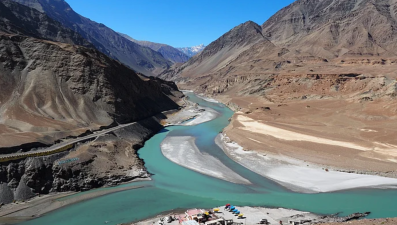
Pakistan’s agricultural and economic life depends on six rivers — Indus, Jhelum, Chenab, Ravi, Beas and Sutlej — all of which flow through India or Pakistan-occupied Kashmir before entering Pakistani territory. From the beginning, Pakistan feared that India, as the upper riparian, could choke off water supplies. Geography, however, places natural limits on this fear:
- The Indus, Jhelum and much of the Chenab flow through mountainous terrain where large storage dams are not feasible.
- India can fully utilise or block the Ravi, Beas and Sutlej, but these eastern rivers together account for only about 20 per cent of the total waters of the Indus river system.
Why the treaty gave Pakistan the western rivers
Negotiated over nine years with the mediation of the “”, the IWT allocated the three western rivers — Indus, Jhelum and Chenab — to Pakistan. India retained limited rights over these rivers for run-of-the-river hydropower and small-scale irrigation, while enjoying full control over the eastern rivers. In effect, India accepted just 20 per cent of the system’s waters, ceding the rest to Pakistan to allay its existential anxieties.
Can India really ‘turn off the tap’?
Despite political rhetoric, India’s capacity to substantially disrupt flows on the western rivers remains limited:
- Large dams on the Indus and Jhelum are ruled out by terrain constraints.
- The Chenab offers scope for hydropower and some diversion for irrigation, but not for large storage projects.
- The long-stalled “” on the Jhelum, blocked for decades due to Pakistani objections, could now be revived.
This is why, even outside the treaty framework, India’s ability to cause large-scale water distress in Pakistan is constrained.
Why Pakistan fears even limited disruption
Pakistan’s sharp reaction — calling any restriction of flows an “act of war” — reflects its deeper vulnerabilities. It is now a water-scarce country, largely due to poor domestic water management. Even small seasonal disruptions, particularly during sowing periods, can affect crop yields. This explains Islamabad’s eagerness to keep the treaty alive and its resistance to any unilateral Indian reinterpretation.
The sub-surface water question
A section of Pakistani opinion has floated the idea of extending cooperation to shared aquifers and sub-surface waters, arguing for joint management. Given Pakistan’s history of obstructionism under the existing treaty, expanding cooperation into this sensitive domain would be strategically unwise for India.
Upper and lower riparian dilemmas for India
India’s position is complicated by the fact that it is not only an upper riparian vis-à-vis Pakistan but also a lower riparian in other basins, such as the Brahmaputra. Any precedent it sets on weaponising water could weaken its own claims elsewhere. This dual status underscores the need for calibrated, legally defensible policies rather than sweeping political statements.
What to note for Prelims?
- Indus Waters Treaty signed in 1960 with World Bank mediation.
- Western rivers (Indus, Jhelum, Chenab) allocated to Pakistan; eastern rivers (Ravi, Beas, Sutlej) to India.
- India’s share of Indus system waters is about 20 per cent.
What to note for Mains?
- Assess the gap between political rhetoric and hydrological realities in India–Pakistan water relations.
- Discuss constraints imposed by geography and international law on India’s use of water as a strategic tool.
- Examine implications of India’s dual status as upper and lower riparian for its water diplomacy.